
Atta Cave
On 19 July 1907 the limestone quarry above Attendorn was a working pit, the kind of place where men spent their days breaking pale rock into useful tonnages. That morning the workers split open a wall and the wall kept going. Behind the limestone face was a hollow, then another, then a long colored gallery of stone curtains and pillars that had been growing in the dark for hundreds of thousands of years without a witness. Within months the Bigge Valley Limestone Works had stopped trying to sell the stone and started selling tickets to see what was underneath it.
A Sea That Became a Mountain
The Atta Cave's deeper origin story begins about 400 million years ago in the Devonian, when the Sauerland hills were not hills at all. The region lay under a warm shallow sea. Coral reefs and shelly creatures laid down thick beds of carbonate that eventually became the limestone of present-day Attendorn. After the sea retreated and mountains rose, rainwater did the long patient work caves require. Water seeping through fissures picked up carbon dioxide from soil and air, formed mild carbonic acid, and over millennia dissolved out the rooms and tunnels visitors walk through today. A second mechanism, Mischungskorrosion, the corrosion that happens when two waters of different chemistry meet inside the rock, finished the carving. Then, in a different rhythm, the dripping began. Each calcite-laden drop left a microscopic layer behind. Stalactites grew down. Stalagmites grew up. Where they met, stalagnates formed: continuous columns of stone.
Iron, Color, and the Rooms Inside
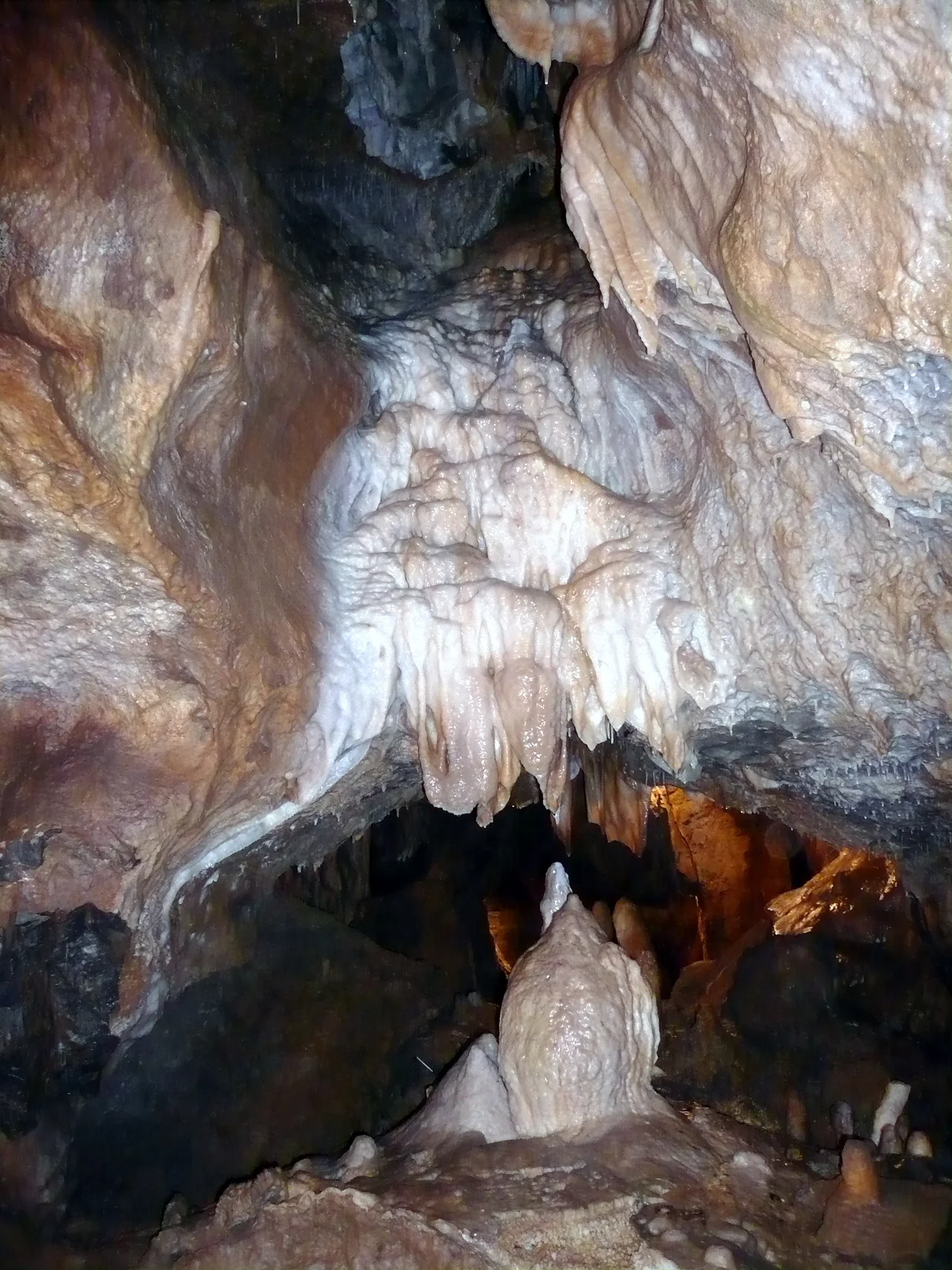
What separates the Atta Cave from a thousand other dripstone caves is its palette. The flowstone drapes that curtain the walls are tinted by iron oxides, which means they are not the dead white of pure calcite but pinks, ochres, reds, and rusts. Lights pick out the pigments and the cave reads like a painted hall rather than a quarry. There are sinter pools, frozen-looking cascades, and calcite crystal formations brought into the public part of the cave to be admired up close. The show route runs about 500 meters in a roughly circular loop, reached through a 90-meter access gallery. Visitors come down through the gallery, through a heavy metal door that seals the original entrance, and step into rooms that have been kept at a steady temperature and humidity since before humans existed.
Bats, Cheese, and a Water Curtain
The cave is alive in ways most visitors do not see. Bats slip in through narrow rock crevices in the hilltop and roost in the inner sections, breeding colonies that have lived here generation after generation. Several thousand years ago an earthquake snapped some of the older speleothems, leaving broken stalactites and stalagmites that today work as accidental geological clocks. The cave's strangest tenant is more recent. In one section of the system, cheese is aged in the cool damp air, a small industrial use that the operators handle with a so-called water curtain to keep the smell from drifting into the tourist galleries. It is a deeply Sauerland combination. Limestone, bats, dripstones, and cheese, all in the same hill.
Six Kilometers, and Counting
What tourists see is only a slice of the full system. In 1985 the local explorer Elmar Hammerschmidt led a survey that pushed the known length of the Atta Cave to about 6,000 meters. Even that figure is provisional. The cave has not been completely mapped, and side passages continue to draw researchers back. The result is that the show route is the inviting front room of a much larger underground building. Today the Atta Cave is the most-visited show cave in Germany, drawing around 350,000 visitors a year, an important driver of the local economy and a long civic identity for the town of Attendorn. The cave is still in private hands, and like most private show caves it has its critics. Entry prices and a long-standing photography ban have drawn complaints. Even so, on most days the parking lot fills, the metal door swings open, and people step out of the Sauerland summer into a kingdom that quarry workers stumbled into more than a century ago.
From the Air
Atta Cave sits at 51.125°N, 7.9156°E in the limestone hills just east of the town of Attendorn, on the western edge of the Sauerland uplands. Cruise the Bigge reservoir corridor at 3,500 to 5,000 ft. The cave itself is underground, but the Biggetaler Kalkwerk quarry above it is easily visible from the air as a pale scar on the green hillside. Nearest airports: Siegerland (EDGS) about 30 km south, Dortmund (EDLW) about 60 km north. Watch for the Biggesee, a dark blue reservoir, as your main landmark.
Nearby Stories
- Festspiele Balver Höhle 2.9 km away
- Schloss Allner 6.1 km away
- Eschbach Dam 15 km away
- Marienstatt Abbey 15 km away
- Ruhr University Bochum 15 km away
- Eresburg 32 km away
- Marburg 36 km away
- Observation Post Alpha 106 km away