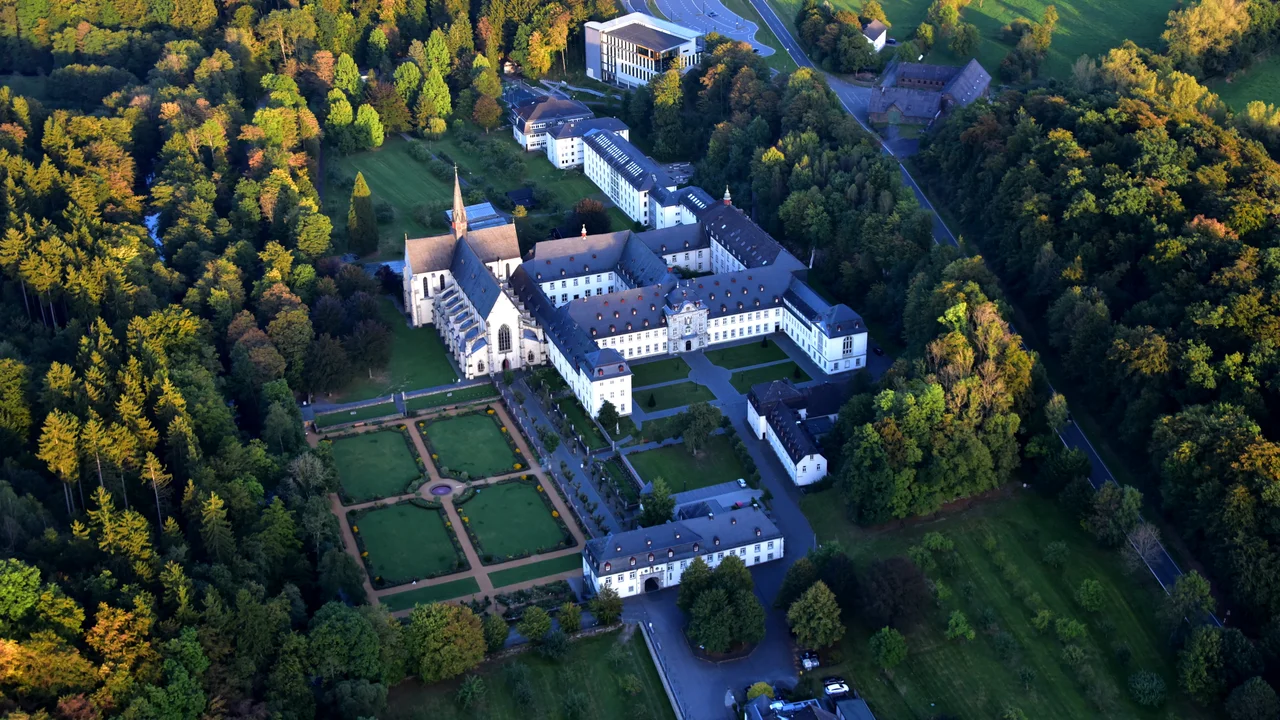

Marienstatt Abbey
Eight hundred and fourteen years is a long time for any one thing to keep happening in the same building, but the Cistercians of Marienstatt are still doing what their founders did in 1212: rising for the predawn office, working the abbey grounds, brewing beer, and turning the Nister valley into a thin place between this world and the next. The Westerwald hills hide the abbey well. You round a curve in the narrow road from Hachenburg and there it is - a long pale early-Gothic basilica beside a tributary stream, the largest pipe organ in the Westerwald speaking from inside its walls, and the brewery and guest house tucked into the cloister buildings as if the whole arrangement had simply been waiting for you.
A Lineage of Mother Houses
Marienstatt's pedigree runs straight back through the great age of European monastic expansion. The abbey was founded from Heisterbach, the famous house in the Siebengebirge above the Rhine, which had itself been founded from Himmerod in the Eifel, which traced its origins to Clairvaux Abbey - Saint Bernard's own community - in 1134. Each daughter house was a colony of disciplined silence: white-robed monks clearing forest, draining marsh, and building economies of grain, wool, and prayer along rivers no one else had bothered with. The Nister valley, a quiet tributary of the Sieg, was exactly the kind of place Cistercians chose. They have been here since 1212, longer than the Holy Roman Empire would survive after them, longer than the Reformation that almost finished them off.
Reformation, War, Refoundation
In 1561, the Counts of Sayn, who held the surrounding territory, introduced the Reformation across their lands. Marienstatt's monks held on for a while, but the political ground beneath them was shifting. The real catastrophe came with the Thirty Years' War. On 3 October 1633 Swedish forces claimed the abbey as Swedish crown land, expelled the brothers, and vandalised the premises. For most of the next two and a half centuries Marienstatt sat half-abandoned - a Catholic foundation marooned in territories that had gone Protestant, its church standing but its community scattered. Refoundation came in 1888, when monks from the Wettingen-Mehrerau Abbey in Austria bought the place back and reinhabited it. The abbot they chose later became Bishop of Limburg. The community has been continuously present ever since.
Pipes, Pews, and Pilgrims
The basilica itself rewards a slow walk. It was built in early-Gothic style, all clean stone arches and high windows, and inside it holds the largest pipe organ in the Westerwald - a Rieger instrument that fills the long nave with sound on feast days and on the Sundays when pilgrim processions arrive carrying their parish banners. The abbey is a working pilgrimage site as well as a community of monks: groups still walk in along the Marien Hiking Trail from Seelbach-Marienthal, and bus pilgrimages disgorge in the car park most Marian feast days. Inside the cloister precinct you'll also find a private secondary school - the Privates Gymnasium Marienstatt - using the former boarding-house buildings, with school rooms in what used to be the basement and a guest house overhead. The church belongs technically to the state of Rhineland-Palatinate; the rest of the property belongs to the abbey.
Brewing as a Form of Prayer
The Marienstatt brewery is one of the abbey's more famous lay-facing institutions. German monasteries have brewed beer almost as long as they have prayed, and the Cistercians here continue the tradition with a small commercial operation feeding both the abbey restaurant and the surrounding region. You can sit on the terrace with a glass of Marienstatter Klosterbrau, look up at the basilica, and listen for the bells. The shop sells books and devotional art. Buses on line 8410 stop nearby. The nearest train station, since the local narrow-gauge line and the abbey's own halt closed long ago, is Hattert in Muschenbach, a short bus ride away. The monks still rise before dawn for Vigils. Whatever else has changed in the Nister valley since 1212, the schedule has not.
From the Air
Marienstatt Abbey lies at 50.69N, 7.80E in the Nister valley of the Westerwald, in northern Rhineland-Palatinate near the town of Hachenburg. From the air the abbey reads as a long pale basilica with cloister buildings beside a small stream amid rolling green hills, roughly halfway between Koln and Frankfurt. Cologne-Bonn (EDDK) is 70 km west-northwest; Frankfurt (EDDF) is 100 km southeast. The Westerwald appears as a patchwork of woodland and meadow, with the Nister valley a narrow cleft running roughly east-west.
Nearby Stories
- Schloss Allner 9.5 km away
- Operation Chastise 14 km away
- Eschbach Dam 23 km away
- Marburg 26 km away
- Edersee Dam 49 km away
- Zwingenberg Castle 122 km away
- Basilica of Saint-Pierre-aux-Nonnains 172 km away
- Fort Jeanne d'Arc 199 km away