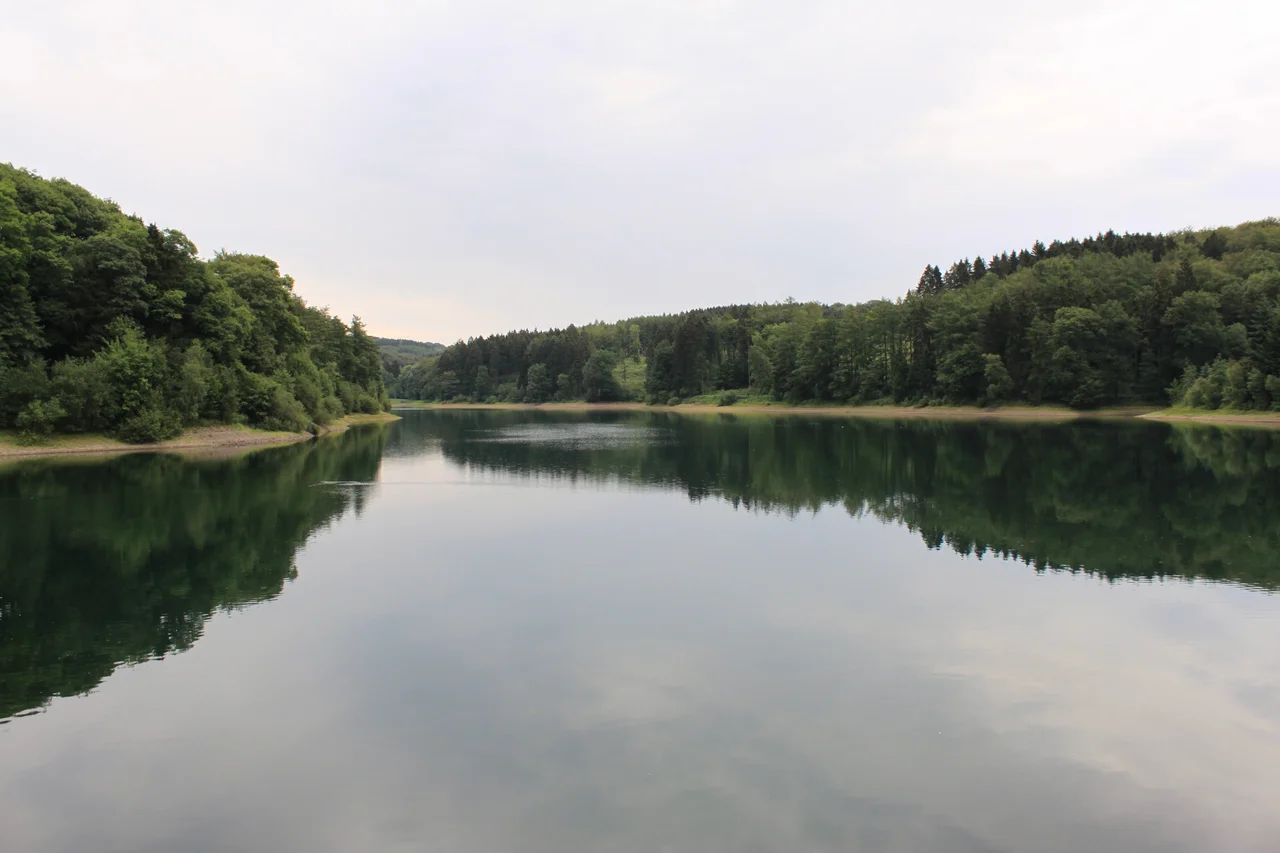

Eschbach Dam
Before 1891, German towns drew their drinking water from wells, springs, and the rivers running past their mills. Then a quiet Bergisches valley above Remscheid did something no other place in Germany had ever done: it stopped the Eschbach with masonry and saved the water on purpose. The dam that rose between the wooded slopes was not just an engineering project. It was the prototype - the first solid-masonry dam in the country built to supply a city with clean water, and a template that engineers would carry to five continents.
The Professor and the Industrialist
The dam grew out of a particular German partnership: a university professor with a theory, and an industrialist with a problem. Otto Intze taught hydraulic engineering at the technical college in Aachen, and his 'Intze Principle' described how a curved gravity dam could lean into the rock at its abutments, transferring some of the water's enormous push into the valley walls themselves. Robert Boker, a Remscheid industrialist, needed clean water for a city whose tool factories and tenements were outgrowing their wells. The two found each other, and between 1889 and 1891 they raised a granite-sheathed wall across the Eschbach valley. The first water flowed into Remscheid's pipes that same year.
When the Kaiser Came to Look
Word travelled. A dam for drinking water was novel enough in Germany that visitors arrived to see it almost before the mortar had finished curing. Prince Friedrich Leopold of Prussia made the journey on 15 July 1897. Two years later Emperor Wilhelm II himself came, and pronounced the structure a great work of Bauteknik und Wassergewerbe - construction technology and water commerce. In the writings of the era the dam was usually called the Remscheid Dam, because German custom of the time named impoundments after the city they served rather than the stream they crossed. The Intze Principle would soon be copied at dozens of sites - in the Eifel, the Harz, and eventually in reservoirs as far away as China and the Americas - but it began here, in this narrow valley.
A Wall Reinforced for the Next Century
By the late twentieth century the original masonry had been holding back water for nearly a hundred years, and it was tired. Between 1991 and 1994 engineers refortified the upstream face with a thirty-five-centimetre concrete liner, threaded an inspection walkway behind it, and installed new drainage and monitoring systems. The dam still looks like its 1891 self when you stand below it - a curved stone wall in a German forest - but its interior is now stitched with the diagnostic equipment of a modern water utility. It belongs today to the Wupperverband, the river-basin association that manages drinking water for this corner of the Bergisches Land, and is linked through pipes and tunnels to the larger Neye Dam upstream.
A Reservoir in the Forest
What you see from the air is small by modern standards - a slim, twisting blue ribbon nestled in beech and spruce woodland southeast of Remscheid, with the curved masonry plug at its downstream end. A road circles the reservoir, threaded with a nature trail that has drawn day-trippers since 1977. From the terrace of the A 1 motorway service area at Remscheid, drivers heading toward Cologne can pause and look down on the same water that Wilhelm II once admired. The Eschbach Dam was never the largest dam in Germany. It was only the first of its kind, which is enough.
From the Air
Eschbach Dam sits at 51.16N, 7.23E, in the wooded hills southeast of Remscheid in the Bergisches Land. From cruise altitude, look for the narrow Y-shaped reservoir tucked among forested slopes between Remscheid and Wermelskirchen, just south of the A 1 autobahn. Nearest major airport: Cologne-Bonn (EDDK), about 35 km southwest. Dusseldorf (EDDL) lies 40 km west-northwest. Best viewed in clear morning light, when the reservoir surface catches the sun against the dark spruce slopes.
Nearby Stories
- ZOOM Erlebniswelt Gelsenkirchen 8 km away
- Hochschule Niederrhein 11 km away
- FC Viktoria Köln 13 km away
- Battle of Werl 14 km away
- Rheinisches Braunkohlerevier 14 km away
- Festspiele Balver Höhle 15 km away
- Wesel Station 18 km away
- Siegen 23 km away