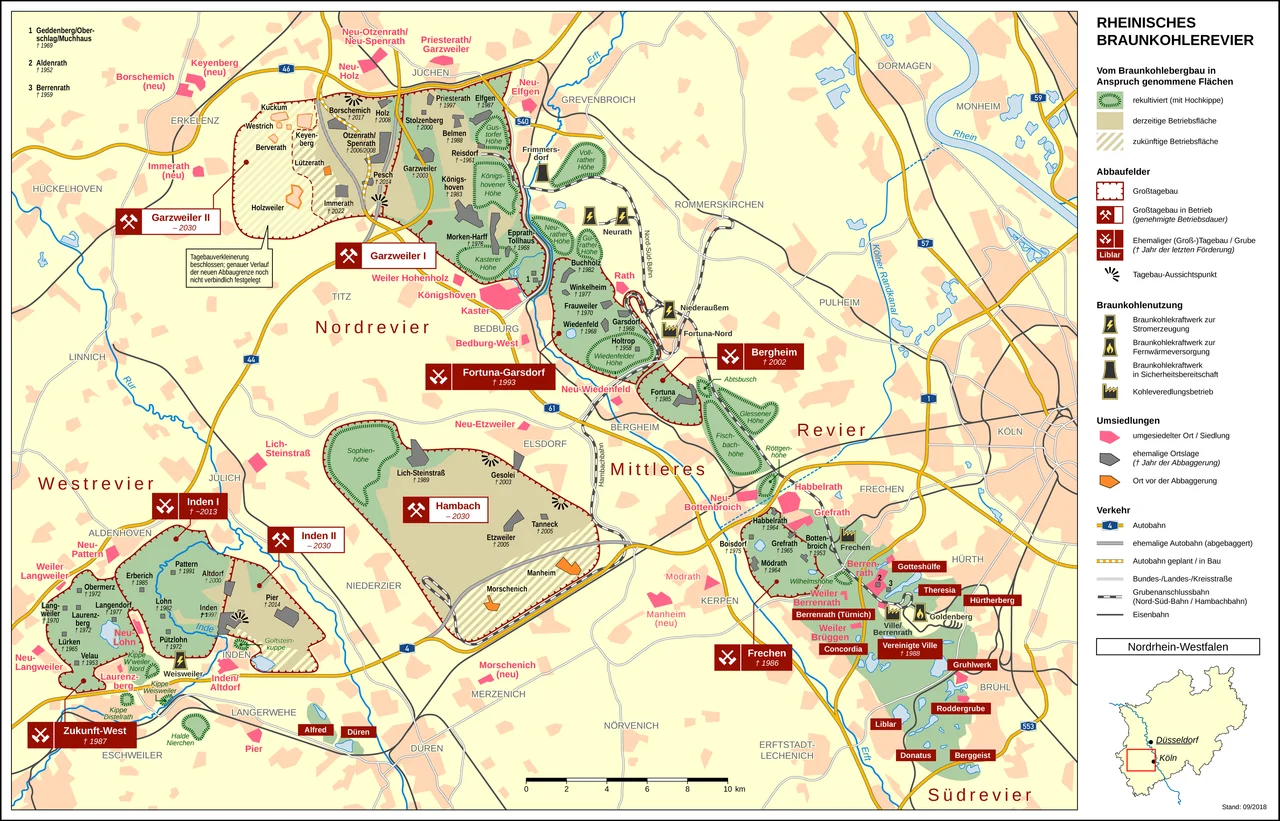

Rheinisches Braunkohlerevier
Otzenrath is gone. The village in the Juchen district was finally demolished in 2006 to reach the coal under it, and the residents - about eighty percent of them, anyway - were resettled together to a new Otzenrath built a few kilometers away. Holz is gone. Pesch is being emptied. So is much of the original Garzweiler. The Rheinisches Braunkohlerevier, the Rhenish brown coal district, is Europe's largest lignite mining area, and the way it has worked for a hundred years is by removing what stands in the way of the seam. Sometimes that is forest. Sometimes that is your kitchen.
What Lies Beneath
The geology under the Cologne Bay made this inevitable. Starting about 30 million years ago, the Lower Rhine Bay subsided into a shallow sedimentation basin. During the early Miocene, between 20 and 23 million years ago, conditions favored peat bogs, which were then sealed under layers of gravel and sand and pressed into lignite. The main seam group of the Ville reaches up to seventy meters thick. In the western district, near the Rur River, the Inden strata formed later, in the late Miocene. Then the basin broke into three blocks along major fault lines, with each block tilting eastward and subsiding at a different rate. The result is one of the richest accessible lignite deposits in Europe - and three present-day open pits big enough that the Hambach mine has been called one of the largest human-made holes on Earth, at a depth of up to 500 meters.
From Klutten to Bucket Wheels
Until the late seventeenth century, the wet brown layer above the clay used in Brühl and Frechen ceramics was just waste to be cleared. Then someone noticed it burned. Small farmers and day laborers began digging it out with spades, pressing it into lumps called Klutten - from the Low German Kluit for lump - and drying them in the air. The Klutten had low heat value. They were burned by the poor. That was the lignite industry until the late nineteenth century, when steam-driven dewatering pumps and mechanical briquette presses suddenly made the seams economical. The first overburden excavator, originally built for the Kiel Canal, arrived at the Donatus mine near Liblar in 1895. The first inclined coal dredger, christened the Iron Man, started work at Brühl's Gruhlwerk in 1907. By 1913, only three of the area's twenty-nine mines were still working without excavators. Production climbed from five million tons in 1905 to 17.4 million by 1913, and then kept climbing.
RWE and the Power Plants
The first lignite power plant came online in 1899 at the Berggeist mine near Brühl, at about one megawatt. By 1932 the Goldenberg plant at Knapsack alone could produce 500 megawatts. Rheinisch-Westfalisches Elektrizitatswerk - RWE - took over Berggeist in 1906, and the alliance between RWE and Rhineland lignite has lasted more than a century. Today RWE Power operates the entire value chain in the district. The Niederaussem station, the Weisweiler station near Eschweiler, the Frimmersdorf and Neurath stations near Grevenbroich - together they have accounted for over a quarter of all carbon-dioxide emissions in North Rhine-Westphalia. The Frimmersdorf plant alone has been ranked the dirtiest in Germany at 1,270 grams of CO2 per kilowatt-hour. Total CO2 from these four sites reached around 83 million tons in 2006.
Villages and the Hambach Forest
The pits move on a fan principle, rotating around a pivot point with the mining front followed by the tipping front. As they move, they consume villages. Resettlement is supposed to keep communities intact - RWE tries to relocate residents to a single new settlement so the social fabric survives the move. It does not always work. Only sixty percent of Garzweiler's original residents resettled together. Compensation is calculated on current building values, which often falls short of the cost to rebuild to modern standards. Before official relocation begins, villages slip into a slow desertification: businesses stop investing, building permits get denied, the young move away, and by the time the bulldozers arrive the demolition is half-finished by departure. The Hambach Forest, an old-growth woodland slated for clearing to make way for the Hambach pit, became the focus of years of protest occupations, drawing international attention to what open-pit mining costs above ground.
The Long Goodbye
Coal production in the Rhenish district peaked in 1984 at 120.6 million tons and has hovered around 100 million tons annually since 2002. Three open pits are still active - Garzweiler, Hambach, and Inden, the last of which exists solely to feed the Weisweiler power plant. The original plan envisioned Hambach and Garzweiler II being exhausted by 2040-2045, with Inden ending about a decade earlier, but the German coal phase-out has compressed those timelines. When the pits do close, they will not be backfilled. The Sophienhohe spoil heap, the largest external dump, holds about a cubic kilometer of overburden and cannot simply be poured back in. Instead the holes will be flooded into lakes. The Inden pit lake would be the size of Lake Tegernsee. The Hambach pit lake, by water volume, would be exceeded in Germany only by Lake Constance, but it would be substantially deeper. Filling them will take until around 2090. The villages that stood where those lakes will be are not coming back.
From the Air
The Rheinisches Braunkohlerevier is centered roughly at 50.91N, 6.50E, in the Cologne Bay west of the city. Recommended viewing altitude is 5,000-10,000 ft AGL to grasp the scale; the Hambach pit alone is up to 470 m deep, with the Sophienhohe spoil heap (290 m above sea level) towering on its northern side. Garzweiler is visible to the northwest, Inden to the southwest near Eschweiler. The Frimmersdorf, Neurath, and Niederaussem power stations are conspicuous landmarks with their cooling towers. Nearest airports are Cologne Bonn (EDDK) to the east, Düsseldorf (EDDL) to the north, and Mönchengladbach (EDLN) and Maastricht Aachen (EHBK) to the west. Expect controlled airspace throughout.
Nearby Stories
- Trolleybuses in Solingen 4 km away
- Wessem-Nederweert Canal 5.9 km away
- Monchengladbach 7.2 km away
- South Limburg 7.6 km away
- European Transonic Wind Tunnel 7.6 km away
- Belgium 105 km away
- Marcinelle Mining Disaster 148 km away
- Zwingenberg Castle 196 km away