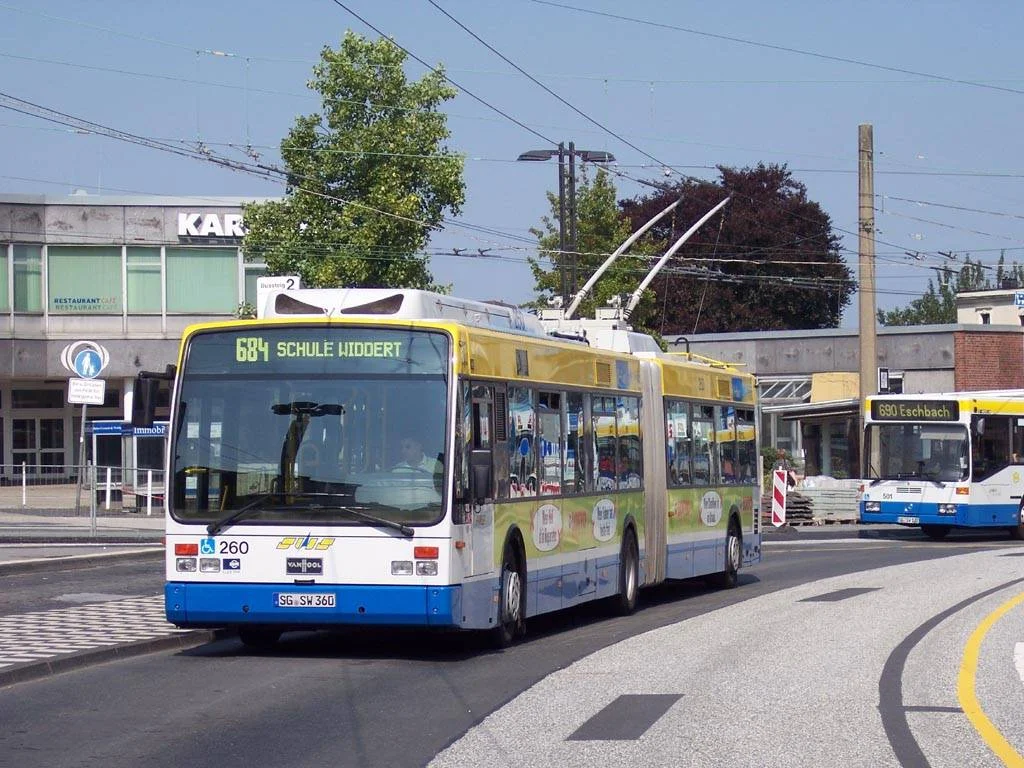

Trolleybuses in Solingen
Solingen calls them Stangentaxis - 'pole taxis' - because of the twin trolley poles sliding along the overhead wires above the city. Watch a Solingen bus pull away from a stop on the steep approach to Graf-Wilhelm-Platz: no diesel growl, no clatter, just the quiet swell of electric torque as a forty-foot articulated vehicle pulls a full passenger load up a Bergisches hill. Germany once had trolleybus systems in dozens of cities. Three remain. Solingen runs the largest of them, and at the southern end of route 683, in a hairpin village above the river Wupper, the world's last surviving trolleybus turntable still spins buses around to face the way they came.
Why the Wires Stayed
The trolley wires went up on 19 June 1952, replacing a tram network that the city decided was not worth rebuilding after the war. Conversion finished in 1959, and ever since the buses have hummed through Solingen's steep streets and into the western suburbs around Ohligs, where the Hauptbahnhof handles connections to the rest of the Rhineland. In the mid-1990s the city flirted with replacing them all with diesel buses. The plan was dropped. Trolleybuses have superior acceleration on grades, they don't choke when stopped at red lights on a climb, and Solingen, draped over a ridge between the Wupper and the Rhine, is nothing but grades. The wires stayed because the topography won the argument.
The Turntable at Unterburg
Route 683 is the network's giant - 14.5 kilometres from Wuppertal-Vohwinkel in the north to Burg an der Wupper in the south, where Schloss Burg crowns its hill above the river. Burg's village of Unterburg is reached by a narrow lane that ends in a yard barely wider than a bus. To turn a trolleybus there in the old days, conductors guided it onto a steel turntable, swung the whole vehicle through 180 degrees while the trolley poles stayed in contact with the overhead, and sent it back out the way it came. When the network switched to articulated buses in 2009, those long bendy vehicles could no longer fit the turntable, and route 683 was extended on diesel power past Unterburg to Burger Bahnhof. The turntable, though, was not scrapped. It still rotates - a working museum piece, the only trolleybus turntable left anywhere in the world.
Batteries Under the Poles
The future of Solingen's wires turned out to involve battery packs. Stadtwerke Solingen, the city utility, began developing the Batterie-Oberleitungs-Bus - the 'BOB' - in the late 2010s: a trolleybus that recharges itself on electrified routes and then runs free of the wires across un-wired sections, drawing on its batteries. On 31 October 2019, the first BOB route entered service - the 695 between Grafrath and Meigen - reusing existing trolleybus wires along Unionstrasse and Bahnhof Mitte and stringing only a few new metres at junctions. By 2023, the old Berkhof Premier AT18 fleet was being retired in favour of full BOB vehicles, and Stadtwerke now plans to convert every diesel line in the city to in-motion-charged electric service. The wires won't disappear. They'll multiply outward into the diesel network.
Seven Routes, One Square
Today seven trolleybus routes radiate from Graf-Wilhelm-Platz in the heart of Solingen, threading the city's neighbourhoods and reaching into Wuppertal along the way. Routes 681 and 682 connect to Solingen Hauptbahnhof out in Ohligs. The long 683 still meets the Wuppertal Schwebebahn at Vohwinkel, an end-of-line handshake between two of Germany's most distinctive transport systems - the suspended monorail above the river and the trolleybus on the ridge above. From the air, none of this is visible. From the street, it is unmistakable. Look up at any intersection in Solingen and the city's nervous system is right there, suspended between the lamp posts.
From the Air
Solingen sits at 51.17N, 7.08E in the Bergisches Land east of Dusseldorf, just south of the Wupper river and the city of Wuppertal. From cruise altitude, the city sprawls across a ridge between the Rhine plain and the Sauerland hills. Dusseldorf International (EDDL) is 25 km west; Cologne-Bonn (EDDK) lies 45 km south-southwest. Look for the dense urban fabric perched on the Klingenstadt ridge, with the Wupper valley curving along the southern flank toward the wooded loop containing Schloss Burg.
Nearby Stories
- ZOOM Erlebniswelt Gelsenkirchen 8 km away
- Hochschule Niederrhein 11 km away
- FC Viktoria Köln 13 km away
- Battle of Werl 14 km away
- Rheinisches Braunkohlerevier 14 km away
- Festspiele Balver Höhle 15 km away
- Wesel Station 18 km away
- Siegen 23 km away