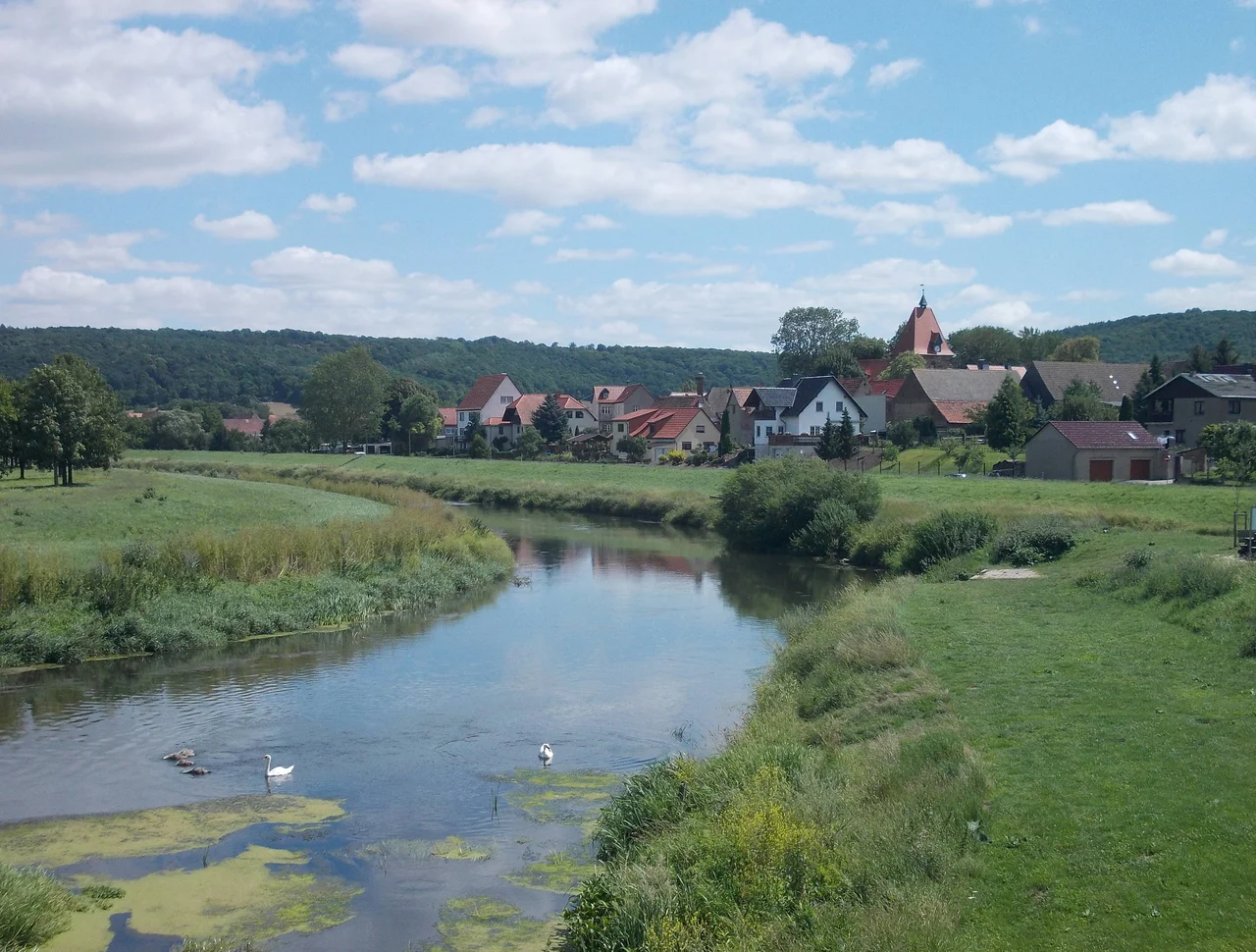

Memleben Abbey
Two of the most powerful men in tenth-century Europe died at Memleben within thirty-seven years of each other, and both deaths happened in the same room. Henry the Fowler, first Saxon king of East Francia, came back here after a stroke in the Harz forest in 936 and died at the royal villa on 2 July of that year. His son Otto the Great, by then Holy Roman Emperor, returned in May 973 to celebrate Pentecost at his father's place of death. He was sixty years old. He died on 7 May. The settlement on the Unstrut was no longer just a hunting lodge after that. It became dynastic memory, set in stone.
The Villa Before the Abbey
The name Mimilebo appears in the records of Hersfeld Abbey before 786, when Archbishop Lullus of Mainz still ruled in central Germany. The settlement sat in the Friesenfeld, a Saxon shire west of the Hassegau, on land Henry the Fowler had inherited through his first marriage to Hatheburg of Merseburg. He kept the estates after the marriage was annulled in 909, and he built up the royal villa across the years he spent hunting the woods around the Unstrut. By the time he became king in 919, Memleben was second only to Quedlinburg in his rotation of palaces. His grandson Otto II, looking for a way to honor his grandfather and his father at once, founded the abbey here around 979 with his Byzantine wife Theophanu.
The Brief Golden Age
Otto II and Theophanu poured estates into Memleben. Land in Thuringia, Saxony-Anhalt, and Hesse, formerly held by Hersfeld, came to the new abbey, along with tithes from the Friesenfeld and Hassegau. Hevelli lands east of the Elbe in what is now Brandenburg were folded in too, though most were lost again during the Great Slav Rising of 983 when peoples on the empire's eastern edge threw off German rule and burned bishoprics from Brandenburg to Havelberg. Otto III, who became emperor as a child, kept the favor flowing: market rights and mint privileges in 994, the Wiehe estates in Thuringia in 998. He even thought about making Memleben the seat of a new Thuringian bishopric. He died in Italy in 1002 at the age of twenty-two before he could act on it.
Henry II's Reversal
When Henry II succeeded Otto III, he confirmed Memleben's privileges at his accession in 1002, putting it on equal footing with Fulda, Corvey, and Reichenau. Thirteen years later he reversed himself. He needed estates for his pet project, the new Bishopric of Bamberg, and Memleben was a useful donor. In 1015 he subordinated the abbey to Hersfeld, the very mother house that had once held the land Otto II had taken away from it. The decline of Memleben as an Ottonian memorial was sealed. The Salian emperor Conrad II stopped here in 1033, the last documented German monarch to do so. After that, the abbey carried on for almost five hundred years as a quiet country monastery, surviving the German Peasants' War of 1525 in damaged form, before being formally dissolved in 1548 in the wake of the Reformation.
Lightning and Slow Erasure
After dissolution, the abbey's estates passed to the Electors of Saxony, who handed them to the school at Schulpforta. The buildings sat. In 1722 a lightning strike set the church roof on fire, and after that several attempts were made to demolish what was left. The walls held on. The Late Romanesque crypt survives, along with the southwestern transept and crossing piers and the southern wall of the nave from the original tenth-century building. Stand in the crypt today and you are below the floor of the church where Otto the Great's heart, according to long local tradition, was buried after his body was carried to Magdeburg to lie beside Eadgyth.
Today, on the Romanesque Road
After the Second World War, an East German agricultural collective took over the surviving monastic buildings and made considerable alterations. Today those buildings house a museum about the royal and monastic history of the place, with a reconstructed scriptorium and a restored monastery garden. Memleben is a stop on the Romanesque Road, the tourist route that threads together the surviving Ottonian and Salian buildings of Saxony-Anhalt. Since 2011, Benedictine monks from Munsterschwarzach Abbey in Bavaria have returned for stretches of the year, the first regular religious presence in centuries. The Unstrut still flows past the same rise of ground where the kings hunted. The walls are mostly stumps now, but they mark where an empire wanted to remember itself.
From the Air
Located at 51.27 N, 11.50 E on the Unstrut river in southern Saxony-Anhalt, in the small village of Memleben. The ruins sit just south of the river bend, set among low rolling farmland. Leipzig/Halle (EDDP) is the nearest major airport, about 60 km southeast. The site is small and easy to miss from altitude; look for the river curving below low limestone bluffs.
Nearby Stories
- Haus am Horn 6.1 km away
- Eisleben 8.7 km away
- Bad Dürrenberg burial 9.7 km away
- Mittelbau-Dora Concentration Camp 11 km away
- Opfermoor Vogtei 33 km away
- Dejudaization Institute Memorial 40 km away
- Bauhaus Dessau 42 km away
- Horch 46 km away