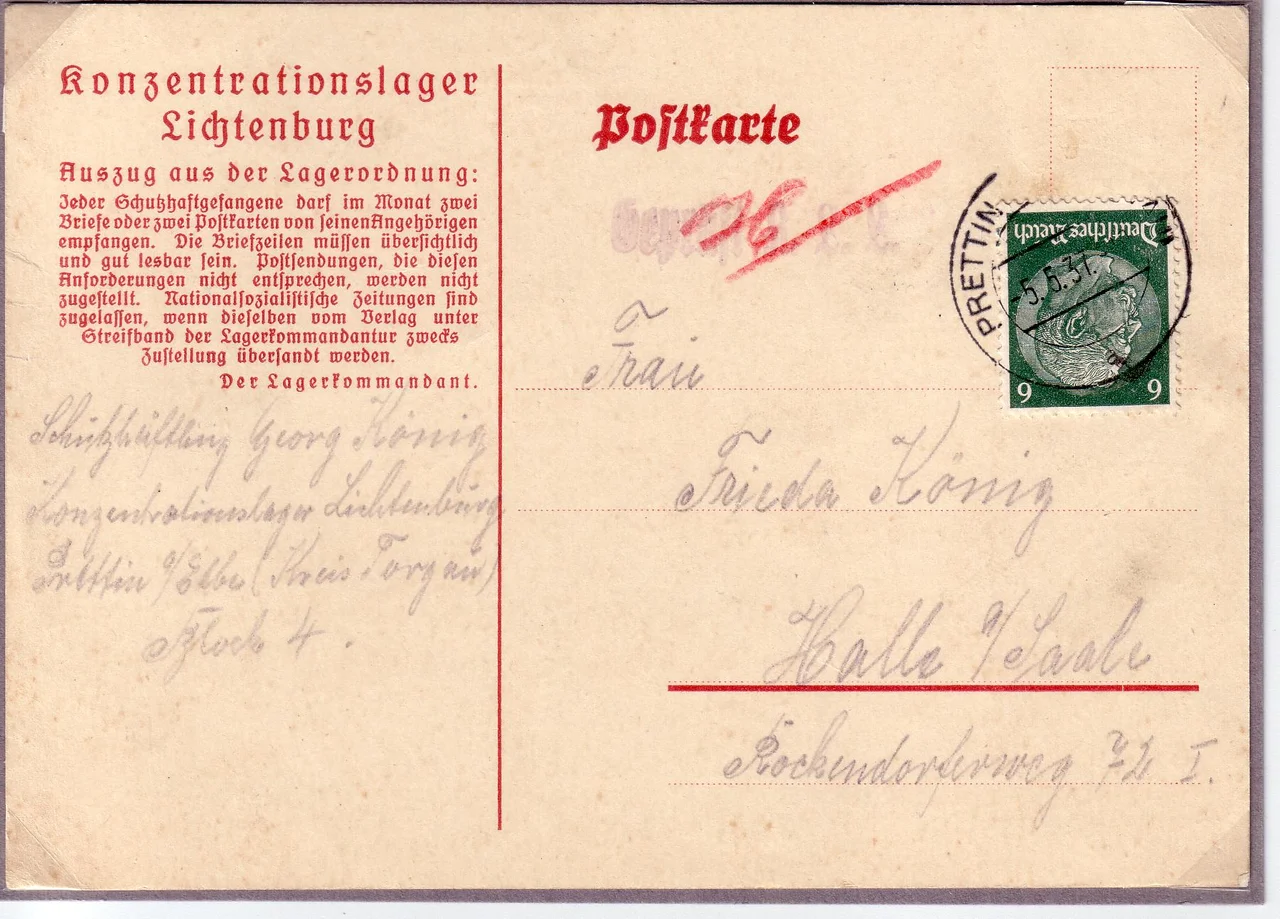

Lichtenburg Concentration Camp
Before Auschwitz, before the gas chambers, before the trains from western Europe, the Nazi state had to figure out how to imprison its own citizens. In the spring of 1933, weeks after Hitler became chancellor, the SS began converting buildings across Germany into camps for political opponents - communists, social democrats, trade unionists, journalists, lawyers, anyone whose existence the new regime could not tolerate. Lichtenburg, a Renaissance castle in the small town of Prettin near Wittenberg, was one of the first. It opened in June 1933 and operated for six years. Up to 2,000 men passed through it as political prisoners between 1933 and 1937. From late 1937 to May 1939 it became a women's camp, holding around 1,000 prisoners at a time - most of them transferred onward in 1939 when the SS opened Ravensbruck specifically as a women's camp. The buildings remain. So does a regional museum that documents what happened here. The architecture is beautiful in the way old German castles are beautiful, and the history is exactly as ugly as the Nazi era was - which is to say it does not soften with the centuries that have passed since the castle was built or the decades that have passed since it stopped being a camp.
The Test Camp
The early Nazi camps were not built primarily to murder - mass extermination of Jews would come later, after 1941 - they were built to imprison and to terrorize. Theodor Eicke became commandant at Lichtenburg in May 1934 after running Dachau, and he treated Lichtenburg as a continuation of the same project: develop the methods, train the guards, refine the techniques of dehumanization that the SS would later export across occupied Europe. The men who served as commandants and protective custody chiefs at Lichtenburg - Eicke, Bernhard Schmidt, Karl Otto Koch, Hermann Baranowski, Hans Helwig, Egon Zill, Alexander Piorkowski, Max Koegel - went on to run other camps elsewhere. Karl Otto Koch became commandant of Buchenwald, where his wife Ilse would become infamous. Max Koegel ran Ravensbruck and later Majdanek. Lichtenburg was, in the most clinical sense, a school for the Nazi camp system.
Who Was Held
The men imprisoned at Lichtenburg were Germans who refused to accept what their country was becoming. Friedrich Ebert junior, the son of the first president of the Weimar Republic, was held here for being a Social Democrat. Ernst Reuter, who would later become the post-war mayor of West Berlin during the Berlin Airlift, spent time at Lichtenburg in 1933 for the same reason. Hans Litten, the lawyer who in 1931 had cross-examined Hitler in court and exposed the Nazi paramilitary's violence under oath, was tortured at Lichtenburg and other camps; he was eventually murdered at Dachau in 1938. Wilhelm Leuschner, a trade union leader who would later be involved in the 20 July 1944 plot against Hitler and be executed for it, was held here. Werner Scholem, the Communist politician and brother of the philosopher Gershom Scholem, was imprisoned here before being murdered at Buchenwald in 1940. The actor Wolfgang Langhoff was at Lichtenburg before he wrote The Peat Bog Soldiers about his experiences. The journalist Erich Knauf was held here for telling jokes about the regime; he was executed at Brandenburg-Gorden in 1944 for the same offense.
The Women's Camp
From December 1937 to May 1939 Lichtenburg held women prisoners exclusively - one of the first Nazi camps to do so. The director was Gunther Tamaschke, with Alexander Piorkowski and Max Koegel as deputies. The 900 to 1,000 women held at any given time included Olga Benario-Prestes, a German-Brazilian Communist resistance fighter who had been arrested in Brazil and deported back to Germany even though she was pregnant; she was eventually murdered at Bernburg in 1942. Lina Haag, who had refused to renounce her Communist husband, was held here and survived to write a memoir. The actress Lotti Huber was imprisoned. So was Lisa Ullrich, a Communist politician. Bertha Falk, an early Witnesses prisoner, was held here. The conditions were what early Nazi camps were before the systematic killing of the war years - brutal, humiliating, and often fatal through neglect, beatings, and despair. When Ravensbruck opened in May 1939, 900 of Lichtenburg's prisoners were transferred there as Ravensbruck's first inmates. Many of them did not survive the war.
The Memorial Today
Lichtenburg closed in May 1939. During the war the SS used it for various secondary purposes. After 1945 it became a regional museum and memorial site, with permanent exhibitions about the Nazi camp's operation and the prisoners who passed through. Detailed documentation became available to researchers only in late 2006, when the International Tracing Service opened its records to outside historians - which means much of what we now understand about Lichtenburg has been pieced together in the last twenty years. The historian Stefan Hordler's 2011 study Before the Holocaust placed Lichtenburg within the evolving Nazi camp system. Sarah Helm's 2015 book on Ravensbruck traced the line of women prisoners from Lichtenburg to that larger camp where so many of them died. Standing in the castle courtyard now, the architectural setting is incongruous - this is a Saxon Renaissance building of the kind that draws tourists everywhere else. But the people who were imprisoned here were not abstractions. They were Germans who had voted differently, organized for unions, written critical articles, defended clients in court, or simply refused to fly the new flag - and the regime that was building toward the Holocaust started by taking everything from them first.
From the Air
Located at 51.66 degrees N, 12.93 degrees E on a bend of the Elbe river at the small town of Prettin, about 22 km east of Wittenberg in Saxony-Anhalt. The Renaissance castle complex sits on the high left bank with clear sight lines down the Elbe. Nearest major airport: EDDP (Leipzig/Halle) about 70 km southwest, EDDB (Berlin Brandenburg) about 100 km northeast. The castle is most clearly visible from southeast approaches; the Elbe meander provides a natural navigation reference.
Nearby Stories
- Dessau-Wörlitz Garden Realm 1.8 km away
- Battle of Lutzen 12 km away
- Lutherhaus 12 km away
- Albrechtsburg 20 km away
- Colditz Cock 22 km away
- Halle (Saale) 26 km away
- Kummersdorf 28 km away
- 2001 American Memorial 39 km away