
Lutherhaus
Martin Luther lived in this building for nearly forty years. He moved in as a young Augustinian friar in 1508 or 1509, when it was still the Black Monastery of the Augustinian Hermits and he was a junior member of the order sent to Wittenberg to study. He wrote the 95 Theses while teaching here in 1517, an act that did not actually involve nailing anything to a door (the Theses door is the Schlosskirche, two streets away) but that did, within a few years, get the building's whole religious order suppressed. After 1524, when most of the friars had left and the Elector of Saxony handed the empty building over to him, Luther moved in for good with his wife Katharina von Bora and their growing family of children, students, and visiting reformers. He died in his hometown of Eisleben in 1546, but he had spent the bulk of his adult life in this house in Wittenberg - eating, drinking, arguing, translating the Bible, building his children carved entryways as birthday presents. The Lutherhaus is the world's largest Reformation museum. It has been a UNESCO World Heritage Site since 1996. It is currently closed for renovation through Spring 2027.
The Black Monastery
The University of Wittenberg opened in 1502, and the next year the Augustinian Hermits were given land near the Elster Gate to build a residence hall and academy for their order's students. Construction began in 1504 on a brick monastery the locals called the Black Monastery, after the dark habits the friars wore. In 1507 Martin Luther, recently ordained, was sent here by his superior Johann von Staupitz to continue his studies. He took a cell in the southwest corner of the new building. Within five years he had earned his doctorate in theology and joined the university faculty as Doctor of Bible. The 95 Theses, his protest against the sale of indulgences, were composed in this building in 1517 and published from Wittenberg in October of that year. The Reformation that followed was not the project of this building alone, but the building was where one of its central figures wrote, taught, prayed, and ate every day for the next decade.
Marriage and the Table Talks
By 1521 Luther had been excommunicated and was forced into hiding at Wartburg Castle. The Peasants' War of 1524-1525 emptied the monastery completely as the friars left their order. In 1524 the Electorate of Saxony handed the empty buildings over to Luther personally. The next year he married Katharina von Bora, a former Cistercian nun who had escaped her convent in a smuggled herring barrel, and the two of them turned the Black Monastery into a home. Katharina ran what was effectively a small commercial operation - brewery, garden, livestock, dormitory for boarders - while Luther wrote, lectured, and entertained an endless stream of students, ministers, princes, and visiting scholars. From 1531 onwards he held his famous Table Talks - the Tischreden - around the meal table, sometimes in Latin and sometimes in German, on every conceivable subject. Students transcribed and later published thousands of his pronouncements. He carved (or had carved) the Katharinenportal, an ornate stone entryway, as a birthday present for his wife. He also wrote some of the most influential and most morally troubling theology of the European sixteenth century from these rooms - including, in his last years, the anti-Jewish tracts that would be cited four hundred years later by the Nazi regime in Germany. Luther was a man of his time and beyond it, and his writings have to be read with both halves of that sentence in view.
Boarding School and Hospital
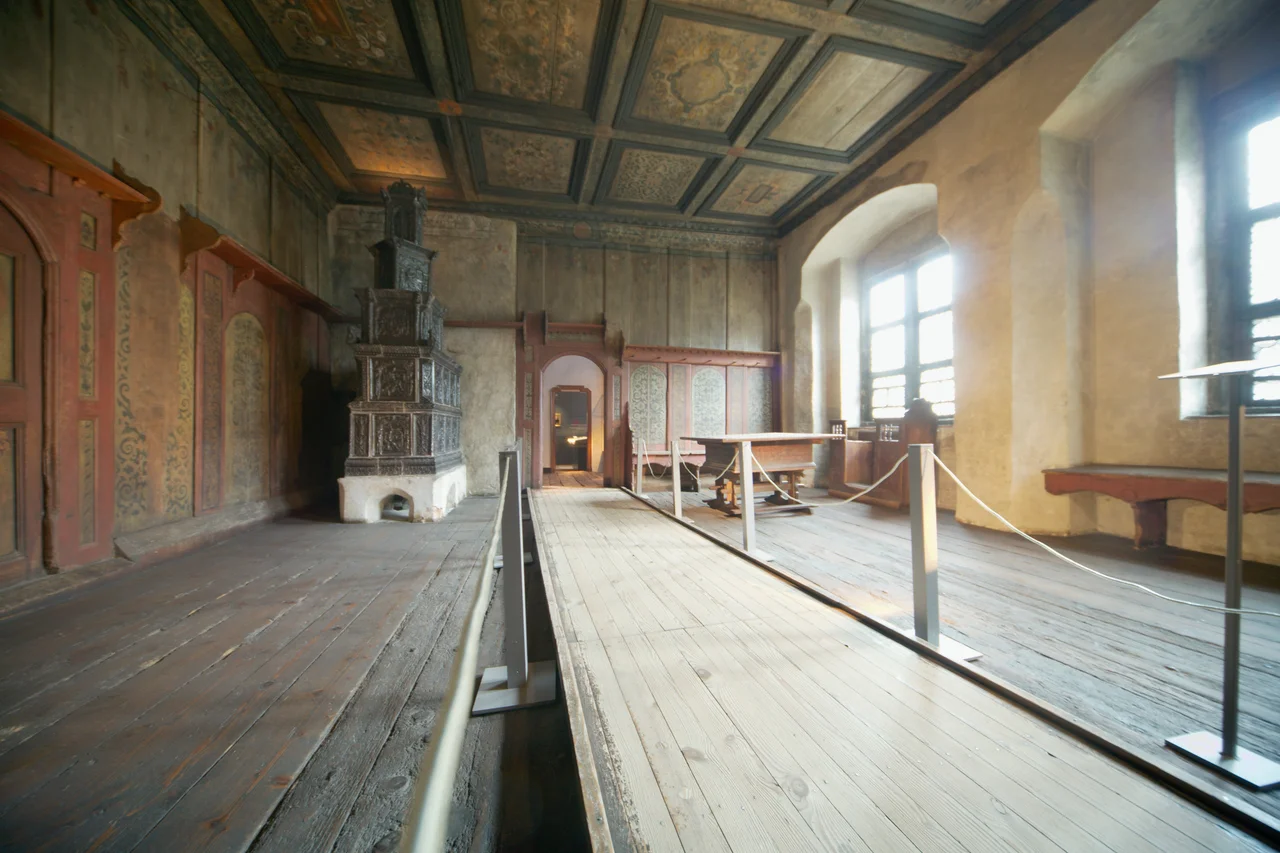
After Luther's death in 1546 the family kept the house for nearly twenty years before selling it back to the university in 1564. The university converted it into a boarding school and added the imposing exterior spiral staircase. The refectory was given a new vaulted ceiling. The great hall - which had been Luther's lecture hall - was redecorated and modernized. Only the Lutherstube, Luther's personal living room, was left as it was, frequently shown to important guests. Wittenberg was attacked by Austria during the Seven Years' War in 1760, and the Schlosskirche, the Castle Church where the 95 Theses had been posted, was severely damaged. The Lutherhaus survived with minimal damage but entered a long period of decline. From 1761 to 1813 it was used as a military hospital. After the Napoleonic Wars, the dissolution of the Wittenberg University and its merger with Halle left the building without a clear function; it became a free school for the poor and continued to deteriorate. By the 1850s it was in such bad shape that the Prussian state hired Friedrich August Stuler, the most distinguished architectural restorer of his generation, to rebuild it. The work, carried out from 1853 to 1856, won the Architectural Prize of Saxony-Anhalt and produced essentially the building visible today.
Museum and World Heritage
The Lutherhaus has been a museum since the late nineteenth century and is now the world's largest collection of Reformation-related material. It contains many original objects from Luther's life: his pulpit from the Stadtkirche down the street, his friar's habit, paintings by Lucas Cranach the Elder (Luther's friend and painter of the most familiar Luther portraits), and an enormous archive of Bibles, pamphlets, and manuscripts. Together with the other Luther sites in Wittenberg and Eisleben, it was added to the UNESCO World Heritage List in 1996. The museum is currently closed for major renovations and is scheduled to reopen in Spring 2027. When it does, visitors will find exhibits that have been increasingly direct about the difficult parts of Luther's legacy - not only the theological breakthroughs and the Bible translation that helped standardize the German language, but also his violent rhetoric against the rebelling peasants and his late-life anti-Semitism. Wittenberg today markets itself as Lutherstadt Wittenberg, a city defined by one resident from the early sixteenth century. The Schlosskirche, with the Theses door, sits at one end of the old town. The Lutherhaus sits at the other. Walk between them and you walk the central axis of European Protestantism.
From the Air
Located at 51.86 degrees N, 12.65 degrees E at the eastern edge of Wittenberg's old town in Saxony-Anhalt, about 100 km southwest of Berlin and 70 km northeast of Leipzig. The brick monastery's distinctive spiral staircase tower (added in the 1560s) and the steep gabled roof are visible against the surrounding low town. Nearest major airports: EDDP (Leipzig/Halle) about 75 km southwest, EDDB (Berlin Brandenburg) about 90 km north-northeast. The Elbe river runs about 1 km north of the building - a useful navigation reference.
Nearby Stories
- Rudolf Virchow 17 km away
- Magdeburg Water Bridge 17 km away
- Stalag III-A 19 km away
- Inner German Border 22 km away
- Jahrtausendturm 29 km away
- Battle of Mühlberg 31 km away
- Lichtenburg Concentration Camp 31 km away
- Eisleben 33 km away