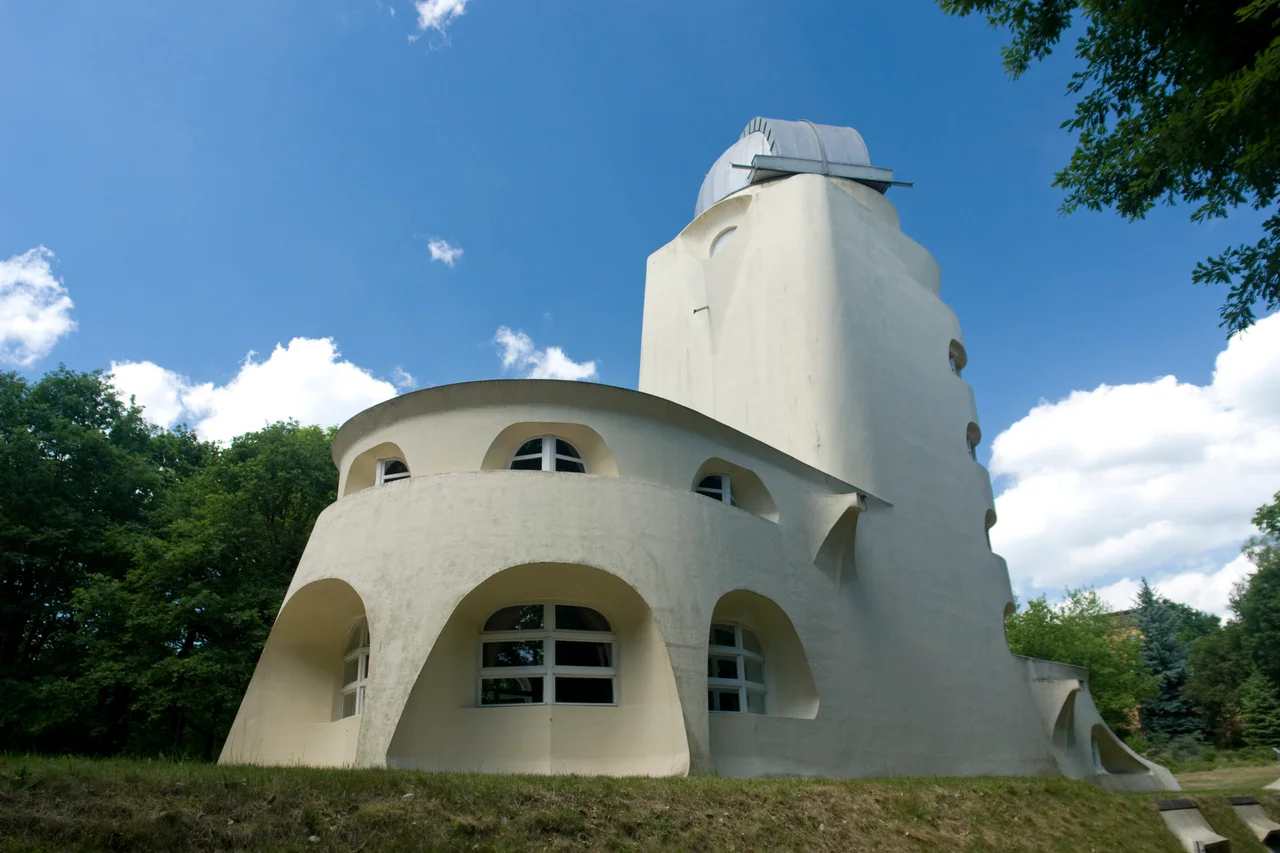

Einstein Tower
The story goes that Erich Mendelsohn took Albert Einstein on a long tour of the finished tower, waiting through hour after hour for some reaction. The building was unlike anything in 1920s Germany: a curving, melted-looking solar observatory that one critic compared to an ungainly spaceship parked in the suburbs of Potsdam. Einstein said nothing as they walked. He said nothing on the stairs. He said nothing in the dome. Hours later, in a meeting with the building committee, he leaned over and whispered a single word: organic. Mendelsohn took it as the highest praise he ever received. Whether the moment really happened that way is a story the building has been telling about itself for a hundred years.
A Building for a Theory
In 1911 Einstein had published the early version of his general theory of relativity, and one of its predictions involved a slight reddening of light from massive bodies - a gravitational red shift in the spectrum of the sun's surface. To test it required precision spectroscopy of solar light, which required a specialized telescope, which required a specialized building. The astronomer Erwin Finlay-Freundlich led the project, modeling the design on the Mount Wilson tower telescope in California. Construction was conceived around 1917, delayed by war and inflation, and finally carried out between 1919 and 1921 with funds raised through public donation. The tower became operational in 1924. From a coelostat at the top of the tower, sunlight is reflected straight down a 14-meter shaft to a 60-centimeter objective lens, then bounced into a horizontal spectrograph laboratory shielded behind an earthen wall on the southern side. The horizontal arrangement is what gives the building its strange elongated shape.
Mendelsohn's Sketches Made Solid
Erich Mendelsohn was one of the founders of expressionist architecture in Germany, and the Einstein Tower was his first major commission - completed when a young Richard Neutra, later one of the great mid-century modernists in Los Angeles, was on his staff. Between 1917 and 1920 Mendelsohn filled sketchbooks with rapid pencil drawings of buildings that looked like nothing yet built: smooth curves, swelling masses, windows like surprised eyes. The Einstein Tower is what one of those sketches looked like once it was scaled up and made structural. Mendelsohn intended to cast the entire building in reinforced concrete, but the construction industry of inflation-era Germany could not handle the complex curves, and most of the tower was instead built in brick and covered with smooth cement plaster to imitate cast concrete. The compromise haunted the building. Cracks and damp problems began appearing within five years, and Mendelsohn himself oversaw repairs in the late 1920s. The building has been periodically renovated ever since, most recently completing a major refurbishment in 2023.
The Bombs and the Stone
When the Nazis came to power in 1933 the Einstein Tower had its name removed and lost its institutional independence. Einstein had emigrated to America that same year; pictures of him were taken down and busts were officially melted. After the war it emerged that staff at the observatory had quietly hidden one bronze portrait bust of Einstein behind crates in the spectrograph laboratory throughout the Nazi years. It was returned to its place at the base of the tower in 1945. There is a small tradition that visitors leave a stone where the bust had hidden - ein Stein, German for one stone, a wordplay on Einstein's name. The stone gets stolen or moved regularly and replaced just as regularly. Allied bombing in World War II severely damaged the building, leaving it in a state that one architecture critic noted was ironically closer to Mendelsohn's original conceptual sketches than the prewar finished structure had been. A full restoration in 1999 marked the building's 75th anniversary.
Still Watching the Sun
The original quest to measure the gravitational red shift took longer than anyone expected. The actual signal was so small, and the turbulence on the sun's surface so disruptive, that the prediction was not cleanly verified until the 1950s. By then the Einstein Tower had pivoted to other questions, and it remains a working observatory today as part of the Leibniz Institute for Astrophysics Potsdam. Modern instruments here measure the magnetic fields that drive solar weather - sunspots, flares, coronal mass ejections - using a double spectrograph and photoelectric polarization analyzers in the basement laboratory. Astronomers based here also help operate a sister observatory on Tenerife, with new instruments tested in Potsdam first. The building serves a teaching function as well, training students in solar physics in the same rooms where Freundlich first tried to catch a relativistic red shift in the spectrum of sunlight. A century after it was built, the white sculpture in the Albert Einstein Science Park is still doing the work it was made for.
From the Air
The Einstein Tower sits at 52.38 N, 13.06 E on the Telegraphenberg in Potsdam, in the Albert Einstein Science Park among other historic observatory buildings. The white expressionist silhouette is small and easily lost from altitude, but the wooded hill itself rises clearly above the surrounding plain south of Potsdam's center. Berlin Brandenburg (EDDB) is 18 km east; the lakes of Potsdam - Templiner See, Griebnitzsee, the Havel - provide easy visual reference. Approach paths into BER often pass north of Potsdam, giving good Cessna-altitude views of the city's parks and palaces.
Nearby Stories
- Karlslust Dance Hall Fire 1.3 km away
- Swiss International Air Lines Flight 850 9.2 km away
- Gigafactory Berlin-Brandenburg 12 km away
- Brandenburg Euthanasia Centre 15 km away
- Wittenberg 18 km away
- Friesack Camp 20 km away
- Spreewald 23 km away
- Lutherhaus 41 km away