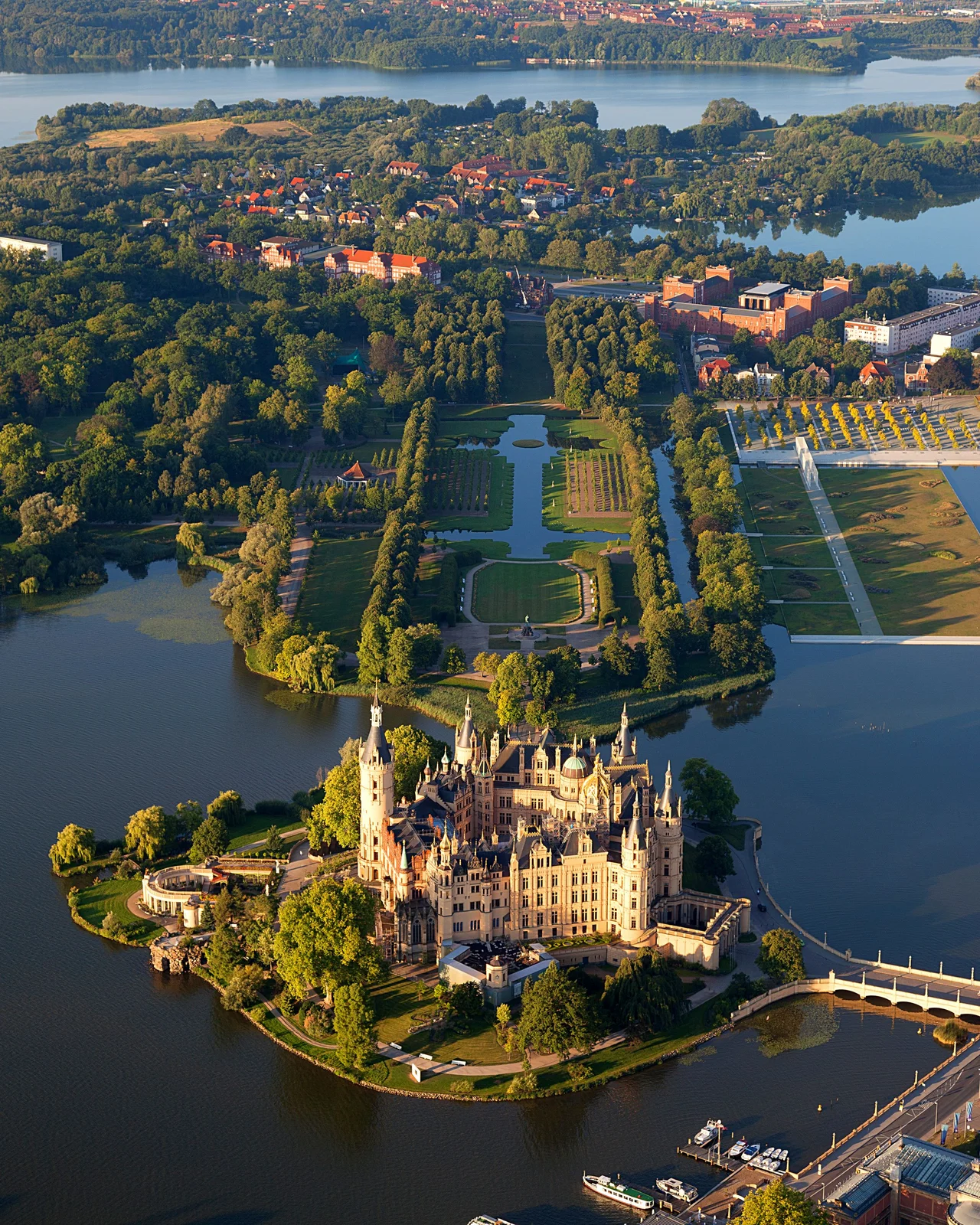

Ludwigslust Palace
Walk into the Goldener Saal at Ludwigslust and look up. The hall rises through two stories. Colossal Corinthian columns frame walls heavy with ornament that flows in the elaborate vocabulary of high Baroque - garlands, putti, allegorical figures, gilt leafwork. It looks like the most expensive carved-wood interior in northern Germany. It is not. Almost everything you see is papier-mache. The Mecklenburg dukes who built Ludwigslust between 1772 and 1776 could not afford to compete with Schwerin's stone or Versailles's gilt-bronze, so they hired craftsmen who developed an extraordinary technique: a moldable, paintable paper composite called Ludwigsluster Carton that could be cast into ornament so convincing that even modern conservators have to look twice. The dukes used it everywhere. Two and a half centuries later, the carton ornament is still in place - lighter than wood, more durable than plaster, and a quiet monument to a Baroque court that solved the problem of grandeur with imagination instead of money.
Ludwig's Joy
The palace's name is wholesome to the point of embarrassment. In 1724, Prince Christian Ludwig, heir to the Duchy of Mecklenburg-Schwerin, built a hunting lodge near a hamlet called Klenow, about 36 km - a day's ride - from the ducal capital at Schwerin. He liked the place so much that even after he became reigning duke in 1747 he spent most of his time there, calling it Ludwigslust: 'Ludwig's Joy.' Forty-one years later, in 1765, his successor Duke Frederick II made the leap permanent and moved the entire ducal seat from Schwerin to this small inland town. It was an unusual decision - Schwerin is a beautiful city on a series of lakes, and Ludwigslust is a flat hamlet in the heath - but ducal preference outweighed urban planning. The town was rebuilt around the new palace. A grand axis was laid through it. The cornerstone of the new schloss went down in 1768. Construction took eight years.
Busch's E-Plan
Johann Joachim Busch designed the palace, executed between 1772 and 1776 in late Baroque about to tip into neoclassicism. The plan is an E - a central corps de logis projecting forward between two recessed wings. The central block uses the rich Corinthian order; the wings carry the lighter Ionic. The exterior is brick clad in local sandstone, and forty over-life-size allegorical figures by Rudolf Kaplunger crown the cornice, alternating with sandstone vases. The entrance front faces a basin that reflects the building back, doubling its size. The garden front opens to a 120-hectare Schlosspark laid out by the French architect Jean-Laurent Le Geay and Busch himself: formal canals, fountains, an artificial cascade so geometrically regular it earned the name Der Walze, 'the Roll.' There are a stone bridge, a grotto built as a deliberate ruin, a Gothic chapel, two mausoleums, and - perfectly Mecklenburg in spirit - a monument to a favorite horse. Bernini's Vatican-scale colonnades were the original inspiration for the tree planting; the trees are gone, but the ambitions are still legible in the surviving plan.
The Carton and the Court
Inside, the interiors are more fully neoclassical. The reception rooms occupy the piano nobile above a low ground floor of guest rooms. The Goldener Saal in the central block rises through two stories with massive decoration in stucco and the Ludwigsluster Carton - the molded papier-mache that is the palace's signature contribution to art history. One wing was semi-public, sequencing antechamber to salon to audience chamber to gallery. The other wing was semi-private - the duke's drawing room and bedchamber, hung with framed miniatures, a cabinet, and a gallery with a porcelain chimneypiece. The town outside grew in deference to the palace. The Hofkirche, built 1803-1809, served as the court chapel. The central Hofdamenallee, the 'Court Ladies' Avenue,' continued the palace's main axis straight through the woods. The court was small by European standards but exact in its protocols, the kind of provincial German absolutism that filled novels in the nineteenth century before democracy ended it.
Schwerin Returns
In 1837 Grand Duke Paul Friedrich moved the capital back to Schwerin, and Ludwigslust became a summer residence. That demotion saved it. The palace was preserved unaltered through the nineteenth century while the Schwerin residences were rebuilt in fashionable styles. The park was relandscaped in the more naturalistic English manner by Peter Joseph Lenne in the mid-1800s, but the central axis was kept. The Mecklenburg-Schwerin family used Ludwigslust until 1945, when the war ended their world. After the war the palace passed to the East German state. A burial site for some 200 inmates of the Wobbelin concentration camp - prisoners who died in the final weeks of the war when SS guards force-marched them west - lies on the grounds, a memorial reminder that even quiet ducal palaces did not escape the twentieth century. Today Ludwigslust houses part of the Staatliches Museum Schwerin/Ludwigslust/Gustrow, with paintings by Jean-Baptiste Oudry and busts by Jean Antoine Houdon - art that represents the actual taste of the Mecklenburg dukes - and the Goldener Saal is used for summer concerts. The Carton still passes for carved wood in the photographs.
From the Air
Located at 53.32 degrees N, 11.49 degrees E in the small town of Ludwigslust in southwestern Mecklenburg-Vorpommern, about 35 km south of Schwerin and 100 km southeast of Hamburg. The palace's E-plan and the long axial Hofdamenallee through the surrounding woodland are the most distinctive features from the air. Nearest major airports: EDDH (Hamburg) about 105 km west-northwest, EDDB (Berlin Brandenburg) about 175 km southeast, EDDP (Leipzig/Halle) about 305 km south. The reflecting basin in front of the entrance front is a striking landmark in clear weather.
Nearby Stories
- Gorleben 6.3 km away
- Scharnebeck Twin Ship Lift 28 km away
- Ebstorf Abbey 33 km away
- Battle of Wittstock 41 km away
- Friesack Camp 57 km away
- Historical Technical Museum, Peenemünde 133 km away
- Lilleø 144 km away
- Scharhörnbake 168 km away