.JPG)
Wildeshausen
In the year 851, a man named Waltbert rode into a sparsely settled patch of the North German Plain carrying a box of bones. The bones were the relics of Alexander, a Roman boy who, the Christian story said, had been martyred with his mother and six brothers during the early persecutions. Waltbert was the grandson of Widukind, the Saxon chieftain whom Charlemagne had finally bludgeoned into baptism. Now Widukind's grandson was using those same Roman saints to convert his own people. The relics ended up in a *Stift* on the Hunte river, and the village around it became Wildeshausen - today the capital of the Oldenburg district, a market town of cobbled squares and quiet brick streets where a 1403 shooting guild still runs the Pentecost calendar.
Five Thousand Years of Burials
Long before Waltbert and the bones of St Alexander, the people who lived along the Hunte were already burying their dead in style. Stone monuments and graves around Wildeshausen date back to the third millennium BC - the Kleinenkneter Steine were reconstructed in the 1930s and still sit out in the heath. But the most extraordinary site is the Pestruper Burial Ground, about 800 metres from the river. Roughly 500 burial mounds covered in grass sods stretch across the heath, raised one by one around 600 BC for individual cremation urns. It is the only preserved urn-field of its kind in Europe. The earliest layers contain ritual plough marks from the Bronze Age, 1100 to 700 BC. The farmers and hunters who lived here were contemporaries of Ötzi, the Iceman frozen in an Alpine glacier.
Translatio Alexandri
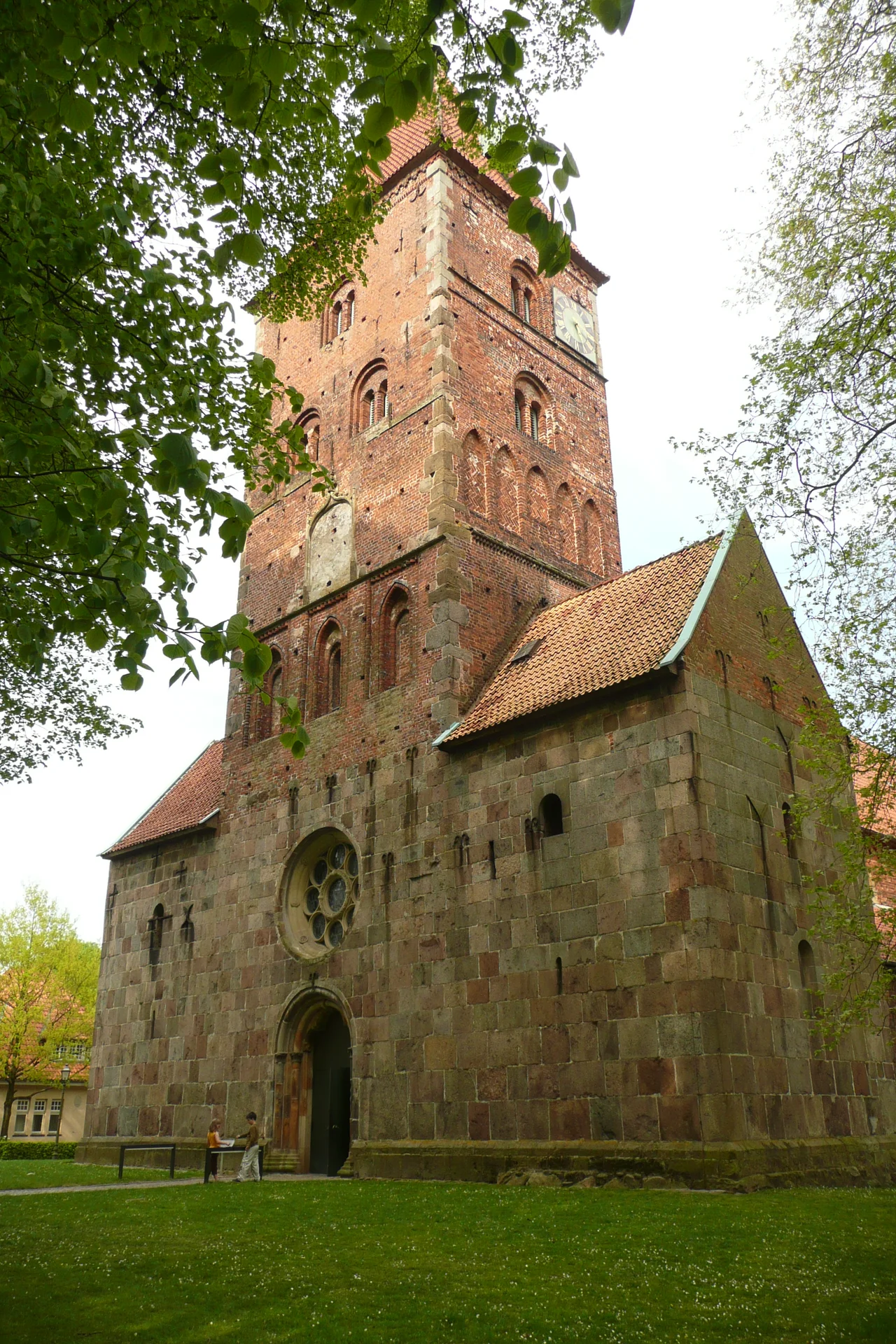
Waltbert's pilgrimage was a piece of medieval logistics that today reads like a road movie. He crossed the Alps to Rome, secured the relics of Alexander and his family, and brought them home over the mountains and back through the Saxon forests. The official date the relics arrived in Wildeshausen is 851, though some accounts place the donation as early as 807. Either way, Waltbert founded a *Chorherren Stift* - a Benedictine-rule canons' foundation - called the Alexander Kapitel, to use as a mission centre for the surrounding Lerigau. The monks of Fulda later wrote it all up in a text called the *Translatio Alexandri*. The relics turned Wildeshausen into a pilgrimage destination and a prosperous one. The Alexander Church that grew out of that mission is the only basilica in the Oldenburg region, its stone fabric tracking the transition from late Romanesque to early Gothic in the thirteenth century. Frescoes hidden under later renovations are still being uncovered.
A Brief Swedish Town
Some history is famous; some is wonderfully obscure. In 1648 the Peace of Westphalia handed several pieces of northwest Germany to the Swedish crown - including, of all places, the little town on the Hunte. Sweden gave Wildeshausen to Count Gustav Gustavsson of Vasaborg, an illegitimate son of King Gustavus II Adolphus and Margareta Slots, and half-brother of the famous Queen Christina. Gustav moved here from Sweden and died in town on 25 October 1653. His son, also Gustav Adolf, was a few months old when he inherited. He grew up to serve in the Brunswick-Lüneburg army, lost the town in the wars of the 1670s, and yet stayed on - dying in Wildeshausen in 1732, a Swedish count slowly fading into Lower Saxon life. The town passed to the Prince-Bishop of Münster in 1679, then to Hanover, then to Oldenburg in 1810 - and only with Oldenburg did the Catholic community finally regain the right to build a proper church, consecrating St Peter's in 1811.
The Town Is the Guild
Walk into Wildeshausen at Pentecost and you will find a town that has not really stopped being medieval. The Schützengilde - the citizens' shooting guild - was founded in 1403, and the week-long *Gildefest* that grows out of it has been running every Pfingsten since. The mayor is automatically the General of the Guild. The town director is the chief of protocol, with the rank of Major. A local saying captures it: *the town of Wildeshausen is the Schützengilde, and the Schützengilde is the town of Wildeshausen.* Granite sculpture in the inner city marks the bond. The Marktbrunnen, the market fountain built in 1747 by Theophil of Bremen, once watered both people and animals; a stone near it commemorates Mayor Jakob Lickenberg, executed on this spot after Münster captured the town in 1529. On Westerstraße, Waltbert rides eternally in bronze, his name and the year 851 and the single Latin word *translatio* carved below the horse.
From the Air
Wildeshausen sits at 52.89 degrees north, 8.43 degrees east, on the River Hunte in the Oldenburg district of Lower Saxony, about 35 km south of the city of Oldenburg. The town anchors the northeast corner of the Wildeshausen Geest Nature Park. From cruising altitude the surrounding terrain is a mosaic of woods, fields and grassland on the geest plateau, around 50 to 60 metres above sea level. The Pestruper urn-field appears as a distinctive patch of low grass-covered mounds about 800 m southeast of the town. Nearest airport is Bremen (EDDW), about 30 km northeast. Münster-Osnabrück (EDDG) lies about 70 km southwest.
Nearby Stories
- 1st Panzer Division (Bundeswehr) 3 km away
- Damme Hills 3 km away
- Stickhausen Castle 16 km away
- Hümmling 17 km away
- Worpswede 18 km away
- Schnoor 28 km away
- Siege of Lingen (1597) 29 km away
- Minden 30 km away