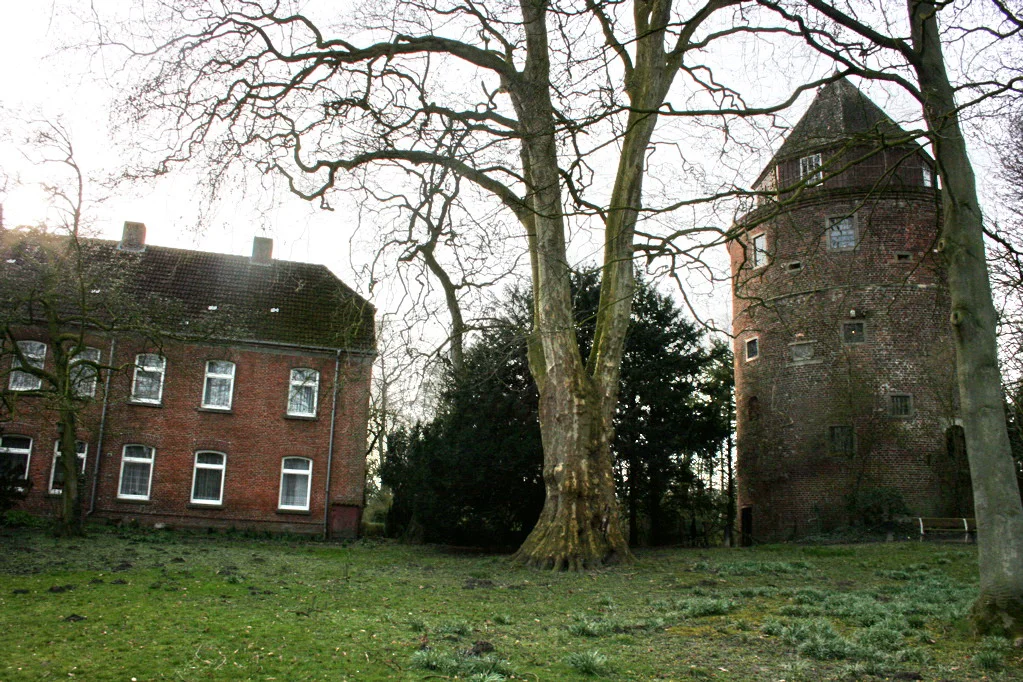

Stickhausen Castle
In 1744, Frederick the Great looked at a map of his newly acquired East Frisian territories and decided one particular castle was no longer worth feeding. The order went out: raze Stickhausen. Hessian fortifications, Mansfeld's mercenary outworks, a three-winged main castle with corner tower, batteries, barracks, a powder tower, a ravelin between the moat and the Jümme river — all of it came down. What survived the Prussian wrecking crew was the part nobody could quite bring themselves to topple: a single round brick tower built by Count Edzard I in 1498, squat and stubborn at the river's edge. It is still there today, the lone Roman numeral left from a fortress that once read like an entire timeline.
A Hamburg Outpost on the Jümme
Stickhausen began not as the seat of an East Frisian chieftain, like most castles in the region, but as a trade-route checkpoint built by a city a hundred miles away. Around 1345, Hamburg commissioned the fortification to protect its westbound merchant traffic. The Jümme and the nearby Leda form what locals still call East Frisian Mesopotamia — twin rivers running east-west through the marshes, the only practical highways through this drowned country. Whoever held the Jümme held the goods. The original castle was modest: a stone house surrounded by a moat, a gatehouse, a bailey for outbuildings, all wrapped in a second wall and second trench. The name itself betrayed the building method. Sticke meant pole, Hause meant house, and Stickhausen meant a place defended by palisades driven into wet ground.
Edzard's Tower and the Siege That Followed
Hamburg eventually tired of holding the place and, around 1453, pledged it to the local chieftains and then to Count Ulrich I of East Frisia. The castle changed character. It became a counts' residence, then a counts' problem. Around 1498, Count Edzard I added the brick round tower that still stands. A few years later his entanglement in the Saxon feud brought a coalition of princes led by George, Duke of Saxony, to his gates. The castle fell. For three years it sat in foreign hands. When Countess Anna later rebuilt and expanded it in 1558, she did not bother quarrying fresh stone — she carted in blocks from the abandoned Barthe Abbey and from Uplengen Castle, which Count Enno II had razed in 1535. Stickhausen, in other words, was partly built from the corpses of other fortresses.
Thirty Years of Foreign Boots
The Thirty Years' War turned Stickhausen into a passing trophy. Between 1622 and 1624, the feared mercenary troops of Ernst von Mansfeld occupied the castle and improved its defenses with new outworks. The counts of East Frisia got it back briefly before Hessian troops moved in from 1637 to 1640 and finished what Mansfeld had started. By the time they left, the complex sprawled across both banks of the Jümme: a three-winged main castle, gatehouse, stables, peat barn, burgrave's mansion, a garrison church wedged into the gatehouse upper floor, an outer wall with powder tower, a ravelin on the south side, and a whole separate fortified substation of barracks and farm buildings on the east. Four batteries in the main castle, one in the substation. It looked, in its prime, less like a castle than a small military town.
What Frederick Spared
Prussia inherited East Frisia in 1744 and inherited Stickhausen with it. To Frederick, it was a redundant inland fortress whose strategic logic had expired centuries earlier, and his crews leveled almost everything. The substation, ironically, survived by ceasing to be military — it grew into the village of Stickhausen that now wraps around the castle's footprint. The gatehouse was rebuilt in 1822 as a bailiff's office, with a 1578 coat of arms still mortared into the outside wall. The round tower itself became a prison and the bailiff's residence, then took artillery damage in the Second World War, then was patched up starting in 1951. Today the tower is a small heritage museum. The ground floor holds prison cells with reproductions of torture instruments — a rack, clamps. The first floor shows how a prison guard once lived. The second floor traces the castle's centuries. In the attic, with the kind of wonderful East Frisian non-sequitur that makes small museums worth visiting, there is a collection of birds and bird eggs.
From the Air
Stickhausen Castle sits at 53.218 N, 7.643 E on the western edge of Stickhausen village in Detern, Landkreis Leer. From cruising altitude look for the confluence of the Jümme and Leda rivers in the broad East Frisian flatlands south of Aurich and west of the Ems estuary. The brick round tower is the dominant local landmark. Nearest sizable airports: Bremen (EDDW) about 75 km southeast, Groningen Eelde (EHGG) about 75 km west, and Wilhelmshaven (EDWI) about 50 km northeast. Light aircraft can use Leer-Papenburg (EDWF) just to the southwest. Low autumn fog forms readily over the river marshes; the best visual approaches are clear summer mornings.
Nearby Stories
- Hümmling 1.9 km away
- Battle of Heiligerlee (1568) 2.7 km away
- Frisia 5.1 km away
- Oldenburg Air Base 5.4 km away
- Lake Bant Tern Colony 8.3 km away
- Low-Frequency Array 11 km away
- Eemshaven Railway Station 14 km away
- Visbek 18 km away