
Hümmling
Over a hundred stone tombs are scattered through these woods. They have been here for roughly five thousand years - older than the pyramids, older than writing reached this part of Europe, older than almost anything the people who walk past them now can name. The Hümmling is a quiet, low ridge in the Emsland region of Lower Saxony, never rising much above the flat North German Plain, never wide enough to be a real upland. The name itself comes from hömil, an old word for a small stone. The stones came first. Everything else - the Baroque hunting castle, the buckwheat pancakes, the dialect that refused to die - arrived later, on ground the dolmen builders had already claimed.
A Ridge Made of Old Ice
The Hümmling is what glaciers leave behind. A ground moraine, geologists call it: a long, narrow swell of sandy debris dropped by retreating ice during the last glaciation, when the North Sea was still tundra and the future Ems valley was a meltwater channel. The ridge runs about twenty-eight kilometers, only a few kilometers wide, hemmed in by the Ems river to the west and the boggy Saterland to the east. Streams that rise on its slopes can't decide which way to drain. Some find the Hase to the south, others the Ems to the southeast, others the Leda to the north. The whole landscape is a quiet argument between water and a slightly higher patch of sand.
The Stones
More than a hundred dolmens survive in the Hümmling hills, scattered through the woods like the bones of a forgotten architecture. The people who built them belonged to the Funnelbeaker culture of the late Neolithic, farming the sandy soils with simple tools and somehow finding the labor and ambition to drag granite boulders into elaborate burial chambers. No one knows the names of the dead inside, or the names of the builders, or what they called this ridge. The stones themselves became the name. The old word hömil - small stone - rolled forward through five millennia, attached itself to a region, and is now printed on highway signs that the descendants of nobody in particular drive past on their way to the supermarket.
The Peasants Who Won
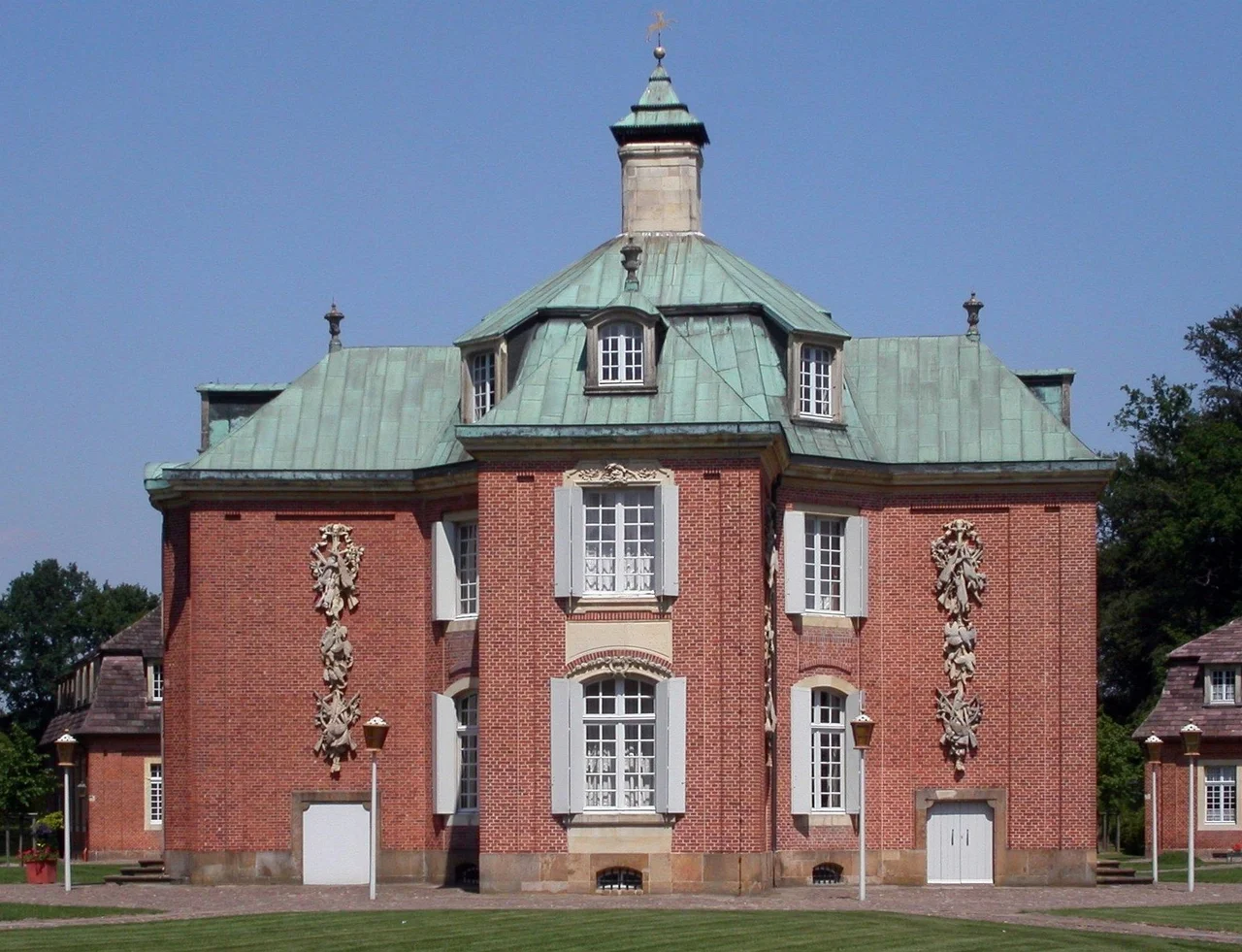
Clemens August, Prince-Bishop of Münster, wanted a summer hunting lodge in the Hümmling. In the 1730s he commissioned Clemenswerth, a starburst-shaped Baroque palace with eight detached pavilions radiating around a central residence - a perfect Westphalian Baroque ensemble built for the prince to chase deer through the heath. To build it, he tried to use feudal labor obligations on the peasants of the so-called Free Hümmling. The peasants refused. They took their case all the way to the Imperial Chamber Court in Wetzlar, the supreme court of the Holy Roman Empire, and after a long, expensive trial they won. They were not, the court ruled, anyone's serfs. The hunting lodge still stands. So does the memory of farmers who outmaneuvered a prince-bishop in his own legal system.
The Last Mill, the Last Speakers
In the village of Hüven stands what is said to be the only fully preserved combined wind- and watermill in Europe - a single structure that catches both the river and the wind, two power sources joined to one set of grinding stones. It is the kind of cleverness that small, isolated communities tend to invent and quietly maintain. The Hümmling has long been like that. Locals still speak Hümmlinger Platt, a Northern Low Saxon dialect, and it was not until about 1975 that whole generations grew up speaking only High German. The food has its own name too: Baukweiten Janhinnerk, a buckwheat pancake eaten with syrup, apple sauce, cranberries, egg, cheese, or rye bread, depending on the household. The 'national anthem' of the region, the Hümmelske Bur, describes the local character with the affectionate exaggeration that small places use when they are sure no one is listening.
What the Ridge Holds
Ninety-three percent of the Hümmling is Roman Catholic, a denominational island left by centuries of being attached to the Prince-Bishopric of Münster while the surrounding regions went Protestant. After 1945, refugees arrived from the lost eastern provinces of Germany. After 1990, ethnic German families came back from the former Soviet Union, bringing New Apostolic and Pentecostal congregations into a region that had not changed its religion in centuries. The ridge keeps accepting newcomers and keeps holding its older layers underneath: the dolmens in the woods, the prince-bishop's hunting pavilions, the dialect of the farmers who refused to be enserfed, the strange little mill that turns whether the wind blows or the water flows. None of it is dramatic. All of it is still there.
From the Air
Centered near 52.91°N, 7.53°E, the Hümmling appears from altitude as a long, wooded swell rising gently from the surrounding flat Emsland farmland. Recommended viewing altitude 3,000-5,000 feet to make out the ridge's outline against the Ems valley to the west. Nearest airports: Münster Osnabrück (EDDG) about 90 km south, Bremen (EDDW) about 100 km northeast, Groningen Eelde (EHGG) about 80 km northwest. The town of Werlte sits roughly at the ridge's center; the Ems river makes the western boundary clearly visible.
Nearby Stories
- Oude Pekela 2.5 km away
- Broken Circle/Spiral Hill 7 km away
- Neuenhaus 7.8 km away
- 1st Panzer Division (Bundeswehr) 8.9 km away
- Damme Hills 9.1 km away
- Meyer Werft 13 km away
- Visbek 16 km away
- Siege of Lingen (1597) 17 km away