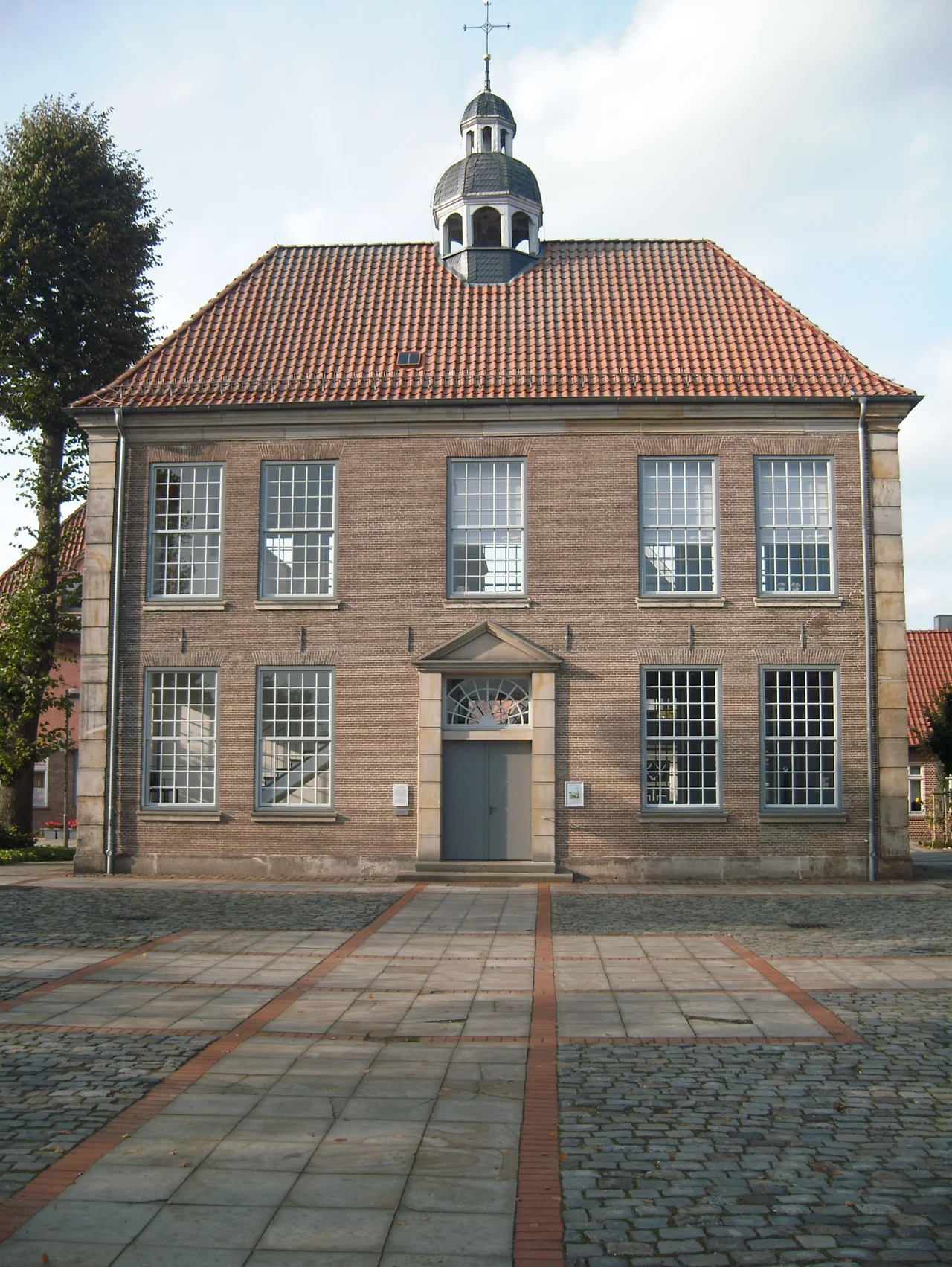

Neuenhaus
On the coat of arms of Neuenhaus, in the red half of the shield, there is a white tent topped with a baronial crown. The tent is Dutch. The town is German. The story of why a German town's official heraldry features a Dutch nobleman's field tent is the story of this whole strip of country, where the border between the Netherlands and Germany has historically meant less than the rivers, the language, and the trade roads that crossed it without ceremony.
Founded on a Trade Road
Neuenhaus was founded in 1317 by Count Johannes II of Bentheim on the medieval trade road that ran between Munster and Amsterdam - a long muddy axis through what is now the Grafschaft Bentheim, the County of Bentheim, that smallest and most westward of Lower Saxon districts. The count built a castle to protect the new town, which was natural enough for a place perched on someone else's commerce. By 1369 Neuenhaus had earned town rights. It sits at the meeting of two rivers - the Dinkel and the Vechte - both of which would later prove inconvenient enough to require dams, weirs, and centuries of patient flood control. The town today is built around the calm versions of those rivers, with weirs in place and a 250-kilometer regional cycle network running along the banks.
The Veld
Just south of Neuenhaus, since 1970 part of the town itself, is the village of Veldhausen - a parish more than a thousand years old. Its name is a small archaeological dig in itself. The first half, veld, is Dutch for field. The villagers of the surrounding farms wanted a closer church than the one at distant Uelsen, and they walked out to a patch of unproductive open ground - a veld - and built one there. They used Dutch for the word because Dutch was what they spoke. Veldhausen's official language was Dutch in church and town hall until barely a hundred years ago. The current Evangelical-Reformed church and the windmill next door are the village's landmarks, and a small mill park behind them includes a working bakehouse where amateur bakers turn the mill's flour into bread.
The Tent on the Shield
Veldhausen also carries a war tent on its coat of arms, and the story behind it explains the older Neuenhaus shield too. The tent commemorates Carl von Rabenhaupt, a Dutch military commander whose actual title was Baron at Sucha. In 1673 and 1674, during the Franco-Dutch War, Rabenhaupt set up his headquarters in Veldhausen to run a campaign against the prince-bishop of Munster, Christoph Bernhard von Galen. The town fed and quartered him; the war passed; and Veldhausen, like a lot of small places, decided to put the most important visitor it had ever hosted on its shield. The four golden orbs on the Neuenhaus arms stand for the Counts of Bentheim. The stepped-gable house in the other quarter comes from the town's seal, which has been in use since 1400.
The Quiet Decades
After the Second World War, the Amt court and other district authorities were relocated from Neuenhaus to the larger town of Nordhorn, ten kilometers south. The passenger railway was discontinued in the mid-1970s; goods trains continued. For decades the line carried only freight. Then in July 2019, after forty-some years of quiet, passenger service resumed on the RB56 route running through Neuenhaus, Nordhorn, and across into Bad Bentheim. The old main street through the inner town has been pulled apart since 2005, after a southwest bypass took the through traffic away. Many of the old Ackerburgerhauser - the houses of the gentleman-farmers, half-rural, half-urban dwellings that defined small Lower Saxon market towns - are being renovated one by one.
Locals Worth Knowing
For a town of barely ten thousand people, Neuenhaus has produced two figures the wider world has heard of and one it should have. Friedrich Anton Wilhelm Miquel, born here in 1811, became a German-Dutch botanist of international reputation. His younger relative Johannes von Miquel, born in 1829, became Prussian Finance Minister and was called the Forefather of All Fiscal Reformers - he later served as chief mayor of both Osnabruck and Frankfurt am Main. And in the dark middle years of the 20th century, Neuenhaus produced Wilhelm Staehle, born in 1877, who joined the German resistance and participated in the July 20, 1944 plot to assassinate Adolf Hitler. He was executed in 1945, a few weeks before the war ended. He is also on the town's quiet roster of native sons.
From the Air
Located at 52.50 N, 6.97 E in the Grafschaft Bentheim district of Lower Saxony, about 10 km northwest of Nordhorn and roughly 8 km east of the Dutch border. The confluence of the Dinkel and Vechte rivers immediately south of town is the easiest visual cue from altitude. Nearest commercial airports: Munster-Osnabruck (EDDG, 60 km south) and Groningen Eelde (EHGG, 75 km north). Enschede Twente (EHTW) lies about 25 km southwest across the Dutch border. Terrain is flat lowland; expect haze over the cycle-path-laced river valleys in summer afternoons.
Nearby Stories
- Dalfsen Train Crash 3.5 km away
- 2024 Dutch Masters of Motocross 4.6 km away
- Sleen 5.6 km away
- Haaksbergen 9.7 km away
- Emsdetten school shooting 11 km away
- Drenthse Veenkolonien 16 km away
- Börger 21 km away
- Rheine 21 km away