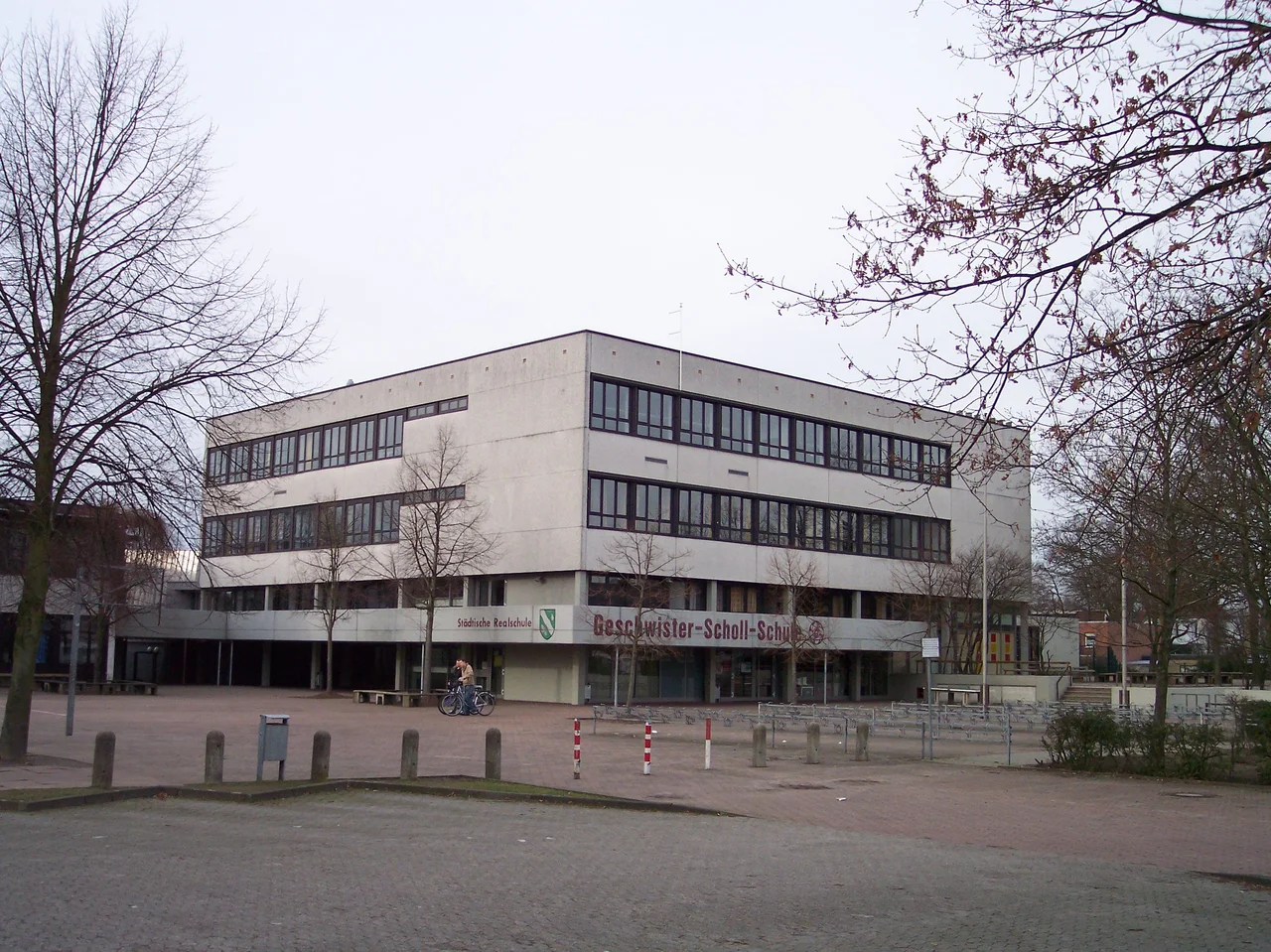

Emsdetten school shooting
It was a Monday in late November, the kind of damp grey morning that arrives early in Westphalia and stays until lunch. Inside the Geschwister-Scholl-Schule in Emsdetten, classes had just begun for the week of 20 November 2006. At approximately 9:20 a.m., an 18-year-old who had graduated from the school earlier that year walked into the schoolyard in a long black trench coat and a black gas mask, carrying a bolt-action rifle and a bag of smoke bombs. By the time it was over, eight students and staff had been wounded - some by gunfire, others while fleeing - and the young man had taken his own life. He was the only fatality. Every other person in that building had to keep living with what they saw.
The People Who Survived
The story belongs first to those who walked into the Geschwister-Scholl-Schule that morning expecting nothing more than a normal school day. The teachers who herded their students into locked classrooms. The custodial and administrative staff who tried to direct emergency responders through corridors filling with smoke. The pupils who hid under desks or ran across the schoolyard. Eight people were wounded that morning, and many more were physically present for the attack and have lived ever since with the memory of it. A school shooting does not end at the moment the gunfire stops. For the wounded, the traumatized, the families who waited for news, and the first responders who entered a smoke-choked building not knowing what they would find, 20 November 2006 became a date that would never quite finish.
What a Town Does Afterward
Emsdetten is a town of around 35,000 in the Munsterland, a place known mainly for textiles and its proximity to Munster and the Dutch border - the kind of community that, until that Monday morning, had never expected to be in the international news. After the attack, the school remained closed while teachers, counselors, and clergy worked with students, parents, and neighbors. The Geschwister-Scholl-Schule itself - named after Hans and Sophie Scholl, the young Munich students executed by the Nazis for resisting the regime - reopened later, and continued to operate. The naming feels poignant in retrospect: a school named for two young people murdered for their conscience, becoming the site of violence inflicted by one young man who had lost his.
The Young Man and What Was Missed
Sebastian Bosse was 18 years old. He had graduated from the Geschwister-Scholl-Schule earlier in 2006. According to the investigation that followed, he had struggled socially through much of his school career and had been required to repeat two years. He spent long hours alone online, posted videos of himself with weapons and explosives, and left a suicide note on his personal website. He had been due in court before the attack on a charge of illegally possessing a Walther P38 pistol. He had been seen at an open-air event with a gas gun while drinking, and police had seized the weapon - but he was still able to legally buy other firearms. The bolt-action rifle he used had been bought from a 24-year-old relative who, investigators concluded, had no idea of his intent. None of these warning signs, individually, was enough. Together, they should have been.
The Aftermath in German Law
Press reports noted that Bosse had spent many hours playing the video game Counter-Strike, and German politicians and media used the phrase Killerspiele - killing games - in the debate that followed. The discussion was loud and not always nuanced, but it did produce legal change: starting in mid-2008, computer games sold in Germany were required to display much larger USK age-rating labels under an updated Article 12 of the Protection of Young Persons Act. Whether stricter age ratings on video games can prevent a young man from walking into a school with a rifle is a question that has no satisfying answer. What does seem clear, in hindsight, is that the gaps in firearm licensing, in mental health support, and in the willingness of online communities to notice someone planning violence - these were the bigger gaps, and they were harder to legislate.
A Place That Is Still There
Almost twenty years on, Emsdetten remains a working Westphalian town. Children still walk to the Geschwister-Scholl-Schule each morning. Teachers still hand out homework. The brick buildings, the schoolyard, the bicycle racks - they are still there because nothing in this kind of attack damages buildings; what it damages is harder to see and slower to rebuild. The German news cycle has moved on through other school attacks - Winnenden in 2009 left sixteen dead - and Emsdetten is sometimes invoked in those later discussions almost as a footnote. But for the survivors, for the families of the wounded, for the teachers who unlocked classroom doors that morning to terrified pupils, the day does not become a footnote. It becomes the central reference point of a life. The least the rest of us can do is remember that, and remember them, with the weight the day deserves.
From the Air
Coordinates 52.166 N, 7.530 E. Emsdetten lies in the Munsterland plain of North Rhine-Westphalia, about 25 km northwest of Munster. The Geschwister-Scholl-Schule is on the western edge of town. Recommended viewing altitude 2,500-4,000 ft AGL. The terrain is flat agricultural land typical of Westphalia. Nearest airports: Munster/Osnabruck International (FMO/EDDG) about 15 km south - the closest major airport. The Dortmund-Ems Canal passes a few kilometers east. This is a location of profound loss; aviation overflight is included only for navigational completeness. The story is about the people, not the geography.
Nearby Stories
- Battle of the Teutoburg Forest 3.9 km away
- Dissen, Lower Saxony 8 km away
- Epe, North Rhine-Westphalia 9 km away
- Lembeck Castle 13 km away
- Neuenhaus 14 km away
- Nordkirchen Castle 14 km away
- Liesborn Abbey 20 km away
- Siege of Lingen (1597) 23 km away