
Lembeck Castle
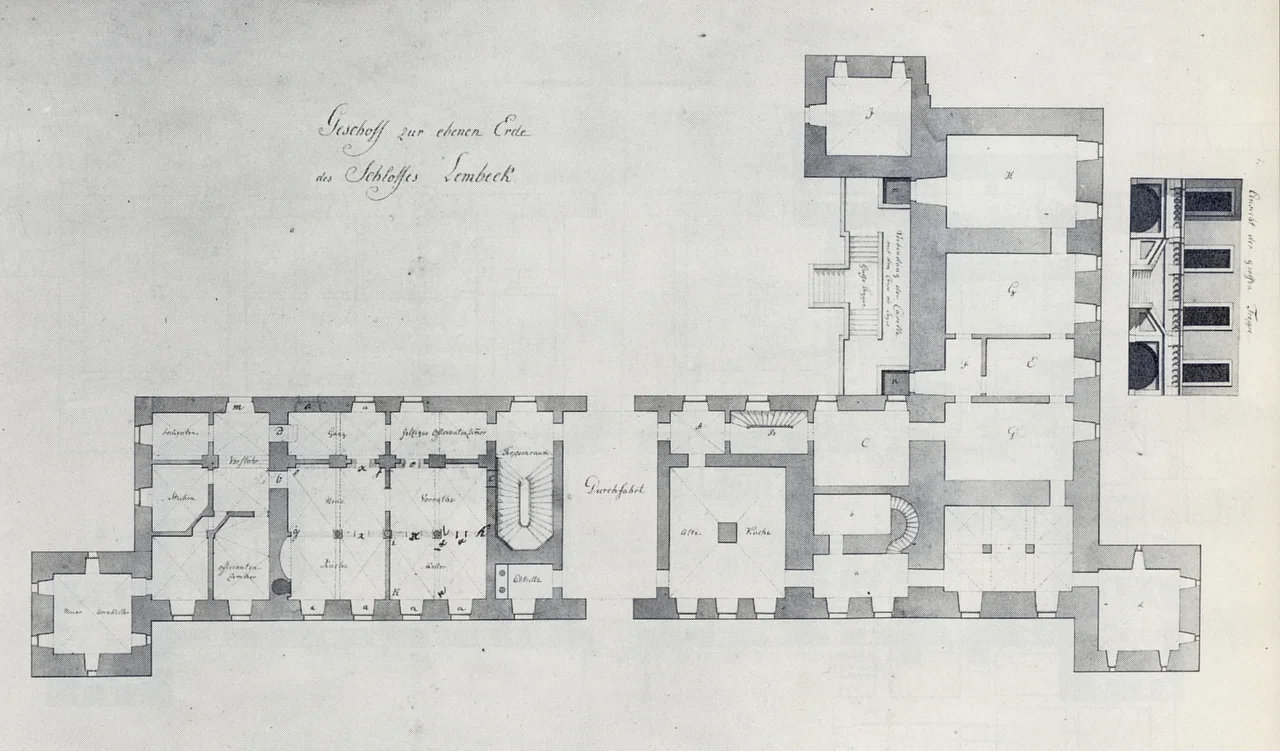
Roll up to Lembeck Castle in a horse-drawn carriage on a wet seventeenth-century evening and you would not need to step into the weather. The architects of the baroque rebuild gave the manor a Renaissance feature borrowed from Florence: a covered passage behind the sandstone portal, modeled on the entrance halls of the Palazzo Pitti and Palazzo Strozzi, where carriages could be turned or parked while their occupants stepped out dry. The same trick appears at the Palazzo Farnese in Rome. It is a detail you do not expect to find in the wet flatlands between the Ruhr and the Münsterland, and yet here it is, in a Westphalian moated castle on an island in a rectangular pond.
An Island in a Bog
The name Lembeck comes from a Low German compound meaning, roughly, slimy brook. The site was a swamp long before it became a castle. The Lords of Lembeck dammed a meadow stream to create a rectangular pond, 190 by 160 meters, and built their fortress on the island that remained. Bridges connect the various parts of the castle to one another and to the surrounding park. The first recorded lord, Adolf von Lembeck, appears in 1177 as a knight serving the Bishop of Münster. From 1390 onward the castle served as an open residence for the bishop himself, available when he needed somewhere to stay between Coesfeld and the coast. The chapel was documented in 1363, the corner tower in the fifteenth century, the modern silhouette during the great baroque rebuild of 1674 to 1692.
Schlaun's Hall
The most famous room in the castle is the work of one of Westphalia's great architects. Johann Conrad Schlaun, the man who shaped much of Münster's baroque skyline, designed the grand ballroom in the north wing. At 140 square meters it spans the full width of the wing. Black marble fireplaces face one another from the short walls. The portraits of Ferdinand Dietrich von Merveldt and his wife Maria Josepha Anna Theodora Gabriele watch over the room from above the mantels, surrounded by eleven more portraits of their children and in-laws. The walls are covered in green silk damask, the lower halves paneled in coffered oak. The ceiling stuccowork, completed between 1730 and 1733, echoes Schlaun's work at Augustusburg Palace and Nordkirchen. War damage forced its restoration twice, in 1954 and 1973.
The Fidelitas Cabinet
Not every room is grand. Some, like the Fidelitas Cabinet, are small and strange and deeply personal. The cabinet takes its name from an oil painting on its ceiling, an allegorical figure representing Fidelity. It is the only surviving original wall painting in the castle. The oak paneling here is painted white rather than left dark, which makes the room feel like a jewel box. Pastel stucco frames small oval portraits, probably of the daughters of Dietrich Conrad von Westerholt and his wife Maria Theodora von Waldbott-Bassenheim-Gudenau. The room measures only ten and a half square meters. A 1972 restoration brought it back from decades of neglect. The chairs that furnish it survived the destruction of the Merveldter Hof in Münster, bombed in 1941.
1943 and After
Lembeck did not escape the Second World War. In 1943 bombings damaged significant portions of the building, and occupying forces caused further harm. The northwest corner of the former library took a direct hit and was never restored to its previous condition. After the war the owners, Maria-Josefa Freifrau von Twickel, born a Countess von Merveldt, and her husband Johannes, decided that the only way to save the castle was to open it to the public. Architect Franz Schneider began the restoration in 1947. His son Paul Schneider-Esleben continued the work in 1948. By 1954 the castle could welcome visitors. The local history society moved into the attic in 1992 and still operates a small museum there on weekends.
Rhododendrons in May
In 1960 the castle's head gardener, Heinrich Nottelmann, began planting rhododendrons in the park. He kept planting. By 1967 a four-hectare section of the grounds had been turned over entirely to the experiment. Today the Heinrich-Nottelmann-Park contains one hundred and fifty rhododendron species and seventy other tree species. From mid-May to mid-June the entire section blooms in waves of pink, white, purple and red, and visitors come from across the Ruhr to walk through it. The petting zoo and playground keep families occupied, the rentable barbecue area keeps the adults fed, and the moat keeps reflecting whatever color the season puts above it. A castle that once needed cannons now charges admission, and seems content with the trade.
From the Air
Coordinates 51.74N, 7.00E. Lembeck sits on the northern edge of the Ruhr region, where the industrial belt gives way to the Münsterland's farms and forests. From altitude look for the rectangular moat enclosing a small wooded island, the long east-west avenue stretching 500 meters from the entrance, and the surrounding Hohe Mark Nature Park. Nearest airports are Düsseldorf (EDDL, ~50 km south) and Münster-Osnabrück (EDDG, ~45 km north). Dortmund (EDLW) is about 50 km southeast.
Nearby Stories
- Metronom Theater 2.5 km away
- Bronckhorst 2.8 km away
- Westfalenstadion 4.9 km away
- Moyland Castle 6.4 km away
- Nordkirchen Castle 11 km away
- Haaksbergen 16 km away
- Emsdetten school shooting 18 km away
- Venlo 19 km away