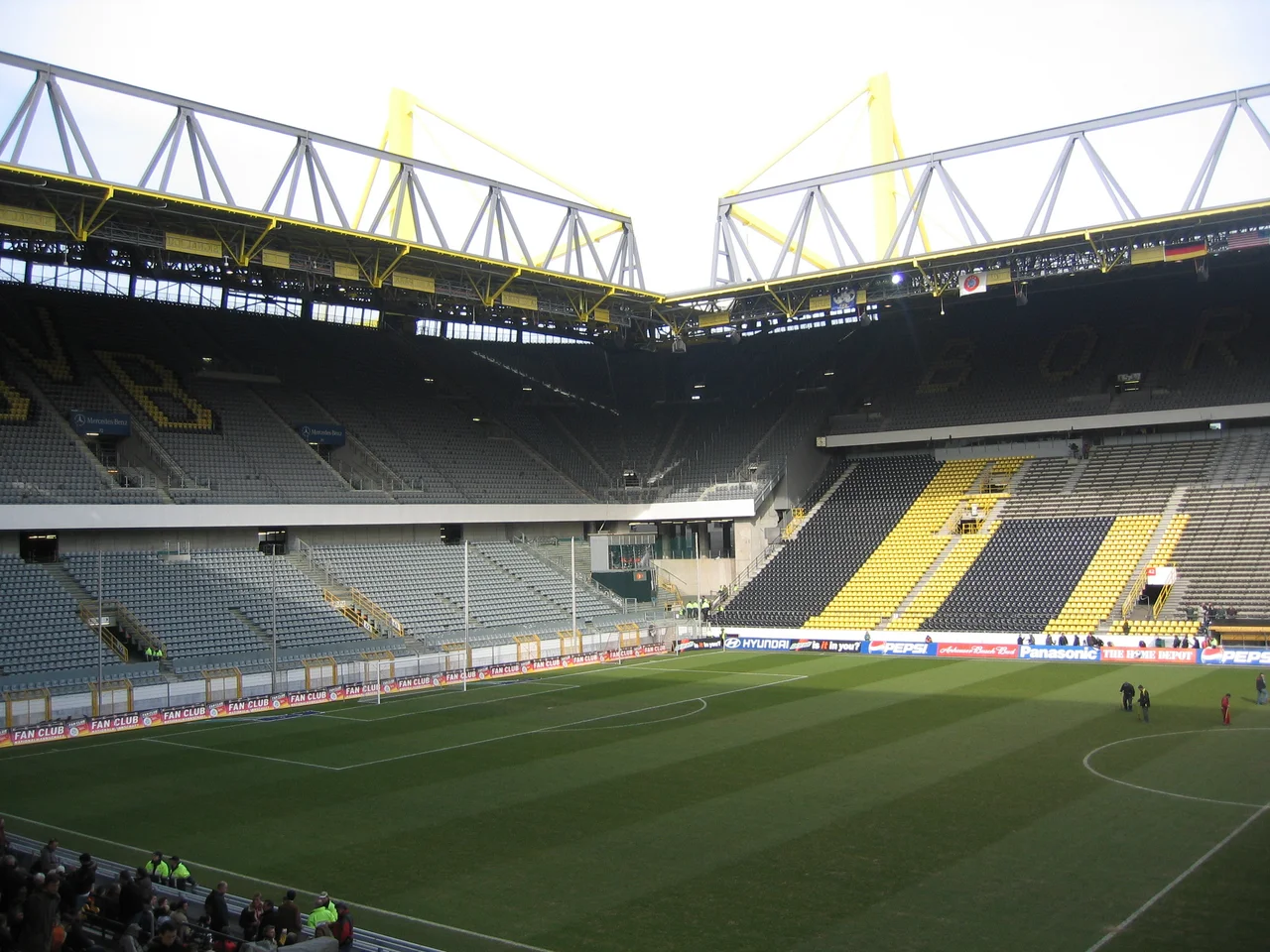

Westfalenstadion
Bastian Schweinsteiger spent his career at Bayern Munich, which means he played at the Westfalenstadion many times. When a journalist once asked whether he feared Dortmund's players more or Dortmund's manager more, he gave a third answer. It is the Yellow Wall that scares me the most, he said. The Yellow Wall is not a player and not a coach. It is a standing terrace. Specifically it is the Sudtribune, the south stand of the Westfalenstadion, 24,454 people deep, all in yellow, all on their feet for ninety minutes, the largest free-standing grandstand in European football and the most consistently terrifying piece of architecture in European sport.
The Numbers, Briefly
Westfalenstadion holds 81,365 people for Bundesliga matches. That is the largest league capacity of any stadium in Germany. For UEFA international fixtures, where standing is forbidden and the Sudtribune is re-equipped with seats, the figure drops to 65,829. The ground is the home of Borussia Dortmund, founded in 1909 by a group of young men in a back room of the Wildschutz pub on Borsigplatz. The stadium took its name from the Prussian province of Westphalia. For sponsorship reasons it has been called Signal Iduna Park since 1 December 2005; in UEFA competitions it appears in print as BVB Stadion Dortmund. Locals still mostly call it the Westfalenstadion. The deal with Signal Iduna runs to 2031 after a February 2022 extension.
Born for the 1974 World Cup
The first expansion plans for a major Dortmund football ground date to 1961, but the money to build them did not exist until 4 October 1971, when the city council voted to construct a stadium for the 1974 FIFA World Cup. Construction lasted three years. The new stadium opened with a maximum capacity of 54,000 and a roof weighing 3,000 tonnes. During the 1974 tournament it hosted three group-stage games and one final group game. One of those, on 14 June 1974, was the Group 2 match between Scotland and Zaire, won 2-0 by Scotland and historic for a different reason: it was the first time a sub-Saharan African nation had played in a FIFA World Cup. The stadium was upgraded several times across the 1990s and 2000s, including a major refurbishment for the 2006 World Cup. In June and July 2024 it hosted six UEFA Euro 2024 matches, including a round of sixteen and a semifinal.
Why The Wall is Yellow
The 1992 UEFA regulations forced most European clubs to convert standing terraces into all-seater stands. Dortmund did so on the north and lower side stands and dropped the capacity from 54,000 to 42,800. But the south end, the Sudtribune, held on. As the rules eased to allow protected standing terraces in domestic competition, Dortmund expanded the south stand into the largest single block of standing fans anywhere in European football: 24,454 people, one immense leaning slope of yellow shirts and yellow scarves and yellow flags, packed end-to-end into a single grandstand with under-soil heating beneath the pitch in front of it. Borussia Dortmund played a complete unbeaten home campaign in the 2012-13 UEFA Champions League partly on the strength of the noise that wall generated. It is also, formally, the largest free-standing grandstand in Europe. There is no equivalent.
Saved Twice
The stadium has been owned by Borussia Dortmund, by the city, by a real estate trust, and, for about two years, by the fugitive German financier Florian Homm. The club nearly lost everything in the financial collapse of 2002, when serious cashflow problems forced the sale of the ground to outside investors. By spring 2005 BVB could not pay the regular rates and stared down formal bankruptcy. The trust agreed to cut the interest rates, the club restructured its finances, and in 2006 Borussia Dortmund bought the stadium back with a loan from Morgan Stanley. The loan was paid off in full in 2008. The whole episode, which would have closed many clubs, made the eventual return to ownership one of the proudest stories the BVB membership tells about itself. The naming rights to Signal Iduna were a part of paying that debt down.
Match Day in the Kreuzviertel
There are big football grounds and there are big football experiences, and the two do not always overlap. Dortmund's does. Match-day supporters approach the stadium on foot through the Kreuzviertel, the bar-and-pub district whose Lindemannstrasse and Arneckestrasse alleys fill with traders selling Bratwurst and scarves. Many fans alight from the U42 light rail at Mollerbrucke station and walk the rest of the way through the district. On game days the special Stadion station opens, used only when Borussia plays, served by the U45 and U46 lines. Deutsche Bahn runs additional regional trains to the Dortmund Signal-Iduna-Park station from Hagen, Iserlohn, Ludenscheid, and the rest of the Ruhr. Match tickets are among the cheapest in Europe's big five leagues, which is why so many English fans now travel for matches. The club plans to install free wifi but to switch it off during play, so that 81,365 people put their phones away and watch the game.
From the Air
Westfalenstadion stands at 51.4925 degrees north, 7.4517 degrees east, about 2 km south of Dortmund city centre. From the air the stadium reads as a near-square bowl with four distinct yellow-tipped roof structures and a smaller companion ground, Stadion Rote Erde, immediately to the north. The Florianturm telecommunications mast and the Westfalenhallen exhibition centre lie just north across the autobahn. Dortmund Airport (EDLW / DTM) is 13 km east; Dusseldorf International (EDDL / DUS) is 60 km southwest. Recommended viewing altitude 1,000 to 2,500 metres; the stadium is unmistakable on a clear day.
Nearby Stories
- Moltkeviertel 3 km away
- Nordkirchen Castle 6.1 km away
- Lembeck Castle 7.4 km away
- Baumberg 11 km away
- Liesborn Abbey 13 km away
- Arnsberg Forest Nature Park 18 km away
- Operation Chastise 21 km away
- Dillenburg 49 km away