
Dillenburg
Listen for the Dutch first. Walk through Dillenburg on the right Saturday and you'll hear them - tour groups, royal delegations, schoolchildren on field trips from Breda or Utrecht, climbing the Schlossberg to stand on the stones where their country began. In 1533, a baby named William was born here in a castle that no longer exists. He grew up to be William the Silent, Prince of Orange, the man who organised the Dutch revolt against Habsburg Spain and laid the foundation of the modern Netherlands. The castle is gone, burned to its casemates in the Seven Years' War. The connection is not. In November 2017 the town officially extended its name to Oranienstadt Dillenburg - Orange-City Dillenburg - to make it impossible to forget.
A Castle on a Hill
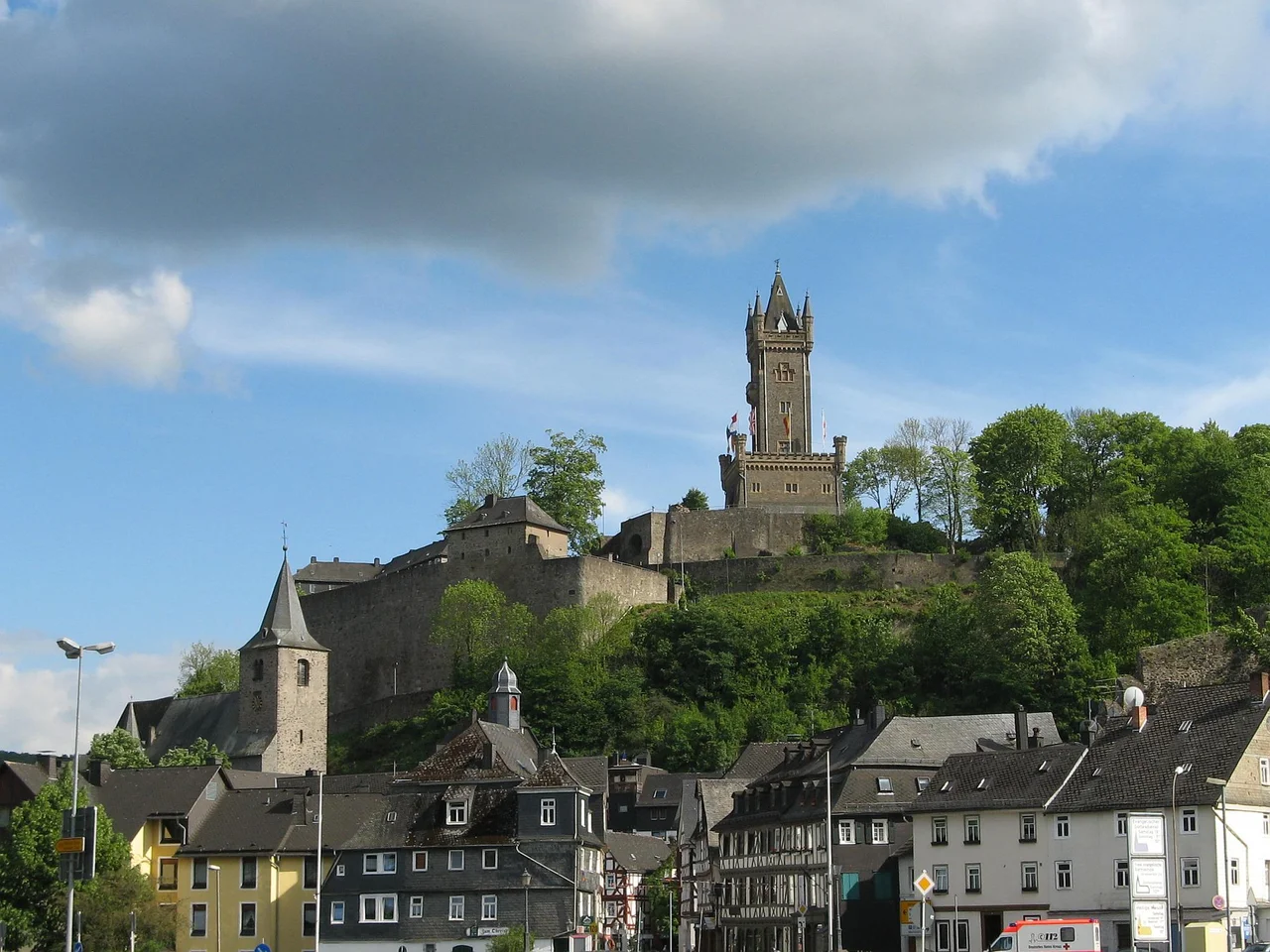
Dillenburg lies in the narrow valley of the river Dill on the eastern edge of the Westerwald, where the Dietzholze flows into the Dill. The town is first mentioned in a document of 1254. Late in the thirteenth or early in the fourteenth century the Counts of Nassau threw up a wooden castle on the dominating peak now known as the Schlossberg. That first castle vanished in the Dernbacher Feud, leaving no surviving picture, but it had already become the ancestral seat of the Orange branch of the House of Nassau by the time the line started producing world-historical descendants. The replacement stone Schloss survived through the early modern period, growing more elaborate with each generation, until 1760 - when, in the Seven Years' War, French troops destroyed it. The remains were carted off to build a street: Wilhelmstrasse, named for the son the castle had cradled.
From Exile, a Revolt
William the Silent grew up in Dillenburg, married into the upper Habsburg aristocracy, and was for a time one of the wealthiest landholders in the Spanish Netherlands. When Philip II's drive to suppress Protestantism in the Low Countries turned violent in the 1560s, William broke with him and, from his ancestral home in Dillenburg, organised the resistance that would become the Dutch Revolt. The years 1567 to 1572 found him here for stretches at a time, raising armies in Germany, writing letters across northern Europe, building a coalition. The Eighty Years' War he started would not end until 1648 - sixty-four years after his own assassination in Delft in 1584. Dutch royal delegations still pay regular visits to the town. It is in some sense where they began. The town's twin cities include Breda in the Netherlands, Diest in Belgium, and Orange in France - the three other anchors of the same family story.
The Wilhelmsturm
There is no castle on the Schlossberg today, but there is a tower. The Wilhelmsturm was raised between 1872 and 1875 as a memorial to William, and it is now the town's defining silhouette - a neo-Gothic stone column with a balcony view that, on a clear day, takes in the whole Dill valley and the Westerwald beyond. Inside it sits the Oranien-Nassau-Museum, an austere little institution covering the family and its global descendants. Below the tower, the casemates of the destroyed castle survive as one of the largest defensive works in Europe. Parts of them have been excavated and opened to visitors. You can walk through low stone corridors where seventeenth-century gunners once waited out sieges, and emerge into daylight on the Schlossberg with the town spread out below you.
Iron, Forestry, and a Forgotten Junction
Dillenburg was more than a Nassau memorial site. In 1797 one of the earliest European schools of forestry, founded by Georg Ludwig Hartig at Hungen a decade before, moved to Dillenburg. It taught here for eight years - until 1805, when Napoleon dissolved the Principality of Orange-Nassau and Hartig lost his post. Iron ore found along the Lahn, Dill, and Sieg made Dillenburg a nineteenth-century rail and metalworking centre, the junction where the Dill line meets the Heller Valley Railway from Betzdorf. In the Second World War the Allies bombed Dillenburg's marshalling yard repeatedly, and the suburb of Niederscheld - where the Adolfshutte was making parts for the V-2 rocket - suffered comparatively heavy damage. The last blast furnace in Oberscheld shut down in 1968. The Schlossberg has been tunnelled under since 2007 by the B277 bypass, one of Germany's biggest tunnel projects, freeing the timber-framed Old Town from through traffic. Cherry market in June; jazz weekend in summer; stallion parade at the state stud farm in autumn. The Dutch keep coming.
From the Air
Dillenburg sits at 50.73N, 8.28E in the narrow valley of the river Dill in Hesse, on the eastern edge of the Westerwald and the southern edge of the Rothaargebirge. From cruise altitude, look for the Wilhelmsturm tower atop the prominent Schlossberg knob in the centre of town, the Dill river curling around its base. Frankfurt (EDDF) is 75 km south; Cologne-Bonn (EDDK) is 100 km west-northwest. The A45 autobahn passes just east of the town. Best viewed from the west, where the Schlossberg and tower silhouette against the rising hills.
Nearby Stories
- Stadtallendorf 21 km away
- Bilstein Castle (Lennestadt) 22 km away
- Battle of Kircheib 22 km away
- Baumwollspinnerei Ermen & Engels 23 km away
- Edersee Dam 30 km away
- Zwingenberg Castle 116 km away
- Basilica of Saint-Pierre-aux-Nonnains 186 km away
- Marmoutier Abbey 206 km away