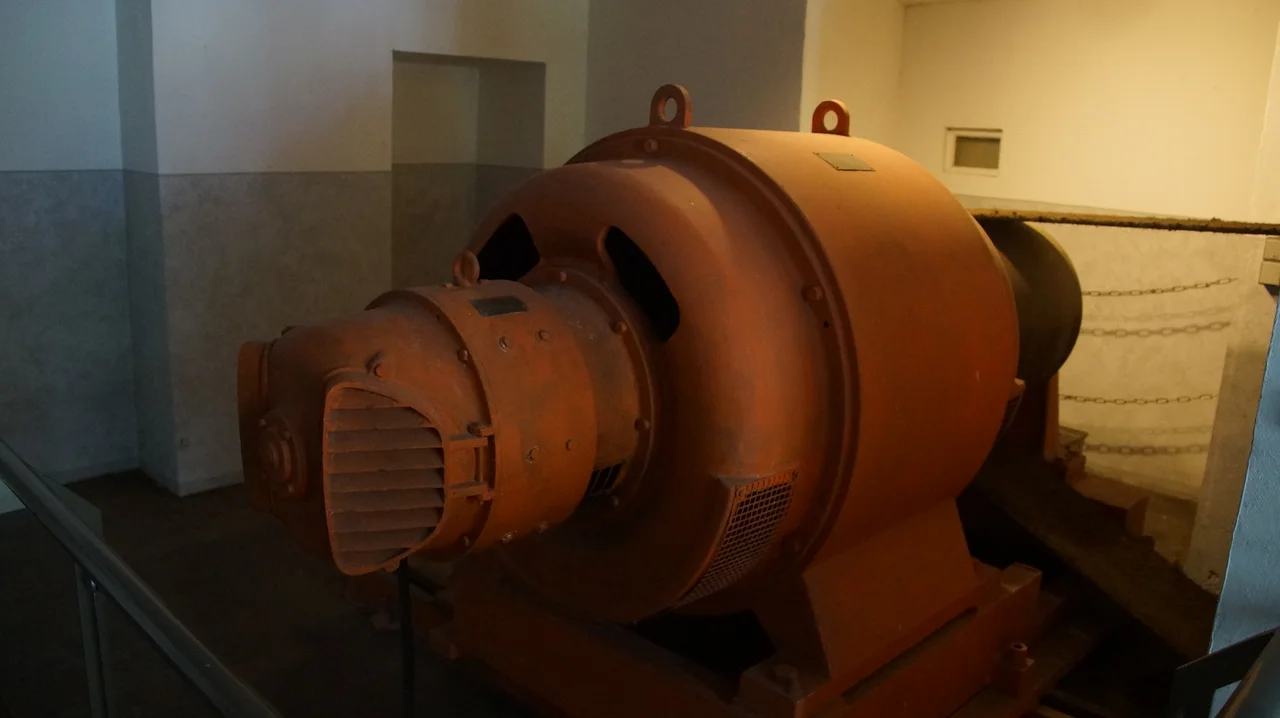

Baumwollspinnerei Ermen & Engels
Friedrich Engels - the Friedrich Engels, the one who would write The Condition of the Working Class in England with Karl Marx in his ear - learned about factories from his father, in his father's factory, on the banks of a small river in the Bergisches hills. The Baumwollspinnerei Ermen & Engels at Engelskirchen was not a place Engels set out to critique. It was the family firm. The waterwheel turning on the Agger, the leather belts whirring on the lineshafts, the looms doubling cotton thread for the Manchester export trade - this was where the most famous critic of nineteenth-century capitalism grew up understanding exactly how nineteenth-century capitalism worked.
The Manchester Connection
In 1837, two manufacturers from the Wuppertal valley travelled together to Manchester: Peter Albertus Ermen and Friedrich Engels senior, father of the more famous Friedrich. England's cotton mills had been doing for half a century what German mills were only beginning to do, and the two men came home with a plan. On 1 August 1838 they formally launched Ermen & Engels, a partnership designed to spin and double sewing cotton on both sides of the Channel. The firm needed a mill site with water power and cheap land, and in Engelskirchen - a village midway between Cologne and Olpe - Engels senior had already bought the Schnabel'sches Hammerwerk, an old iron-working hammer mill with rights to a twenty-foot waterfall on the river Agger. The young Friedrich, sent to Manchester in his late teens to learn the trade at the firm's English plant, watched the smoke of Salford and Ancoats from inside the family business.
Pietists in a Mill Town
The Engels were Calvinist - severely so, in the Reformed tradition of the lower Rhine. They believed in predestination and in hard work as evidence of grace, and the founder Johann Caspar Engels had built the family fortune in Barmen by realising the lime-free Wupper water was perfect for bleaching linen. By the third generation the family ran lace and ribbon factories, sat on town councils, and built churches; they were paternalistic employers, providing houses, schools, even a grain cooperative for their Barmen workers. They also saw, without apparent contradiction, that their employees lived in poverty while they themselves grew rich. Poverty, on a Calvinist reading, was simply the destiny of those it befell. The young Friedrich, raised inside this worldview, came to see it from outside. The Condition of the Working Class in England - drafted between September 1844 and March 1845 - was the result.
Power, Belts, and Lineshafts
Production at Engelskirchen began in 1844. Water drove a wheel; the wheel drove a lineshaft running the length of the mill; leather belts slapped down from the shaft to each spinning machine on the floor below. By 1909, the firm had replaced the wheel with hydroelectric turbines generating 640 horsepower. In 1924, mains electricity from the Elektrizitatswerk Engelskirchen reached the factory floor, transmitted from a steam plant at Dieringhausen and absorbed in 1935 into RWE, the giant utility that still powers the Rhineland. The mill ran on each new technology in turn, never quite getting ahead of the curve and never falling far behind. Spinning cotton was still profitable here in the 1960s. By the 1970s textile work had shifted to Asia, and in 1979 Engelskirchen closed.
The Museum That Remained
After closure the land was sold and the usual demolition began. Before it could finish, the surviving buildings were listed as Denkmalschutz, protected industrial monuments, and between 1993 and 1996 they were reconfigured for a second life. The site is now part of the LVR-Industriemuseum, the Rhineland's network of industrial-heritage museums, devoted in this case to electricity, to the history of the mill itself, and - inevitably - to the worker who became its most famous historian. Visitors can walk past the same waterwheel pit on the Agger that turned in Friedrich's youth, look at the lineshafts that drove the spindles, and stand inside a building that ran for 135 years on the labour of people whose lives the founder's son helped the world to see. The factory ended its working life and became, in the end, a place to think.
From the Air
Engelskirchen lies at 50.98N, 7.41E in the Bergisches Land east of Cologne, in the narrow valley of the Agger river. From cruise altitude, look for the A4 autobahn corridor running east from Cologne toward Olpe; the mill is in the river-valley town a few kilometres south of the A4 just before the autobahn enters the Aggertal tunnel. Cologne-Bonn (EDDK) is 30 km west; Dortmund (EDLW) is 60 km north. The Agger valley appears as a winding wooded cleft amid the rolling hills of the Oberbergischer Kreis.
Nearby Stories
- Limburg-Hohenlimburg 4 km away
- Cologne Lowland 9.6 km away
- F.L.Y. 11 km away
- Museum Folkwang 13 km away
- Battle of Kircheib 14 km away
- Dillenburg 16 km away
- Arnsberg Forest Nature Park 20 km away
- Warsteiner 44 km away