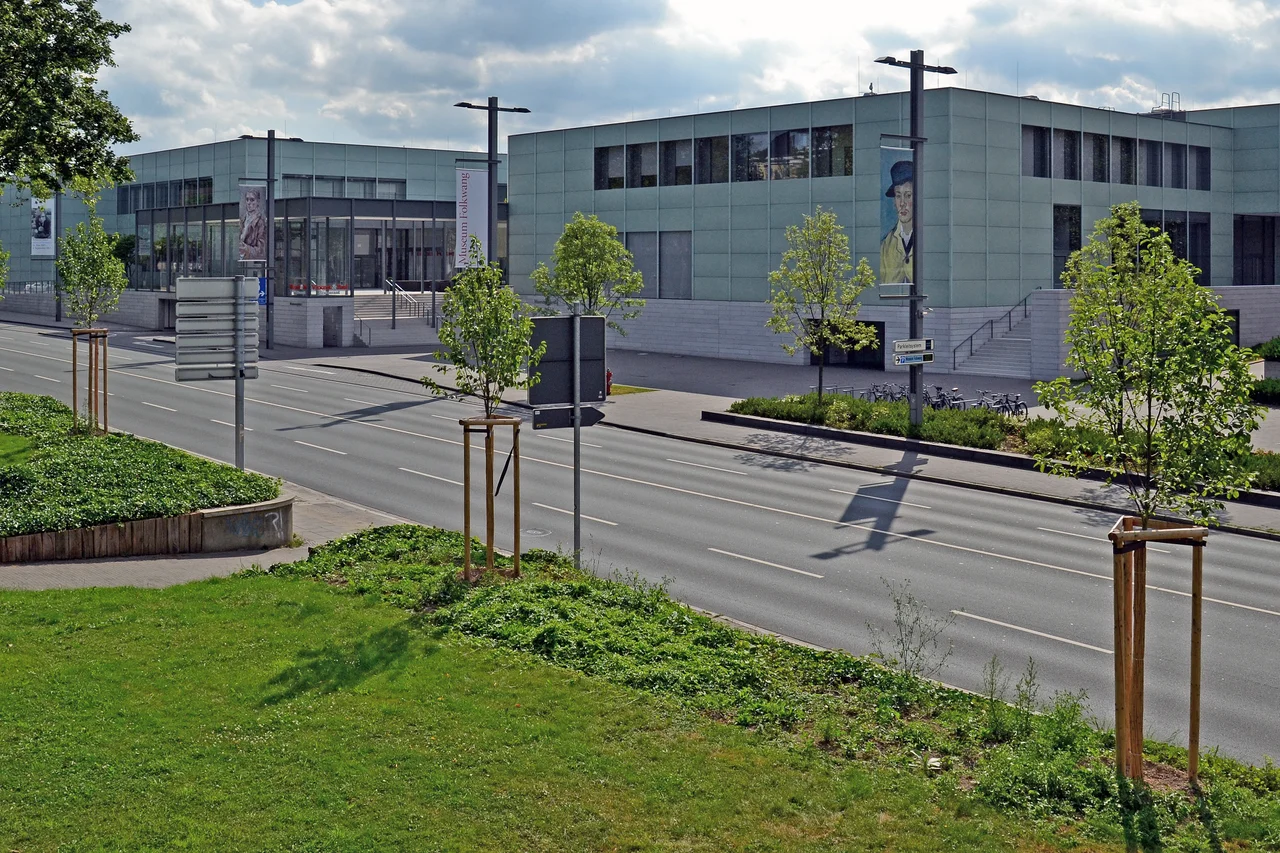

Museum Folkwang
In 1932 the Harvard curator Paul J. Sachs - the man who had effectively invented the museum-studies profession in America - visited Essen and called the Museum Folkwang the most beautiful museum in the world. Five years later, Joseph Goebbels's commission for the purging of so-called degenerate art removed more than twelve hundred works from its walls: Cezannes, Matisses, Munchs, Braques, Derains, de Chiricos. Roughly five thousand of the seventeen thousand pieces stripped that year from German museums were later burned. The Folkwang never tried to recover them. The seizures, the institution acknowledges, had been technically legal under German law.
The Name and the Patron
Folkvangr is the meadow of the dead in Norse mythology - the afterlife field presided over by the goddess Freyja, where half of those slain in battle go (the other half going to Odin's Valhalla). Karl Ernst Osthaus, a banker's son with an inheritance and a passion for new art, founded the original Folkwang Museum in 1902 in Hagen, a smaller town twenty kilometres east of Essen. He bought Cezanne when most Germans had not yet heard the name. He bought Van Gogh, Gauguin, Matisse. He commissioned Henry van de Velde to design the interiors. When Osthaus died in 1921, his collection was at risk of dispersal. Essen - flush with Ruhr money and ambitious for cultural standing - moved fast. In 1922 the city merged its own Essener Kunstmuseum (founded 1906) with Osthaus's collection and brought the combined institution west. The Folkwang has been an Essen museum ever since.
The Most Beautiful Museum
Through the 1920s and into the early 1930s the Museum Folkwang became one of the leading collections of modern art in the world. The director Ernst Gosebruch and his curators bought aggressively and well; the museum was where Germany's most ambitious patrons of new painting went to see what was happening in Paris. Paul Sachs's 1932 praise was a measured judgement from someone who knew the field. Within months, the political ground was about to give way. The National Socialists came to power in January 1933. By 1937 Goebbels had appointed Adolf Ziegler - a painter best known for academic nudes - to lead the commission that would purge German state museums of abstract, cubist, expressionist, surrealist, and impressionist art.
Twelve Hundred Works
Over twelve hundred pieces were taken from the Museum Folkwang. The names read like a roll call of the artists who had defined the early twentieth century: Cezanne, Matisse, Munch, Braque, Derain, de Chirico, Henri-Edmond Cross. Across all German state collections roughly seventeen thousand works were confiscated. The Nazi regime first organised a touring exhibition of degenerate art, which - in a bitter irony - drew enormous and largely curious crowds. It then began selling the confiscated works abroad to raise foreign currency, and many of the pieces ended up in private and museum collections in the United States, Switzerland, and Britain. Of the inventory deemed unsaleable, approximately five thousand works were burned. The Folkwang and the other German museums that had been raided have generally not sought restitution. The works were government property at the time and the government, under the laws then in force, had the legal right to dispose of them. The legal cleanliness of the catastrophe does not soften it.
The Photography Collection
The Folkwang has another distinction that less famous than its painting catastrophe. In 1929 it hosted Fotografie der Gegenwart - Photography of the Present - one of the seminal exhibitions in the history of the medium, gathering the leading photographers of Germany, Austria, and France in the years when photography was first taking itself seriously as an art form. The museum established photography as an independent collecting department in 1978, and the collection now numbers over fifty thousand prints. The Folkwang holds the copyrights of Germaine Krull, Helmar Lerski, Walter Peterhans, and Otto Steinert - four photographers whose work shaped how the twentieth century saw itself. The Alfried Krupp von Bohlen und Halbach Foundation has funded fellowships in contemporary German photography in cooperation with the Folkwang since 1982. The museum also stewards the Deutsche Plakat Museum, the German poster museum, with around 340,000 posters covering politics, commerce, and culture.
The Chipperfield Building
In March 2007 the British architect David Chipperfield won an international competition - over proposals from David Adjaye, Volker Staab, and Zaha Hadid - to design a new wing for the Museum Folkwang. The 16,000-square-metre extension opened in January 2010, the year Essen and the wider Ruhr Area held the title of European Capital of Culture as Ruhr.2010. Chipperfield's addition is austere, glass-walled, organised around interior courtyards - a quiet building that lets the collection do the talking. The galleries hold what remains of Osthaus's original vision and the substantial postwar rebuilding of the collection: nineteenth- and twentieth-century European painting, modern art, prints and drawings, the photography collection, the posters, ancient and non-European holdings. The Folkwang Museum Association, founded in 1922, is co-owner of the collections with the city of Essen - an unusual arrangement that gives a civic membership association formal standing in the museum's stewardship. Around four hundred members and corporate patrons keep it going.
From the Air
Museum Folkwang stands at 51.442 N, 7.004 E in central Essen, on the southern edge of the Stadtgarten park and a short walk south of the main railway station. From altitude the David Chipperfield extension, opened in 2010, is recognisable for its low rectilinear glass-and-stone volumes set among the older brick city fabric; the green of the Stadtgarten immediately north is a useful landmark. Nearest airports: Essen-Mulheim (EDLE) 7 km west, Dusseldorf International (EDDL/DUS) 30 km southwest. The Zollverein World Heritage coal-mine complex, 5 km northeast, is a major regional landmark. Best viewed at 1500-2500 ft AGL.
Nearby Stories
- Zons 3.5 km away
- Erkelenz 8.1 km away
- Borussia Dortmund team bus bombing 9.3 km away
- Raesfeld Castle 9.5 km away
- Moyland Castle 11 km away
- Nordkirchen Castle 12 km away
- Venlo 13 km away
- Baumwollspinnerei Ermen & Engels 19 km away