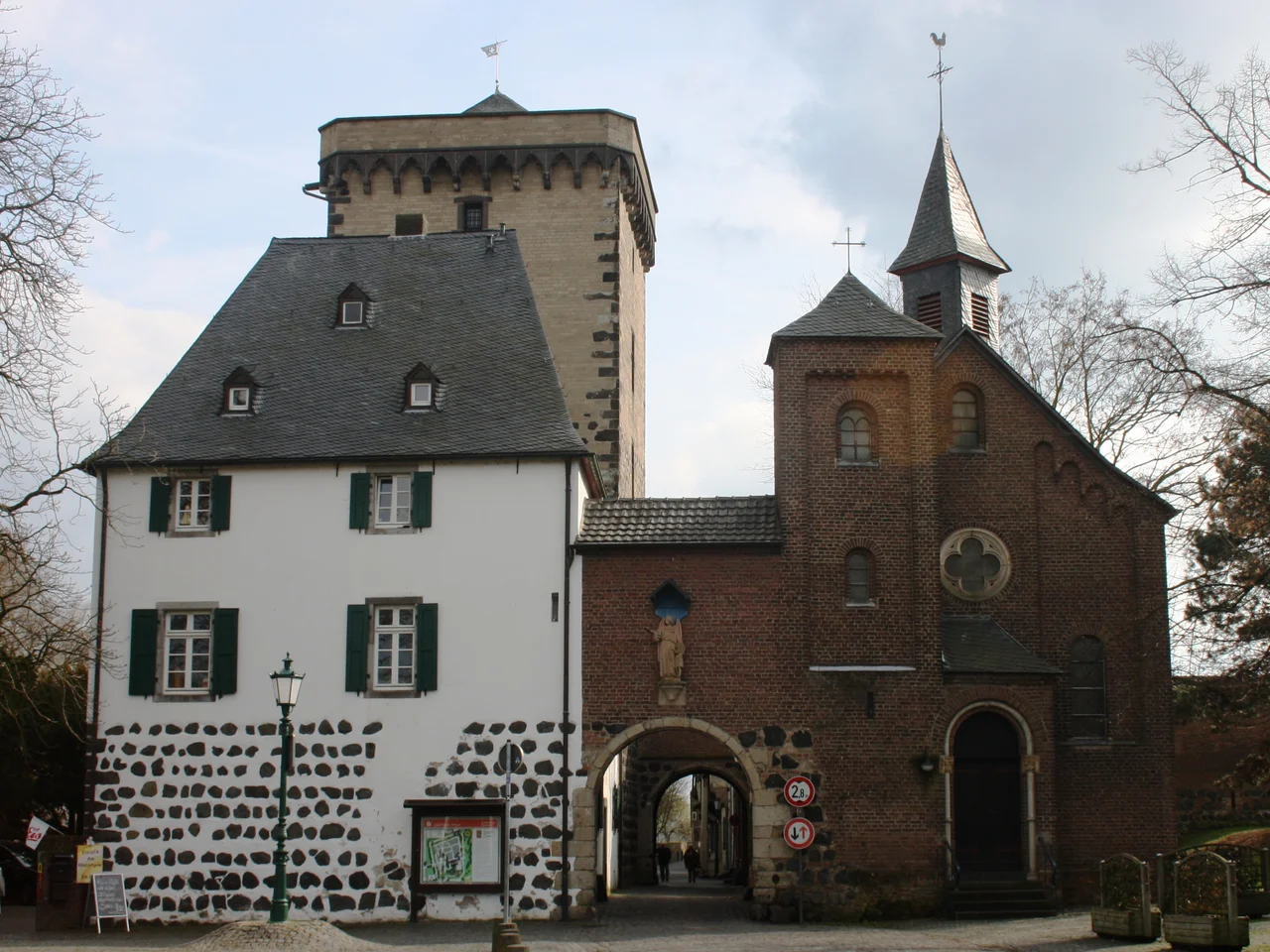

Zons
In 1372, the Archbishop of Cologne moved his Rhine toll station upriver from Neuss to a small village called Zons, walled it in with basalt stone, drew a wide moat around it, and gave the place town privileges the following year. The idea was simple: any cargo barge floating down the Lower Rhine between Cologne and Dusseldorf would now have to stop, hand over a fraction of its goods, and pay the archbishop's clerks. The toll is long gone, but the fortress is still there. All of it. The rectangular town wall, the corner towers, the south gate, the central castle, the church inside, the housing plots squeezed against the inner wall. Zons is what most medieval German towns were before the modern world arrived to flatten them. Then the modern world somehow forgot to flatten Zons.
Why Zons Survived
Most fortified medieval towns on the Rhine did not last in this condition because they kept growing. Successful trading towns burst their walls, rebuilt their gates as triumphal arches, then knocked everything down for nineteenth-century railway expansion. Zons did the opposite. It never had more than 124 building plots inside the walls. After three great fires in 1464, 1547, and 1620, after Thirty Years' War sieges and bombardments, after waves of plague that cut the population to 172 souls by 1648, the town simply stopped trying to be important. Its road access was poor. Newer trade routes bypassed it. By the seventeenth century, Zons had become economically irrelevant, and that irrelevance turned out to be the best possible preservation strategy. Nobody bothered to demolish what nobody needed to expand.
The Five Towers
The walls of Zons stretch about 300 meters north to south and 250 meters east to west, and at each corner stands a tower of a different shape, as if a medieval architect had been showing off. The northeast holds the rectangular Rheinturm, also called the Zollturm or Peters-Turm: the toll tower itself, where Rhine cargo was once counted. To the northwest stands the round Krotschenturm. The southwest holds the round Muhlenturm, originally a defensive tower but later capped with sails and converted into a working windmill, a transformation that became its second life. The southeast guards the Schlossturm. And rising inside the walls is the tallest of them all, the round Juddeturm: 35 meters high, with the roof beginning at 24 meters and a baroque cap adding another 11 meters above that.
Friedestrom Castle
At the heart of the fortress sits Friedestrom Castle, the original administrative and military center of the toll operation. Its name translates loosely as 'peace river,' an aspirational title for a building whose actual job was extracting money from anyone who tried to navigate the Rhine. The castle held the archbishop's clerks, the toll records, the guards, and the strongroom. In 1463 the entire town and parish of Zons were mortgaged to the Cologne cathedral chapter, which then ran the place like an absentee landlord for the next 331 years, until French revolutionary armies arrived in 1794 and abolished the whole arrangement. Today the castle's manor house and stables hold the district museum, while its west and south wings house an international dialect archive named for the Niederrhein poet Ludwig Soumagne.
The Killing Ground That Became a Theater
Between the outer South Gate and the inner castle lies a zwinger, a narrow enclosed corridor that in medieval defensive design was deliberately built as a death trap. Attackers who broke through the outer gate would find themselves penned into this killing ground, exposed to defenders firing down from the surrounding walls. Today the zwinger has been repurposed in the gentlest way imaginable: every summer it serves as an open-air theater for fairy-tale plays, mostly aimed at children. A space designed for medieval slaughter now hosts performances of Hansel and Gretel. Add to that the annual medieval tournament in September, the Schutzenfest marksmen's festival in July, and the daily flow of day-trippers who arrive on the car ferry from Dusseldorf-Urdenbach across the Rhine, and the old fortress feels less like a museum than like a small town that simply never stopped being a small town.
The Town Across the River
Originally, the parish of Zons included a village called Burgel, sited on what was then the same west bank of the Rhine. Then, in 1374, the Rhine itself moved. A shift in the river's course left Burgel stranded on the east bank, where it has remained ever since. Today Haus Burgel sits on the opposite shore from Zons, an old manor built on the ruins of a Roman settlement, technically part of Monheim am Rhein but historically a child of Zons that the river kidnapped. Standing on the Zons embankment looking east across the Rhine, you can see how arbitrary medieval geography really was. A century of flooding, one bad spring storm, and a parish boundary becomes an international curiosity.
From the Air
Zons sits at 51.12 north, 6.84 east, on the west bank of the Lower Rhine roughly halfway between Cologne (20 km south) and Dusseldorf (20 km north). The nearest major airport is Dusseldorf International (EDDL), about 18 km northeast, with Cologne Bonn (EDDK) 30 km south. From the air, look for a small rectangular walled settlement directly on the river bank, with the round Juddeturm rising above the historic core. The Rhine ferry to Dusseldorf-Urdenbach crosses just north of the old town.
Nearby Stories
- F.L.Y. 1.7 km away
- Erkelenz 1.9 km away
- Hagen Open-air Museum 6.6 km away
- Baumwollspinnerei Ermen & Engels 9.2 km away
- Lordship of Broich 11 km away
- Battle of Kircheib 11 km away
- Venlo 12 km away
- Eilendorf (Aachen) 13 km away