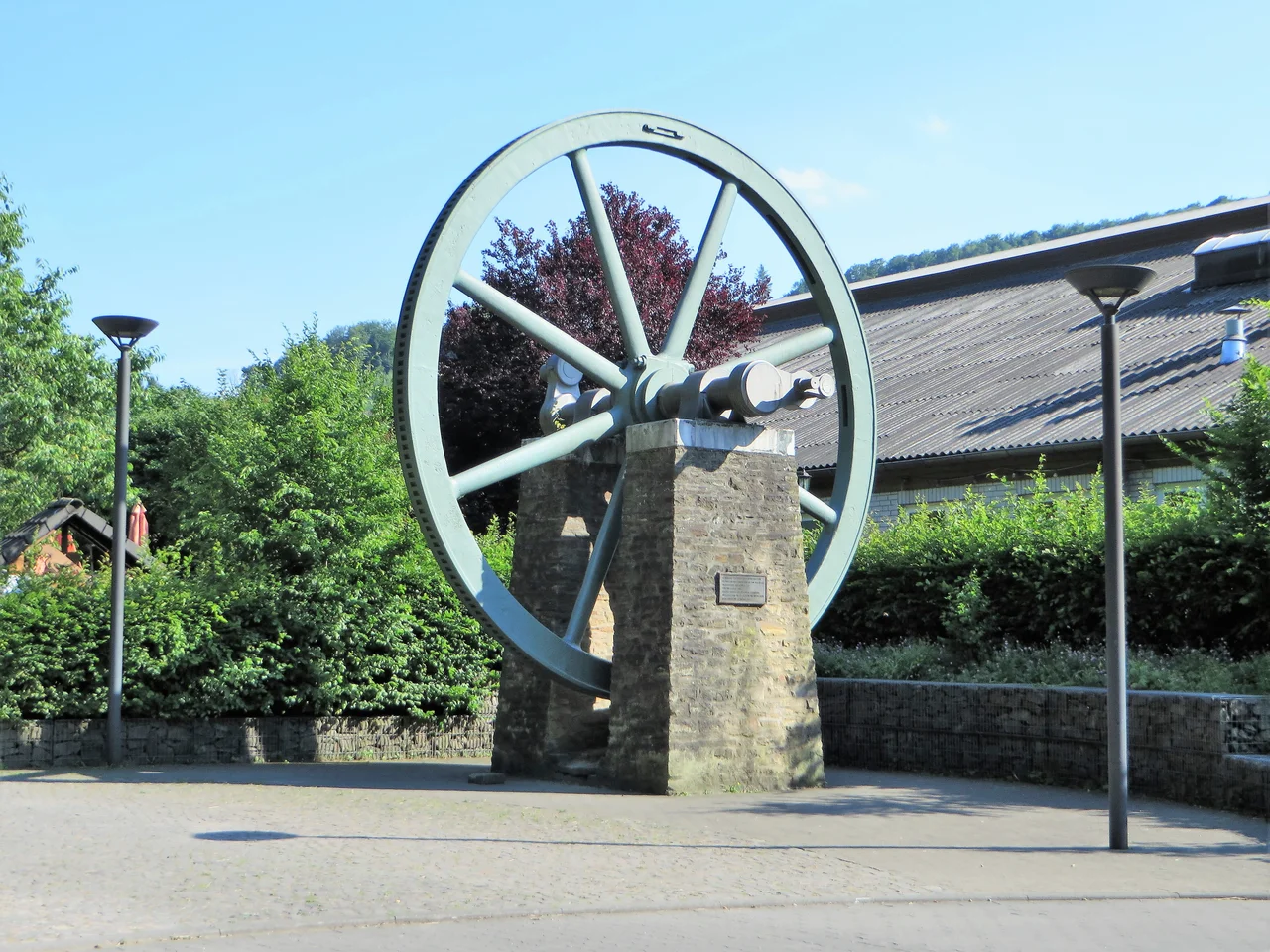

Hagen Open-air Museum
The Mäckingerbach valley is so narrow that you can throw a stone from one wooded slope to the other. That tightness is the whole point. Wind funnels down it, water races through it, and the steep wooded sides held the firewood and charcoal that 18th-century Westphalia ran on. In the 1920s, a building councilor named Wilhelm Claas walked this gully and saw what an open-air museum could be: not a peasant farm, not a romanticized village, but the moment the workshop became a factory. Half a century later, sixty rebuilt workshops fill the valley, and most of them are still working.
The Three Reasons This Valley
Westphalian industry in the 18th and 19th centuries needed three things to set up shop: wind, water, and wood. The Mäckingerbach has all three in compressed quantity. The steady downvalley breeze drove forges and brewing. The fast-falling stream powered hammers and grindstones. The forested ridges supplied the charcoal that smelted iron before coke arrived from the Ruhr. When the Landschaftsverband Westfalen-Lippe founded the museum in 1960, the planners didn't have to invent the location. The valley had already shown, two centuries earlier, exactly why a craftsman would choose this slot in the hills over flat ground anywhere else. Most open-air museums in Europe display rural life. The Hagen museum's quiet argument is that what mattered in Westphalia happened in workshops, not on farms.
Sixty Workshops, Twenty Still Burning
Forty-two hectares of valley floor hold the rebuilt buildings, most of them moved here piece by piece from across Westphalia. Ropewalks run straight for the length the ropemakers needed to twist hemp. Tanneries face downstream so the foul rinse water leaves first. A timber-framed Amtshaus relocated from Neunkirchen anchors a cluster of administrative buildings. Inside more than twenty of these workshops, craftspeople aren't reenacting. They are actually working: turning out paper, printing broadsides on a hand press, baking, brewing, milling grain, smithing iron, tanning leather, and making rope. Visitors can sometimes step in and do part of the job themselves. The museum opens in March or April and closes for the winter in October, the same seasonal rhythm the workshops would have followed when the stream froze or thinned out.
The Triphammer
The valley's signature sound is the triphammer. When the waterwheel engages, a cam lifts a heavy iron head and lets it fall against an anvil, pounding hot iron at a tempo no human arm can sustain. The Hagen triphammer is set up for making scythes, the long curved blades that mowed European hay until tractors arrived. The smith feeds glowing iron between hammer and anvil and works it through a process called peening: the blade is stretched and thinned along its cutting edge until it takes a sharp, springy temper. The noise is concussive enough that the building is sometimes called the loud workshop. It is also the workshop that explains, in twenty seconds, why proto-industry concentrated along streams. A human striker could swing maybe sixty times a minute. The triphammer never tires, never misses, and never needs to eat.
The Quiet Crafts
Not everything in the valley is loud. The paper mill is meditative. A skilled worker dips a wire mould into a vat of pulped fibre, lifts it level, drains it, and turns out a single damp sheet onto felt. Stacks of sheets go to a press, then to a drying loft. The brewery follows the same patient logic: malt, mash, boil, ferment, wait. The bakery turns out loaves on a schedule the temperature of the oven dictates. The tobacco manufactory, set up beside one of the timber-framed buildings, is where leaves were cut and rolled by hand. Each trade has its own pace, and walking the valley from one workshop to the next is partly a tour of how time worked before the clock ran the day.
How a Region Became Its Reputation
The museum's full name is a mouthful: LWL-Freilichtmuseum Hagen, Westfälisches Landesmuseum für Handwerk und Technik. The blunt translation is the Westphalian State Museum of Craft and Technology. The argument inside that name is that Westphalia's identity, the one that still drives the region's economy, was forged in valleys like this one before it scaled up into the iron and coal cities a few kilometres north. Wuppertal, Solingen, Hagen, and the Ruhr towns owe their character to people who first learned, in places like the Mäckingerbach, that water could do the work of arms. Walk out of the museum on a quiet day and the ridge above is just forest. Walk fifteen kilometres north and it is the industrial Ruhr. The valley is the hinge.
From the Air
The museum lies at 51.33°N, 7.48°E, tucked into a north-south wooded valley in the Selbecke neighbourhood of Hagen, on the southeastern fringe of the Ruhr. Best viewed from 2,500-3,500 ft AGL, slowly, because the valley is genuinely narrow and the buildings hide under the canopy. Dortmund Airport (EDLW) is 18 nm northwest; Siegerland (EDGS) is 35 nm south. The Ruhr's industrial belt is to the north; to the south the wooded Sauerland hills rise quickly.
Nearby Stories
- Moltkeviertel 3 km away
- Nordkirchen Castle 6.1 km away
- Lembeck Castle 7.4 km away
- Baumberg 11 km away
- Liesborn Abbey 13 km away
- Arnsberg Forest Nature Park 18 km away
- Operation Chastise 21 km away
- Dillenburg 49 km away