
Moltkeviertel
In 1908 the city of Essen bought half a square kilometre of empty land just southeast of its main railway station. The city councillor in charge had a single idea: plan the entire district at once, as one composition. Wide streets to ventilate the air. Parks within walking distance of every front door. Tennis courts already pencilled in on the master plan. Streets named after the great architects of European history - Schinkel, Semper, Olbrich - so that residents would think about who built their world. Robert Schmidt's plan opened the Moltkeviertel between 1908 and 1914, and a hundred and twelve years later it is still doing exactly what he designed it to do.
The Reform-Era City Planner
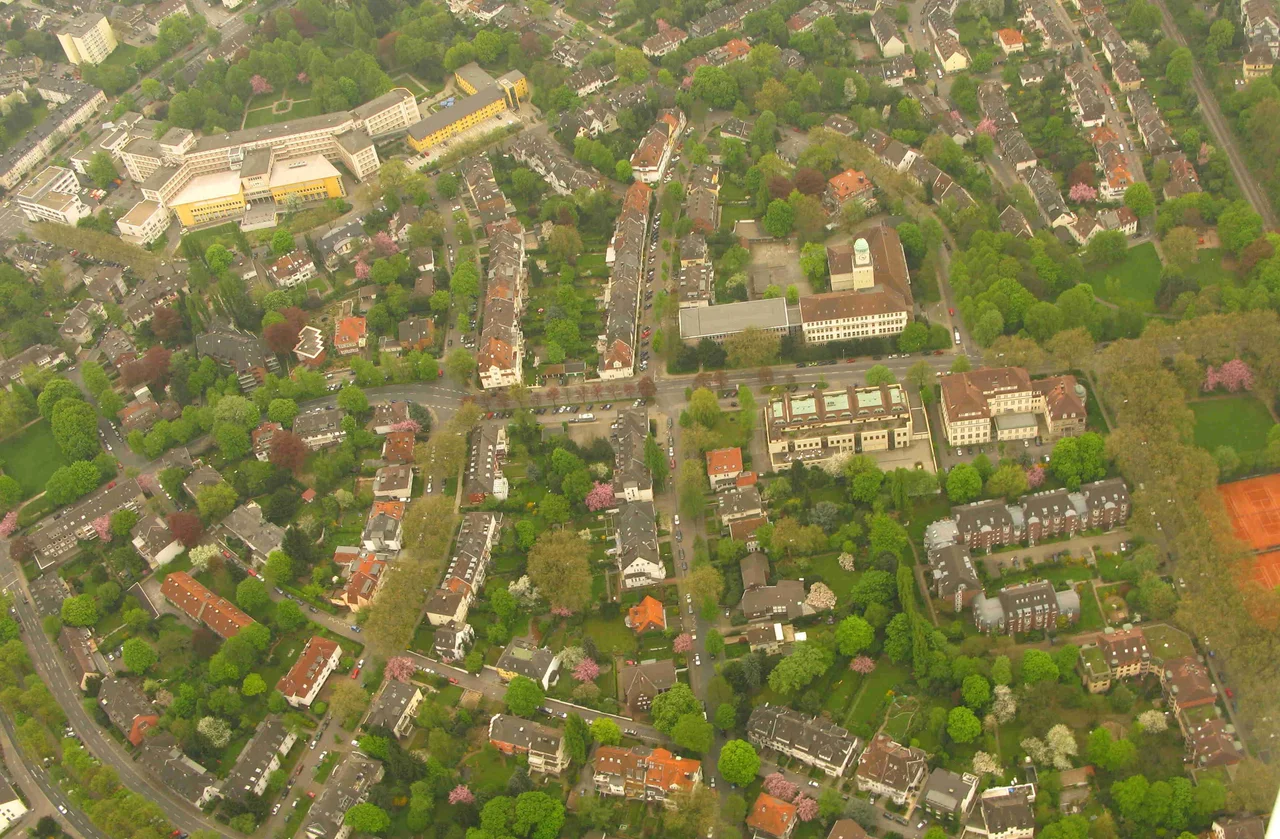
Robert Schmidt was a professor and a city councillor in turn-of-the-century Essen - the city's first dedicated planner in an era when most German cities still grew by accident. He read the British garden-city literature, the Viennese debates on Camillo Sitte's urbanism, the Berlin discussions on Reformarchitektur and the New Objectivity. He understood that Essen, exploding with Krupp money and Ruhr coal, was building cheap workers' tenements at terrifying speed and almost no high-quality housing for the prosperous middle class. So he proposed the opposite of speculative building: a single coherent quarter, planned whole, with broad green corridors built into the design from day one. The site bordered Kronprinzenstrasse, Ruhrallee, Töpferstrasse, Rellinghauserstrasse, and the railway running south to Werden. At its centre, on the corner of Moltkestrasse and what is now Robert-Schmidt-Strasse, the Royal Building College Essen rose between 1908 and 1911 - clock tower visible from across the district, training the next generation of builders.
Mansions With Margins
From 1908 the plots filled in. The architecture is what Germans call Reformarchitektur - a kind of disciplined reaction against ornamental historicism, simpler in mass and silhouette but still allowing significant individuality on each lot. Georg Metzendorf, Edmund Körner, and other prominent Essen architects worked on commission for industrialists and senior professionals. The houses were built to suit each owner's finances, ranging from terraced and semi-detached to outright mansions, but the overall texture is consistent. Front gardens are deep; the street trees were planted as the district was laid out and are now over a century old. At Moltkeplatz, the architect Otto Bartning built his first church in Germany in 1910, for the Old Lutheran parish. He returned in 1929 to build the nearby Auferstehungskirche - a building so influential it is now studied as one of the founding models of modern church architecture in central Europe.
An Architect's House for an Architect
On the corner of Moltkestrasse and Camillo-Sitte-Platz, Edmund Körner built his own house and studio in 1928 and 1929. The result is one of the more unusual buildings in the district - a residence and atelier that draws on both the Neues Bauen modernism then sweeping German architecture and on the industrial vocabulary of the nearby Zollverein coal mine, which Körner's colleagues were then designing in austere Bauhaus brick. Walk down Schinkelstrasse and you can still find a more curious echo of Essen's industrial identity: a hammer-and-pick miner's emblem carved over the entrance to one of the private houses, a reminder that this whole district was built on coal money from the seams running deep beneath the Ruhr.
Sculptures Under the Plane Trees
In 1981 the Essen gallerist Jochen Krüper and the sculpture curator Uwe Rüth - then director of the Glaskasten Sculpture Museum in Marl - began placing major works of contemporary sculpture on the Moltkeplatz green. The list of artists is unusual for a residential square: Heinz Breloh, Christa Feuerberg, Hannes Forster, Gloria Friedmann, Lutz Fritsch, Friedrich Gräsel, Ansgar Nierhoff, Ulrich Rückriem. The works sit under hundred-year-old plane trees, in plain sight of front doors, maintained by an association of local residents - Kunst am Moltkeplatz e.V. - who took over from Krüper after his death in 2002. In 2010 the residents added a parallel programme, junge Kunst am Moltkeplatz, rotating temporary work by young artists. The arrangement is rare: a residential community as the long-term steward of a permanent outdoor sculpture collection.
A District That Outlived Its Era
Robert Schmidt's quarter survived the bombing of Essen in 1945 better than most parts of the city, and unlike many German districts of similar age it was not redeveloped during the postwar boom. A preservation statute covering most of the area has been in force since 1983, defended by what the city itself describes as the quarter's traditionally self-confident residents. The Villa Koppers at Moltkeplatz 61, once the home of the coke-oven engineer Heinrich Koppers, now houses the International School Ruhr. The Royal Building College has been the Robert-Schmidt-Berufskolleg since 2000, training another generation. In 1925 work began on the Wiebe-Anlage, an enclosed public park ringed by the back gardens of the houses around it - the first park of its kind in Germany - and it too still functions. The Moltkeviertel was planned for around four thousand residents and three thousand workplaces. It has, more or less, been those things for over a century.
From the Air
The Moltkeviertel lies just over a kilometre southeast of Essen Hauptbahnhof, centred near 51.443 N, 7.026 E. From the air it appears as an unusually green and orderly grid wedged between the heavier urban fabric of Essen-Südostviertel and Essen-Huttrop, with mature tree canopies and the open green of Moltkeplatz visible in the centre. The Royal Building College clock tower and Otto Bartning's Auferstehungskirche are local landmarks. Nearest airport: Essen-Mülheim (EDLE) 8 km west, Düsseldorf International (EDDL/DUS) 35 km southwest. Best viewed at 1500-2500 ft AGL when low sun rakes across the Reformarchitektur villa roofs.
Nearby Stories
- Zons 3.5 km away
- Erkelenz 8.1 km away
- Borussia Dortmund team bus bombing 9.3 km away
- Raesfeld Castle 9.5 km away
- Moyland Castle 11 km away
- Nordkirchen Castle 12 km away
- Venlo 13 km away
- Baumwollspinnerei Ermen & Engels 19 km away