.jpg)
Moyland Castle
At the foot of the staircase that leads up to Moyland Castle's main door, a small bronze pug sits on the railing. On the opposite side, a wolf. The pug is Winston Churchill. The wolf is Voltaire. They are not the kind of statues one expects on a German country castle, and the choice is deliberate: this moated water castle, surrounded by black water and red brick towers in the Lower Rhine country near Kleve, has hosted both a Prussian king's philosopher and a British prime minister watching his army cross the Rhine. The pug stands at the lower end of the railing - small, stout, and quietly representing a man who, for a few days in March 1945, made Moyland the watchtower of an empire at war.
Mooiland
The name itself is a small joke from Dutch workmen. In 1307, a leaseholder named Jacob van den Eger brought a crew of Dutch laborers to drain the wetlands around a fortified farm in the Lower Rhine. They looked at the wet, flat, beautiful land they were standing in and called it Mooiland - beautiful country. The German tongue softened the diphthong and the name stuck as Moyland. The fortified farm grew into a square Gothic castle in the mid-fourteenth century, with three round towers and a fourth larger one that served as a dungeon, complete with - by the standards of the era - quite comfortable amenities: a well, a toilet, light niches, and a fireplace inside the third tower. The water around it never went away. It still defines the place.
Frederick and Voltaire's Truth Factory
In 1740 the Prussian King Frederick II - Frederick the Great - met the French philosopher Voltaire at Moyland during one of his many stays. The two men were already in a long correspondence about everything from poetry to politics, and they spent days at the castle dreaming up something they called a Truth Factory: a philosopher's academy, to be set up at Moyland itself, where reason and inquiry would do the slow work of grinding away at superstition. The academy never quite materialized. The friendship, famously, eventually soured. But the conversation happened in these rooms, and that is the moment the wolf on the staircase commemorates. Voltaire was selected to be ferocious in argument with the king, and the castle thought a wolf about right.
Churchill at the Rhine
Two centuries later, the war that ended European empires brought another statesman to Moyland. Field Marshal Bernard Montgomery took the castle as his headquarters during Operation Plunder, the British and Canadian crossing of the Rhine in late March 1945. Winston Churchill came to Moyland to observe the operation, accompanied by Field Marshal Alan Brooke and US General Eisenhower's deputies. He was, as the castle's history notes with quiet weight, one of the last people to see the intact, sumptuously furnished 200-year-old fortress before its contents vanished. After the Allies moved on, the building was stripped - looted and vandalized by passing Canadian soldiers - and its baroque interior was effectively destroyed. The pug on the staircase remembers Churchill standing here. The empty rooms it leads into remember what came after.
The Beuys Collection
For thirty years after the war, Moyland sat in slow decay. The roof leaked. A 1956 fire in the western roof truss made things worse. The owner, Gustav Adolf Steengracht von Moyland - who had served as state secretary to Hitler's foreign minister Joachim von Ribbentrop and had been tried for war crimes by the Americans before receiving amnesty in 1950 - could not raise the money to rebuild. What finally saved Moyland was a private art collection. Two brothers, Hans and Franz Joseph van der Grinten, had spent decades quietly buying up the work of one artist: Joseph Beuys, the felt-and-fat sculptor who had grown up in nearby Kleve. They needed a home for the collection. Moyland needed a future. The Castle Moyland Museum Foundation was formed in 1990, the buildings were restored, and in May 1997 the castle reopened as the world's largest single collection of Beuys's work - nearly 5,000 pieces, plus an archive of around 220,000 documents tracing his life and ideas.
The Park and the Sculptures
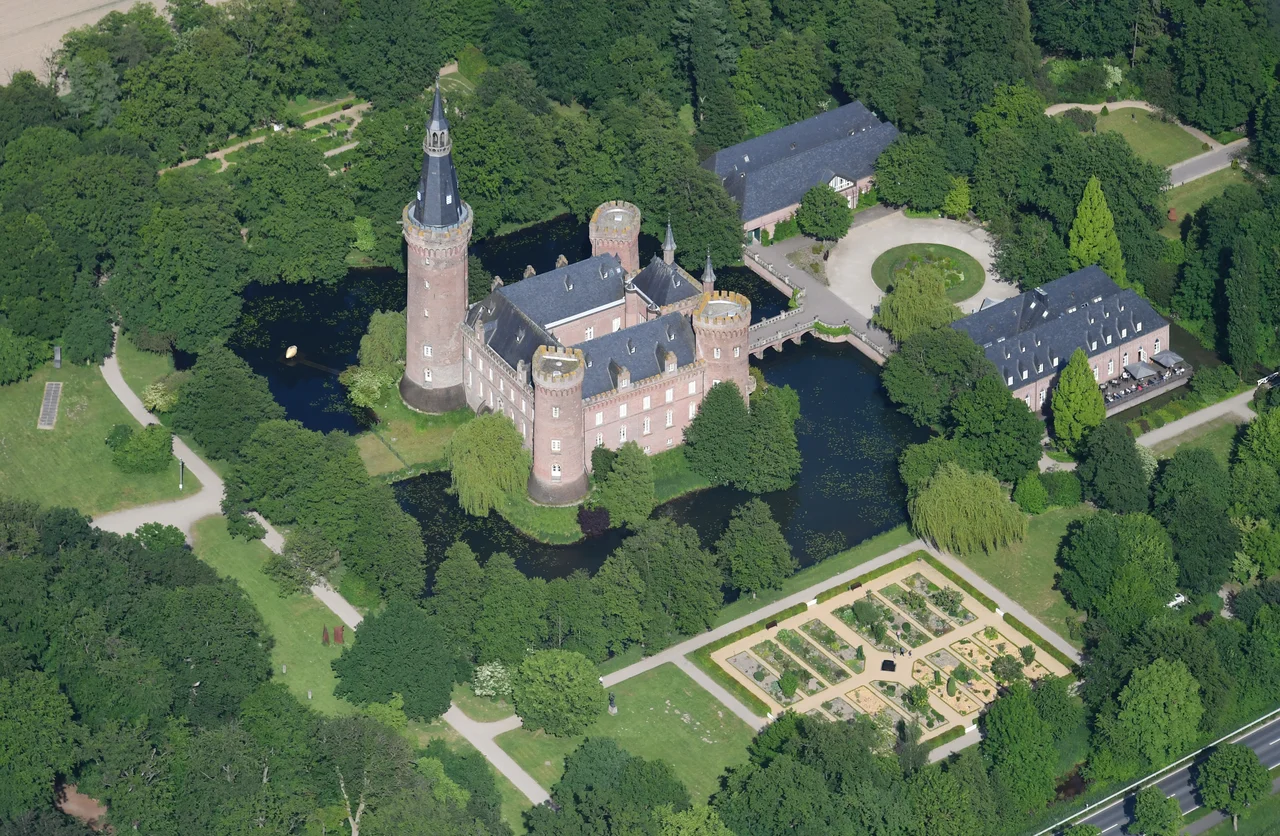
The grounds around Moyland make the castle work. Restored in the mid-1990s to reflect their late-nineteenth-century appearance, the park combines English landscape garden softness with the geometry of a baroque architectural garden, and it carries the marks of two centuries of design layered on top of each other. In 2004 it was added to the Strasse der Gartenkunst - the Road of Garden Art - a tourist route through the Rhine country's most significant gardens. Among the old oaks and avenue trees, sculptures from contemporary artists around the world keep company with the castle: Eduardo Chillida, Antoni Tapies, Heinz Mack, Gerhard Marcks, and others. The moated keep at the center, with its four corner towers and its 2008 polygonal lantern roof, looks like a child's drawing of a castle done in red brick and slate. The two lions at the top of the staircase are the older original figures. The wolf and the pug at the bottom are the more recent ones - the staircase's way of saying that history climbs up to the door from both directions.
From the Air
Moyland Castle stands at 51.76 N, 6.24 E in Bedburg-Hau, a village in the district of Kleve in Germany's Lower Rhine country, about 10 km southeast of Kleve itself. The Rhine flows past 6 km to the east. Nearest commercial airports are Weeze (EDLV) 25 km south and Dusseldorf (EDDL) 75 km southeast. Recommended viewing altitude 2,500-4,000 ft - low enough to pick out the moat ringing the red-brick keep, the four corner towers, and the layered geometry of the restored gardens. The flat Lower Rhine farmland makes the moated castle look like a brick island in green water.
Nearby Stories
- Hof te Dieren 4.8 km away
- Heesen Yachts 5.4 km away
- Landschaftspark Duisburg-Nord 7.4 km away
- Kleine Dommel 8.8 km away
- Raesfeld Castle 11 km away
- Grebbe Line 12 km away
- Haaksbergen 14 km away
- Venlo 15 km away