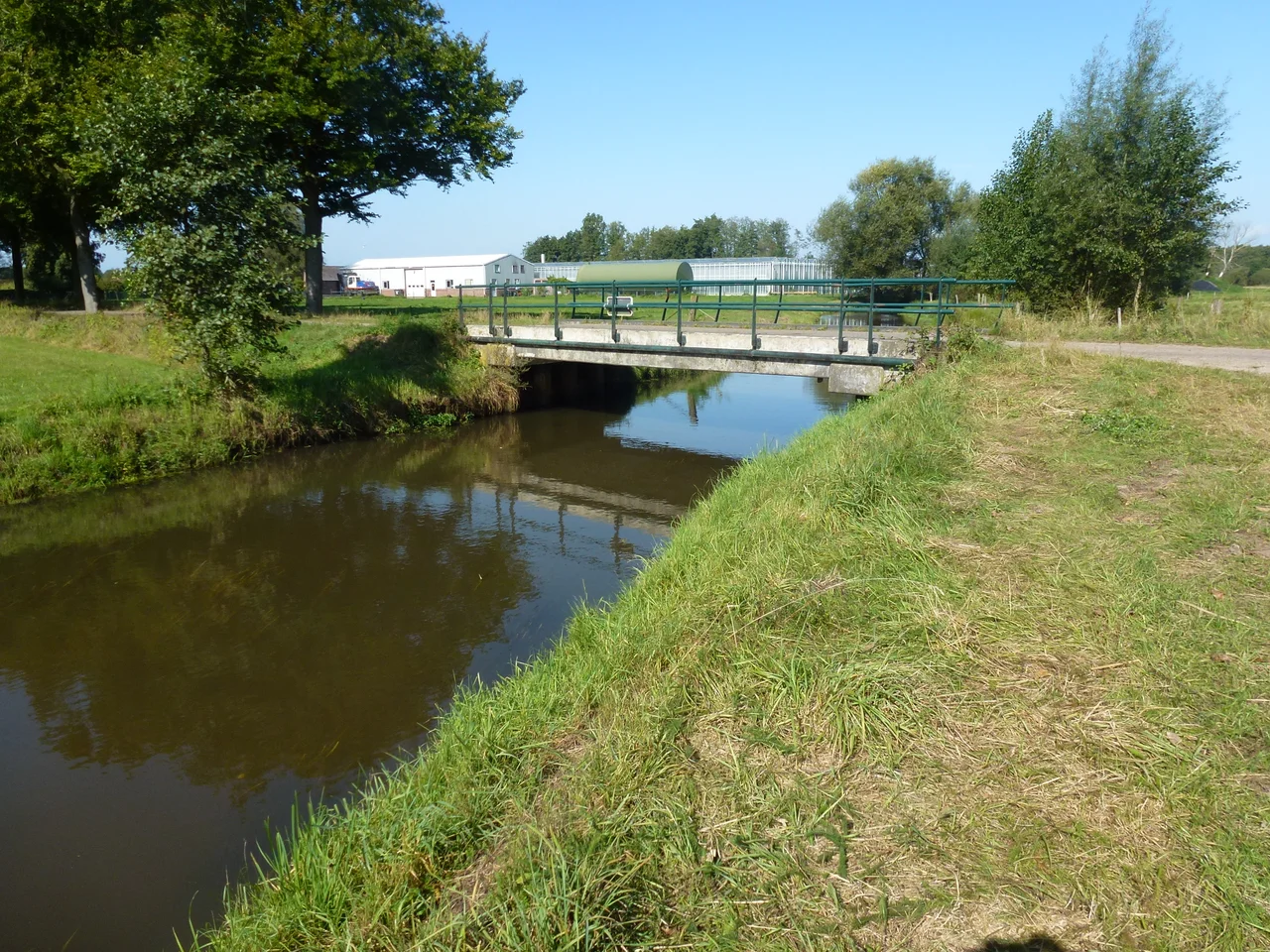

Kleine Dommel
Vincent van Gogh painted this little brook in 1884, when he was still working in dark Brabant tones and had not yet seen the sun of Provence. He set up his easel at the Watermill at Kollen, the dam pooling the Kleine Dommel into a still mirror, and produced a canvas that the Noordbrabants Museum bought in 2017 for three million euros. The Kleine Dommel is not big. You could ford it in the right shoes. But it carries Brabant's whole twentieth-century relationship with water, from confident industrial straightening to humble ecological undoing.
Three Watermills and a Painter
The Kleine Dommel rises in the south of North Brabant at the confluence of two smaller streams near Heeze Castle. It runs roughly north through Geldrop and on past Nuenen until it joins the Dommel proper west of Son. Along its short course, three old watermills still stand. The Geldrop Water Mill is recorded as far back as 1403 and is now wrapped inside a nineteenth-century factory building that houses the city's textile museum, the Weverijmuseum. The Watermill at Kollen, near the hamlet Eeneind, is the one Van Gogh painted. The Watermill at Opwetten, west of Nuenen, has the largest wheel in the Netherlands and Van Gogh painted it too. The mills always operated on the edge of their water supply. The Kleine Dommel never carried quite enough flow to run them reliably.
The Straightening of the Sixties
In the 1960s and 70s, Dutch hydraulic engineering was at peak confidence. The Kleine Dommel in Geldrop, like brooks across the Netherlands, was straightened to move water faster off the land. North of the village, a kilometer of original streambed was abandoned and replaced with a deeper, straighter channel cut east of the old course. The new bed carried more water but ran slower. The old meanders simply sat in the landscape, dry curves through the grass, a fossil river beside a working one. Meanwhile the surrounding heaths were drained and broken for agriculture, severing the slow hydrological cycle in which rainwater sinks into heathland and reappears, weeks later, as cool clean springwater in the valley below. The Kleine Dommel got faster. The land around it got drier.
Putting the Bends Back
The 1995 near-disaster in the Dutch river delta, when the great rivers nearly overtopped their dikes and a quarter of a million people were evacuated, prompted a national rethink. Quick drainage upstream, it turned out, only made the lower rivers more dangerous. In Geldrop in 1995 the old Kleine Dommel meanders were restored. Three kilometers of channel became four, the flow slowed by a third, the bed rose 60 centimeters, and the groundwater table climbed 40 with it. Most of the straight 1960s sections were left in place but blocked with low stone dams, so the meandering brook does the work most of the time and the straight bypass only opens when water gets dangerously high. In the 2000s the same work was done upstream at Rul, where a special sluice now diverts summer flow through the restored bends while still keeping the bypass available for winter floods.
A Valley That Floods on Purpose
Between Heeze Castle and the A67 motorway, the Kleine Dommel valley is about 3.6 kilometers long and only 400 to 500 meters wide, but it is deep enough that flooding it would not displace many people. So the Dutch waterboard built a dike along the southern side of the A67, rising about three and a half meters above ground level, with a top elevation of 21 meters above the Amsterdam Ordnance Datum. Where the brook crosses the dike, an automated sluice with two five-meter gates rises on its own when the water hits a threshold. The whole valley can now be filled with 1.5 million cubic meters of overflow water, protecting Geldrop downstream from a once-in-a-century flood. The engineers expect it will need to fill once every sixteen to twenty-five years. In March 2020, water rose high enough to worry the locals but not high enough to trigger the sluice.
Living Water Through Heath and Mill
Most of the valley between Heeze and the motorway lies within the Natura 2000 reserve Strabrechtse Heide and Beuven, a survivor of the heathlands that once stretched unbroken from Nuenen to the Peel. East of the brook lies the Goorse Zeggen, a wet woods of birch and alder, and the rare Brabant ecosystem of blauwgrasland, a wet meadow grassland of which only sixty hectares remain in the whole country. The Watermill at Kollen still grinds grain and presses oil. In 2015 a fish ladder was added to help bitterling, gudgeon, stone loach, river lamprey, and spined loach pass the dam. The valley Van Gogh walked through still feels like his canvases: dark willow, wet pasture, the silver glint of a brook that does not flow as fast as it used to, by design.
From the Air
The Kleine Dommel rises near Heeze (51.38 N, 5.55 E) and runs roughly north to its confluence with the Dommel near Son en Breugel. From altitude look for the contrast between the dark green of the Strabrechtse Heide reserve and the lighter agricultural land along the brook, and for the obvious east-west line of the A67 motorway with the water storage dike running along its southern edge. The brook flows through Geldrop and past Nuenen, the village where Van Gogh worked from 1883 to 1885. Nearest airport is Eindhoven (EHEH) about 8 km west, well within the controlled airspace around the city. Cruise altitude 2,000-3,500 feet gives the best view of the meander restoration work.
Nearby Stories
- Geertruidenberg Castle 4.8 km away
- Castle of Westerlo 7.6 km away
- Binnendieze 9.8 km away
- Hoogstraten Castle 9.9 km away
- Steyl 14 km away
- Kleve 17 km away
- Heinsberg-Lindern Railway 17 km away