
Steyl
In 1875, a German priest crossed the Meuse with a plan that sounded faintly ridiculous: he would found a worldwide Catholic missionary order in a Dutch riverside village best known for unloading marl and wine. Arnold Janssen had reasons to be quiet about his ambition. Back in the new German Empire, Otto von Bismarck's Kulturkampf was choking Catholic institutions out of existence, and Janssen needed a base on the safe side of the border. He bought a wine warehouse in Steyl. A century and a half later, the Society of the Divine Word he started there works in more than seventy countries, and the village that hosted his experiment has become something almost unique in the Netherlands: a kloosterdorp, a monastery village.
Where Wine Gave Way to Prayer
Before the monasteries arrived, Steyl was a port. Bargemen unloaded marl, coal, and wine for the Duchy of Jülich on the right bank of the Meuse, and the Moubis family grew rich on the trade. Their 18th-century mansion still stands, brick and stone proof that this little stretch of waterfront once paid for chandeliers. When river commerce faded in the 19th century, the Moubis estate became a real-estate opportunity. In 1876, German nuns from Münster bought the mansion. Around the same time, another order from Essen bought the family's wine warehouse. Within a generation the wharves had gone quiet and the chapel bells had taken over. Today only the ferry house remains as a hint of the old commercial life, and it serves beer and bitterballen rather than rolling barrels onto barges.
A Saint Made on Site
Arnold Janssen was not, by all accounts, an easy man. He was rigid, demanding, and possessed of a fundraising drive that left donors slightly winded. But he was also effective. From his foothold in Steyl he founded three congregations: the male missionaries of the Society of the Divine Word, the active Missionary Sisters Servants of the Holy Spirit (the Blue Sisters, for the color of their habits), and the contemplative Holy Spirit Adoration Sisters (the Pink Sisters, who maintain perpetual adoration of the Blessed Sacrament behind the grille of their chapel). All three motherhouses are still active. Janssen himself was canonized by Pope John Paul II on October 5, 2003, and his sarcophagus lies in the lower chapel of St. Michael's Monastery, where pilgrims still come to pray over the priest who built a global mission from a village few outsiders had heard of.
Five Sacred Hearts and a Botanical Garden
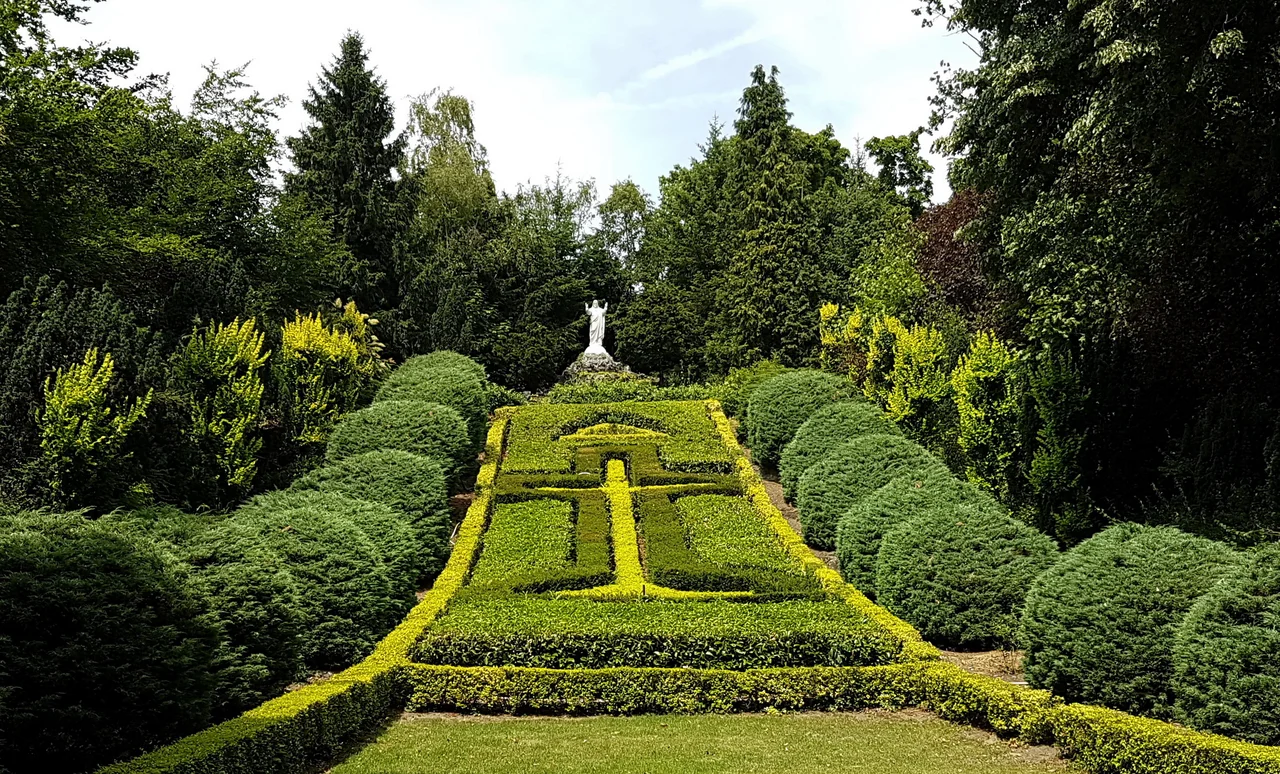
Walk between the monasteries and the strangeness of Steyl reveals itself. Each garden contains its own cemetery and its own version of devotional Europe: Lourdes grottoes, Stations of the Cross, Calvary groups, Marian shrines, busts of Arnold Janssen, and no fewer than five separate statues of the Sacred Heart. The gardens around St. Michael's are open to the public; the Sacred Heart Monastery requires permission; the Holy Ghost gardens are closed entirely. Slipped into all this religious landscape is something unexpected, a botanical garden called Jochumhof, named for an SVD biology teacher who used tropical plants to prepare future missionaries for the climates they would meet in the field. Volunteers tend it now, and the greenhouses still hold the same lesson they did a hundred years ago, that even a man bound for Papua New Guinea benefits from knowing his orchids.
The Museum of Faraway Things
Tucked into the print-shop building across the road from St. Michael's is the Missiemuseum Steyl, the oldest museum in Venlo and one of the strangest in Limburg. SVD missionaries began contributing to it in 1879, when the first objects arrived from China, and the layout has barely changed since the early 20th century. The collection is essentially a Victorian Wunderkammer that never updated itself: taxidermied polar bears and Amazonian birds, painstakingly pinned arthropods, and ethnographic artifacts from every country an SVD priest ever set foot in. Among the most affecting pieces are the clothes worn by two missionaries killed by spear thrusts during China's Boxer Rebellion at the turn of the 20th century. The bloodstains and the holes are still visible, a reminder that the global Catholic missionary project these monasteries launched was not abstract and was not safe.
When the River Comes Inside
Old Steyl sits in a curve of the Meuse, and the Meuse periodically remembers it. In both 1993 and 1995, the river burst its banks and flooded much of the old village. Photos from those weeks show monastery walls rising out of brown water and Pink Sisters carrying chairs upstairs. The 2004 designation as a beschermd dorpsgezicht, a protected village landscape, was partly a recognition that what Steyl preserved was unrepeatable: an intact 19th-century monastery colony hard against an unpredictable river. The ferry still runs across to Baarlo on the other side. The twin towers of St. Michael's still rise above the water meadows. And the Pink Sisters, behind their grille, continue the perpetual adoration that has not stopped since the chapel opened in 1914.
From the Air
Steyl sits at 51.33 degrees north, 6.12 degrees east, on the right bank of the Meuse just south of Venlo and a few kilometers from the German border. From cruising altitude the village reads as a small dense cluster on the curve of the river, with the twin towers of St. Michael's chapel as the most prominent landmark. Nearest major airports are Weeze Airport (EDLV) about 30 km north in Germany, Maastricht Aachen Airport (EHBK) to the south, and Dusseldorf (EDDL) about 60 km southeast. The Meuse below is a navigable inland waterway and a useful linear reference for VFR transit through Dutch Limburg.
Nearby Stories
- Duisburg-Hochfeld Railway Bridge 4.6 km away
- Geldrop Castle 4.7 km away
- Moyland Castle 10 km away
- Heinsberg-Lindern Railway 12 km away
- Zons 12 km away
- Heesen Yachts 12 km away
- Raesfeld Castle 14 km away