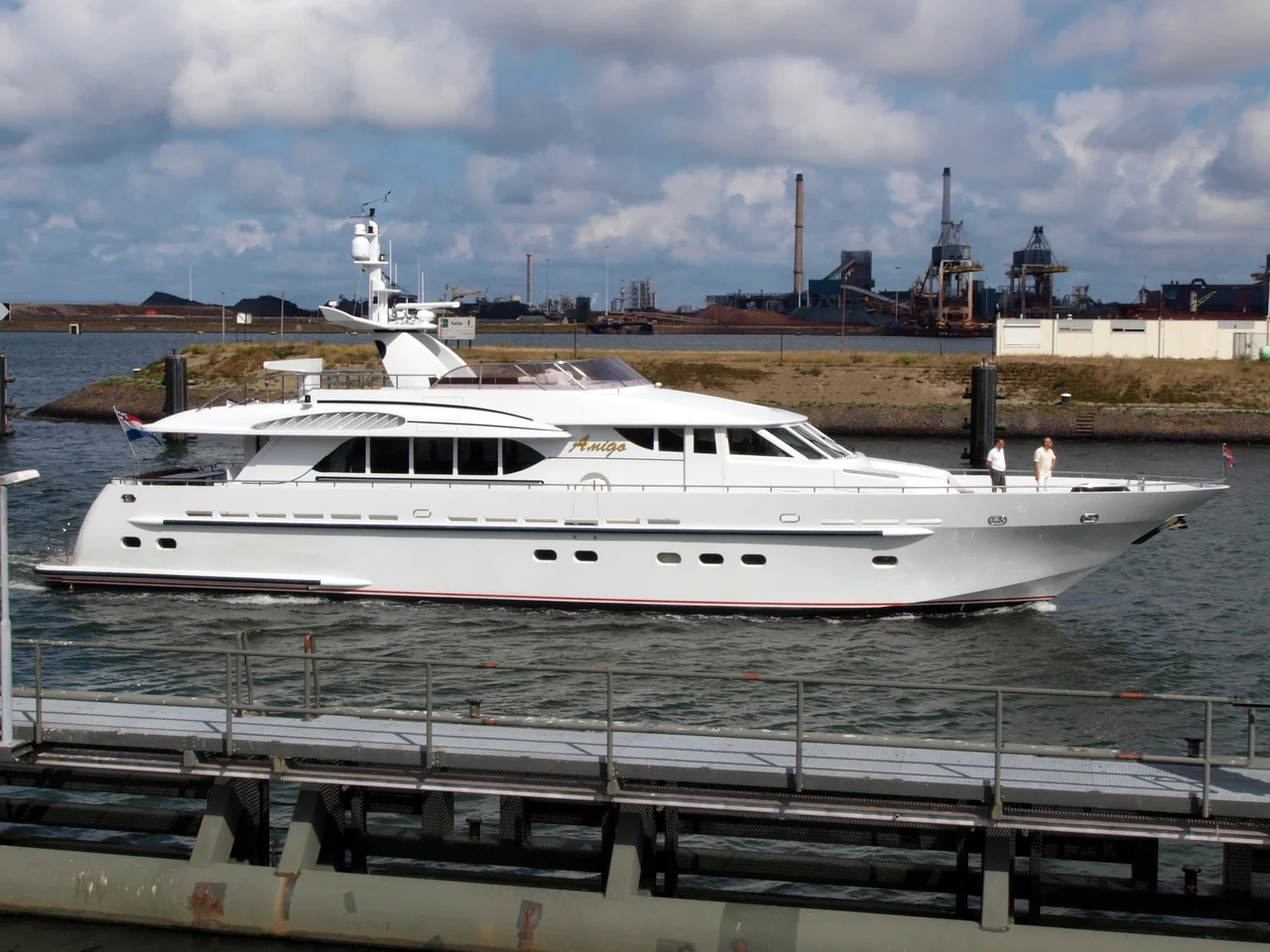

Heesen Yachts
In 1988 an American car dealer named John Staluppi handed a small Dutch shipyard an almost impossible contract. He wanted a superyacht just under 44 meters that could do more than 50 knots. The penalty clauses got worse with every tenth of a knot below the target; below 48 he could walk away. The yard's owner, a former plastics entrepreneur named Frans Heesen, took the job. The yacht he delivered hit 53.17 knots on her sea trials and earned the yard a bonus. Staluppi named her Octopussy, after the 1983 James Bond film. From that one delivery Heesen Yachts, of Oss in southern Holland, became one of the names billionaires call when they want a custom superyacht.
How A Town Of 90,000 Builds Superyachts
Oss sits in North Brabant, about 30 kilometers east of 's-Hertogenbosch, with a population the size of a small American city. It is not a coastal town. There is no harbor scene, no marina, no view of the sea. What it has is a shipyard on the Heesen-controlled canal connections to the Meuse, 4.4 acres of construction sheds and dry docks where 80-meter yachts are built indoors on a frame and then floated out. Heesen employs 500 people permanently, and on a typical day around 1,000 are working in the yard counting subcontractors and agency staff. That makes the company one of Oss's top five employers. The local football club, TOP Oss in the Dutch Eerste Divisie, plays its home matches at the Frans Heesen Stadion. A town of 90,000 has built a global reputation for crafting machines that cost more than its mayor will earn in several lifetimes.
Octopussy: The Yacht That Could Not Be Built
In 1988 a superyacht that could reach 25 knots was considered a feat of engineering. Doubling that, most builders agreed, was inconceivable. But Staluppi already had his propulsion package - three MTU engines making 7,500 horsepower combined, three KaMeWa waterjets - and MTU put him in touch with Dutch naval architect Frank Mulder and Frans Heesen. The contract had no soft edges: a financial penalty for every tenth of a knot under 50, and the right to walk away below 48. Heesen and his small team built it. Octopussy delivered at 43.6 meters, hit 53.17 knots, and registered as the fastest superyacht on record. She was later refitted and lengthened by another company, gained weight, and dropped out of the speed rankings. But the principle she proved - that a Dutch yard with a wild-eyed brief could outperform what everyone said was possible - became the company's identity. By 1990 Heesen had built more than 25 yachts over 27 meters. The sister yacht Mirage, launched in 1991, hit 48 knots and ranked as the 16th fastest in the world.
Engineering Strange To The Naked Eye
What Heesen sells, beyond the visible luxury, is hydrodynamic obsession. The company's Fast Displacement Hull Form (FDHF) is the result of years of work at the Wolfson Unit's test tank in Southampton, which ranks it as the most efficient hull in its database between 15 and 44 knots. The first FDHF yacht, the 65-meter Galactica Star, launched in 2013 and won nine awards including a World Superyacht Award. On the 42-meter Alive, delivered in 2014, Heesen added a Hull Vane - a stern-mounted underwater fixed foil developed with Van Oossanen - and sea trials showed her 35 percent more efficient than any other yacht of her size. On the 50-meter Home, delivered in 2017, hybrid diesel-electric propulsion gave a fuel consumption of just 45 liters per hour at 9 knots in electric mode. The 80-meter Cosmos, completed in 2023 as Genesis, required Heesen to invent a patented structural element called the Backbone, running fore to aft, to keep an all-aluminum hull at that length stiff enough to take its design speeds of 30 knots.
The Money Behind The Aluminum
In 2008 a Russian oil billionaire named Vagit Alekperov bought Heesen Yachts. Under his ownership the company grew from a family firm into a global player. After the 2022 Russian invasion of Ukraine, Western sanctions targeted many Russian billionaires; Alekperov was not on the EU list, but he sold Heesen to an independent Dutch foundation for an undisclosed sum. In April 2025 the foundation in turn sold the company to Dutch billionaire Laurens Last. The yachts themselves end up with owners whose identities the yard does not always confirm. The Galactica Star, that nine-award-winning 65-meter, was acquired in 2013 by Nigerian oil magnate Kola Aluko through a British Virgin Islands company that later turned up in the Panama Papers - Heesen denied selling directly to him. The 2020 revenue topped 200 million euros, a record for the company; the company's order book in 2024 stretched to 2027. The yachts displace luxury that almost nobody on earth can afford, built by Brabant welders most of the buyers will never meet.
Jack De Wit
On 6 April 2017 a Heesen welder named Jack de Wit was found unconscious in the lower tip of a keel he had been welding alone. He died in hospital from inhaling argon, the noble gas used as a shielding gas in aluminum welding - colorless, odorless, heavier than air, and capable of displacing oxygen in a confined space. In 2021 the Dutch Public Prosecution Service charged Heesen Yachts with failing to ventilate the workspace adequately. A judge convicted the company that April, imposing a 100,000 euro fine plus 25,000 in probation, and ordering an article published in trade journals stating that the company had not properly guaranteed worker safety. Heesen denied the allegation, claiming ventilation had been adequate. The yachts kept being built. Jack de Wit's name does not appear on the hulls; the names that go on the transoms - Octopussy, Galactica Star, Genesis, Lusine - belong to the buyers. But every weld on a Heesen yacht was put there by someone, and one of them never went home from the keel.
From the Air
The Heesen shipyard sits in Oss at 51.78 N, 5.55 E, on the canal network connecting to the Meuse. Cruise overhead at 3,000 feet for a clear view of the construction sheds - the 90-meter hall built in 2016 dominates the site. Eindhoven Airport (EHEH) is 22 nm south-southwest; Niederrhein (EDLV) and Dusseldorf (EDDL) lie east across the German border. Finished yachts leave Oss via the Burgemeester Delenkanaal to the Meuse, then downriver to the North Sea via Rotterdam (EHRD nearby). The visual contrast - heavy industrial sheds in a town surrounded by farmland - tells you immediately why an 80-meter superyacht built in landlocked Brabant is one of the stranger sights in modern manufacturing.
Nearby Stories
- Gelders Arcadië 2.2 km away
- Catharina Ziekenhuis 4.5 km away
- Grebbe Line 5.4 km away
- Woerden 6.6 km away
- Geertruidenberg Castle 8.7 km away
- Kleve 12 km away
- Hoogstraten Castle 15 km away
- Venlo 20 km away