
Gelders Arcadië
A railway changed everything. When Staatslijn A finally connected Arnhem to Leeuwarden in the 1860s, the slope where the Veluwezoom dunes meet the river IJssel became suddenly easy to reach from anywhere wealthy people lived. Within a generation, that slope was studded with country estates - houses with names, gardens with gates, woods kept for hunting. A century and a half later, the gates are mostly open. The estates of Gelders Arcadië, especially around Arnhem, have been turned into public parks. The Dutch word Arcadië nods to the Greek pastoral ideal, and that is more or less what this strip of country is now: an aristocratic retreat that history quietly handed back to the public.
Where the Hills Meet the River
The Veluwe is the largest continuous forest in the Netherlands - sand dunes left by retreating glaciers, draped in pine and heath, sloping eastward to the IJssel. Gelders Arcadië occupies that eastern slope, where the trees give way to the floodplain. Two municipalities make up the part covered here: Rheden along the wooded edge, and Rozendaal climbing the dune side. (Arnhem, the city the region is built around, has its own story.) The contrast is the appeal. Walk west and you are in hill-and-heath country with deer and wild boar. Walk east and you are on the polder flats by the river. The settlements - Velp at one end, Dieren at the other - sit on the seam between the two.
Two Thousand Years and a 9th-Century Footnote
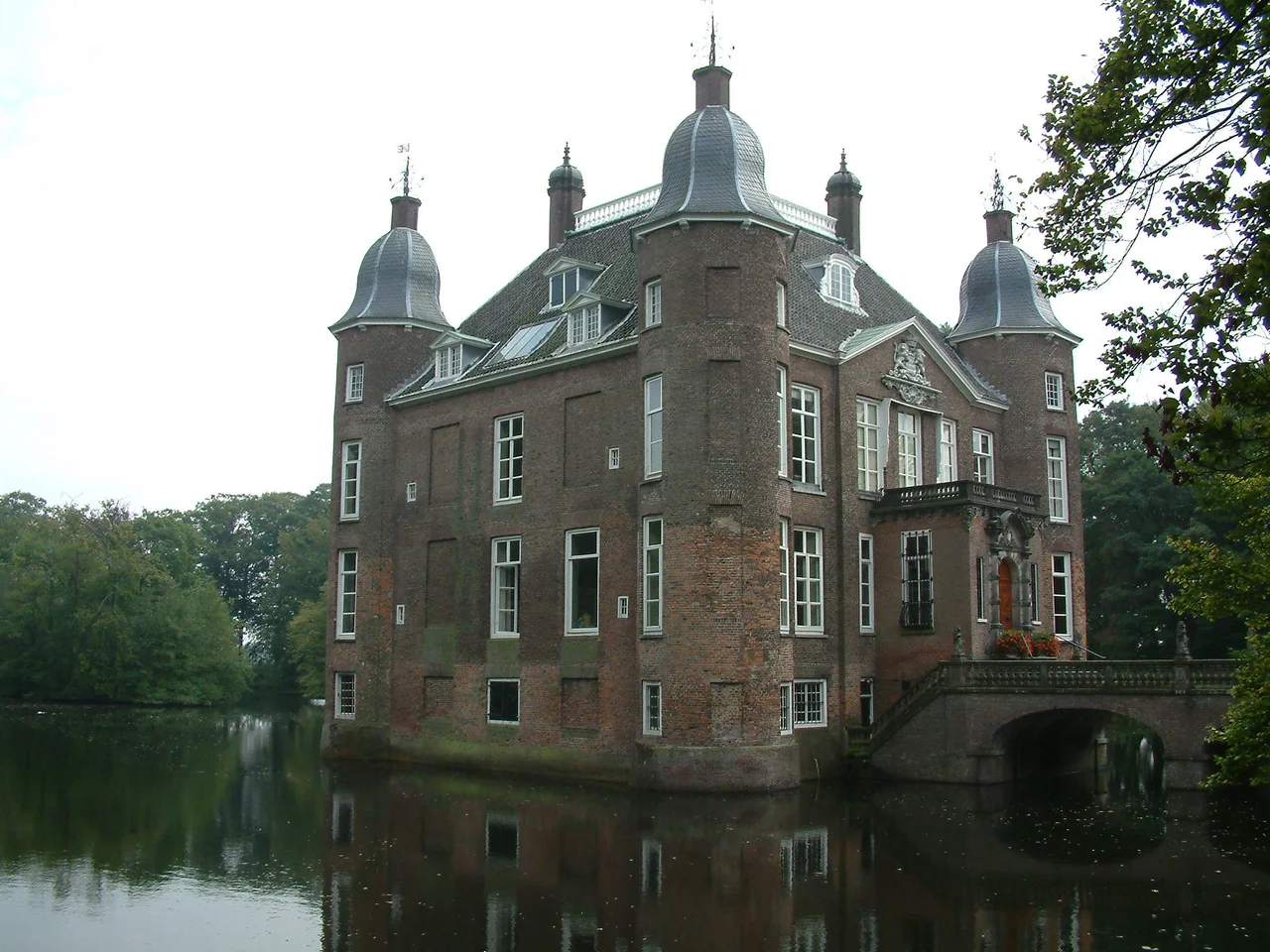
The Veluwe has been settled for over two thousand years, and the oldest known settlements in Rheden go back to the ninth century. That is the long history. The estate history is much shorter and much more visible. Castles came first, built where rich woodland made hunting easy and where the rivers and roads made supplying the kitchens easier still. The estates that followed were a Renaissance and post-Renaissance idea: a country seat with formal gardens, a working farm, a private chapel sometimes, all on land big enough to be its own small world. Middachten Castle in De Steeg is a prime example - a moated, double-winged residence still surrounded by the kind of avenue planting that signals 'this is private land, but you may admire it.'
The Train That Built the Boom
The estate boom did not really hit until Staatslijn A opened. Once a wealthy family in The Hague or Rotterdam could board a train in the morning and reach a country house in Gelderland by lunchtime, the calculus changed completely. The Velperbroek and Velperpoort interchanges where modern motorways now twist together are layered on top of a much older transport story: this was always the way in. Today three stations - at Velp, Rheden and Dieren - serve the region, with Intercity trains stopping only at Dieren. Dieren is also the eastern terminus of the VSM heritage steam railway, which runs old rolling stock west to Apeldoorn on a schedule that rewards advance planning. The line that built the estates still brings the visitors.
From Private to Public
What makes Gelders Arcadië unusual is what happened next. Many of the estates - especially around Arnhem - have been opened as public parks. Walking paths thread through what were once hunting woods. Picnic benches sit where summer gazebos used to be. Some of the houses are still private; some are museums, hotels, restaurants, conference centres. A few are gone, leaving only the landscaping behind. The shift was gradual and uneven, driven by inheritance disputes, twentieth-century taxes, two wars, and the slow rise of preservation organisations like Natuurmonumenten and Geldersch Landschap & Kasteelen. The end state, intended or not, is one of the more democratic landscapes in the country: a former playground for the wealthy that anyone can now walk through with a bicycle and a thermos.
The Park That Lives Inside
Gelders Arcadië borders and partly contains the Veluwezoom National Park - the older, smaller sister of the better-known Hoge Veluwe. Sand dunes, ancient oak woods, purple heath that flowers in late summer, herds of Scottish Highland cattle doing landscape management with their teeth. The park is best approached on foot or by bike. The estate region around it is best approached the same way. The Wikivoyage maxim for this corner of Gelderland - rent a bicycle in Arnhem and pedal village to village - is also the sincere local recommendation. The roads were not designed for cars. They were designed for carriages, then for walkers, then for the kind of slow weekend that turned this region into Arcadia in the first place.
From the Air
Coordinates 52.04°N, 6.01°E, the eastern edge of the Veluwezoom in Gelderland, immediately northeast of Arnhem along the river IJssel. From the air the region reads as forested dune country to the northwest meeting flat floodplain to the southeast, with the towns of Velp, Rheden, De Steeg and Dieren strung along the seam. Nearest airfield is Teuge International (EHTE), about 25 km north; Niederrhein (EDLV) in Germany lies roughly 60 km east. Recommended viewing altitude 3,000-5,000 ft AGL.
Nearby Stories
- Haaksbergen 5.8 km away
- Heerde 6.1 km away
- Kleve 7.3 km away
- Heesen Yachts 9.8 km away
- Aviodrome 11 km away
- Grebbe Line 12 km away
- Raesfeld Castle 15 km away
- Hans Philipp 17 km away