
Haaksbergen
In the early 1970s, 80 percent of the people working in Haaksbergen worked in textiles. Then, within a few short years, almost none of them did. Cheaper labor abroad collapsed the Dutch textile industry, and the eastern weaving towns - Haaksbergen, Enschede, Hengelo, the whole of Twente - had to find something else to be. Half a century later, the looms are silent, but the town that once spun thread for Europe still sits where it always has, on the Buurserbeek stream in the southeastern corner of Overijssel.
Hockesbeghe
Humans have left traces around what is now Haaksbergen since roughly 800 BC. The city itself is younger - the urban settlement dates to around 800 AD - and the first written record appears in 1188, in a register of goods belonging to the same Count Hendrik van Dale of Diepenheim who also owned property in Ahaus and in a village called Epe. The 1188 listing called the place Hockesbeghe. By the late Middle Ages, the Buurserbeek stream had been rerouted south of the village - around 1400 - to connect to the Schipbeek. Before that, it had run straight through the village center as Haaksbergen's main source of water. The rerouting was not nostalgic engineering: it opened a navigable connection to the Hanseatic trading cities of Deventer, Kampen, and Zwolle, and a small inland community suddenly had access to a network that stretched from London to the Baltic.
When the Looms Came
The nineteenth century rewrote the town's economy. Textile production took over from agriculture as the dominant source of income, and by the early twentieth century four out of every five working people in Haaksbergen earned their living from fabric. Across Twente, the same story played out in slightly different shades: Enschede became the regional textile capital, Hengelo built the machinery to weave the cloth, smaller towns like Haaksbergen filled the spaces between. The whole landscape of brick mill buildings, workers' housing, and dye works was a single connected economy. When the bottom fell out in the early 1970s, the connected economy fell out together. Haaksbergen lost the industry that had defined three generations of its working life.
The Trains That Refused to Quit
Haaksbergen used to have a train station with regular service. It sat on the line from Doetinchem to Hengelo, and before the Second World War it carried passengers as well as freight. After the war, the passenger service died first. The line stayed open for freight until 1972 - the same general window in which the textile mills were closing - and then the rails went quiet too. They did not stay quiet for long. Today the line is operated as a heritage railway by the Museum Buurtspoorweg, which runs vintage trains north out of Haaksbergen toward Boekelo through Twente fields and pine plantations. The locomotives are older than most of the passengers. The schedule is seasonal, the steam is real, and the whole thing has the slightly conspiratorial quality of a community that decided not to throw something away.
The Watermill and the Countryside
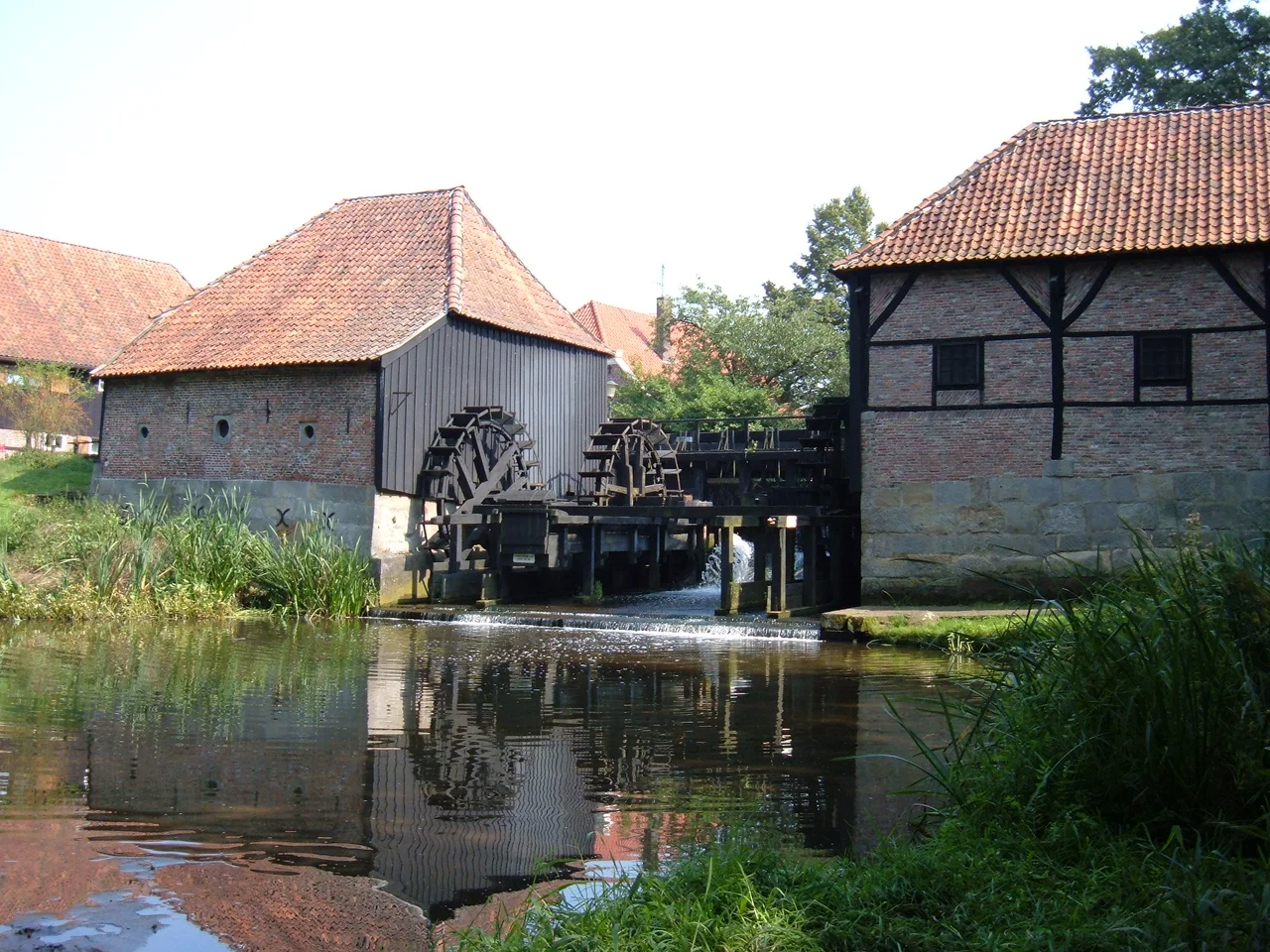
Just south of the town, the Oostendorper Watermolen still sits beside its stream - a double-wheeled wooden watermill that has been grinding grain in one form or another since the seventeenth century, and is now one of the visual emblems of the Haaksbergen countryside. The land around the town is classic Twente: a soft mosaic of small farms, hedgerows, country lanes, and patches of birch and oak woodland, much of it suited to slow exploration on foot or by bicycle. The N18 runs along the north edge of town, connecting east to Enschede and southwest to Doetinchem; the bus lines fan out from a central hub on the Zeedijk toward Neede, Borculo, Hengelo, Eibergen, Holten, and Goor. The geography that once made Haaksbergen a Hanseatic outpost still puts it within easy reach of half of eastern Netherlands.
What Lies Around
Haaksbergen sits at the seam between two regions, and the seam is the interesting part. To the north and east is the rest of Zuid-Twente, with the bigger former mill cities of Hengelo and Enschede. To the south is the Achterhoek - flat, hedge-lined farmland with its own quiet identity - and just over the line, in Berkelland and Oost Gelre, you find the Zwarte Cross festival each summer, billed as the largest paid music festival in the Netherlands and the largest motocross event in the world. A little further west, at Groenlo, the bi-annual Slag om Grolle reenacts the 1627 Dutch siege that the locals still tell stories about. Haaksbergen itself is the quieter middle ground: not the city, not the festival, not the battlefield. The town in between, where the heritage train still leaves on time.
From the Air
Haaksbergen sits at 52.15 N, 6.74 E, about 12 km southwest of Enschede in the southeastern corner of the Dutch province of Overijssel, very close to the German border. Nearest airports: Twente Airport (EHTW) immediately north of Enschede, Münster-Osnabrück (EDDG) about 50 km east, Niederrhein/Weeze (EDLV) further south. From low altitude, look for the compact town center surrounded by the small-field landscape of Twente, with the Buurserbeek stream curving south of the village and the heritage railway line running north toward Boekelo. The Oostendorper Watermill stands south of town beside its stream.
Nearby Stories
- Vorden 2.3 km away
- Raalte 3.6 km away
- Raesfeld Castle 10 km away
- Emsdetten school shooting 11 km away
- Moyland Castle 13 km away
- Neuenhaus 15 km away
- Nordkirchen Castle 17 km away
- Osnabrück Canal 39 km away