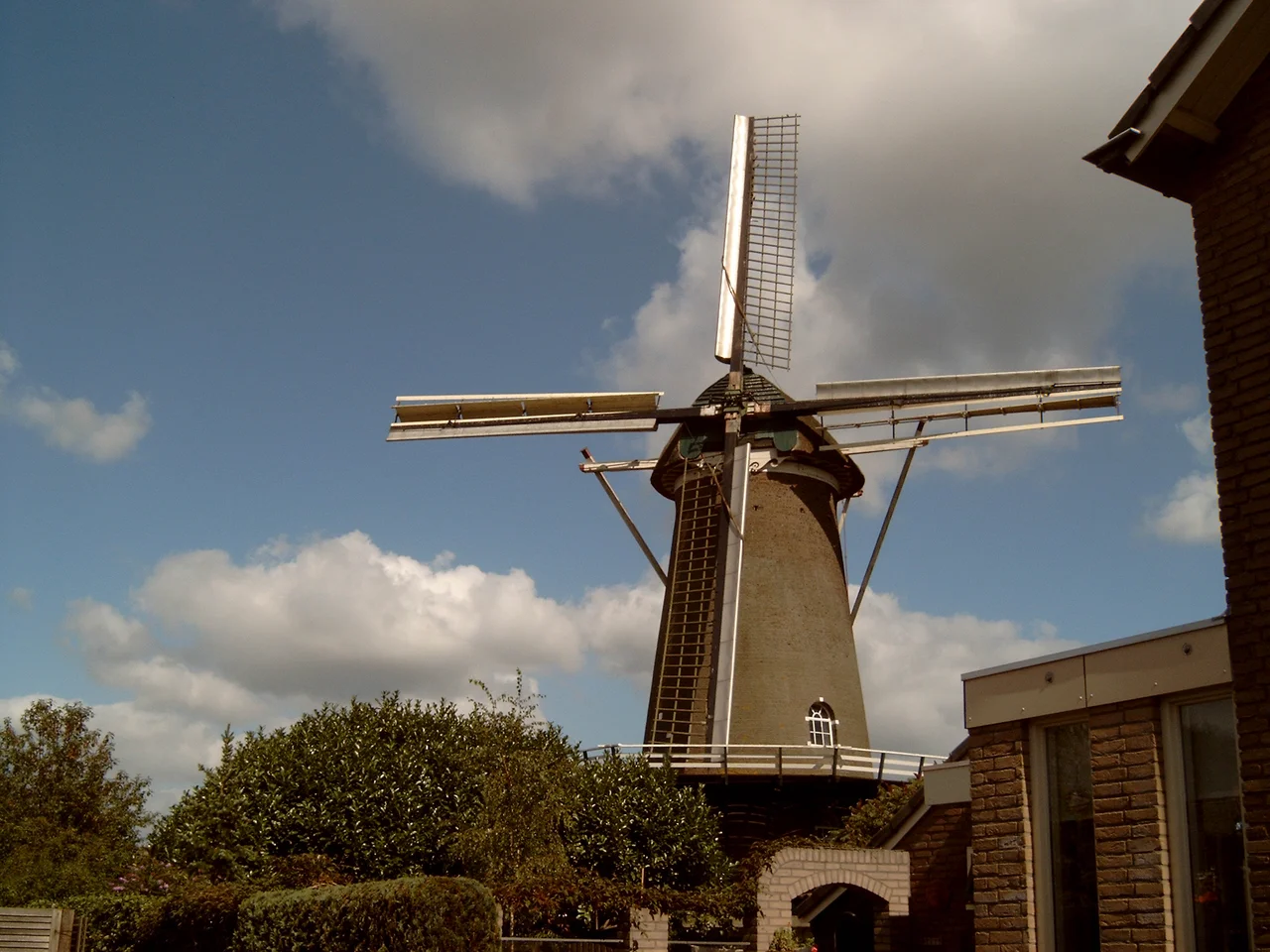

Vorden
Count them, because the number matters: Vorden, Onstein, Medler, Hackfort, Kieftskamp, De Wiersse, Wildenborch, and Den Bramel. Eight castles in a circle around a single village of fewer than ten thousand people. House Vorden sits on the outskirts; the other seven ring it like points on a clock face. There is a 34-kilometer cycling route that connects them, the Achtkastelenroute, and it is the geographic shape of how aristocrats once stacked themselves in a productive corner of the eastern Netherlands. The eight-castle village is not metaphorical. It is mappable.
A Ford in the Brook
The name Vorden first shows up in a document from 1121 AD. It probably descends from the Old Dutch word voorde, meaning a ford - the shallow place where a wagon could cross the Vordensche brook that still wanders through town. By 1235 the parish was independent. For most of its history Vorden was an agricultural village in the Achterhoek, the flat green region east of the IJssel that always felt one province removed from the rest of the country. Industry arrived in the late nineteenth century, when the Zutphen-Winterswijk railway opened in 1878, and the small station on the Stationsweg is still working. In 2005, after centuries as an independent municipality, Vorden was merged with four neighbors to form the new municipality of Bronckhorst.
Eight Castles, Eight Stories
House Vorden itself goes back to 1315 and once served as the town hall, until the municipality sold it to a private owner in 2004; today it hosts weddings. Hackfort, first mentioned in 1324, burned in 1586 during the Eighty Years' War, was rebuilt, and acquired its current Louis XVI facade in 1788; the building now houses apartments. Den Bramel dates largely from the 1720s, though earlier versions are recorded in 1396. The Wildenborch, first noted in 1372, is best known as the home of the Romantic poet Anthony Staring, who lived there from 1791 until his death in 1840 and turned a rebuilt gate tower into a working country house. De Wiersse appears in records from 1288. Onstein, in Louis XIV style, was raised in 1711 on the foundations of a 1613 mansion. Kieftskamp went up in 1776, Louis XV. Medler is a 17th-century manor, renovated repeatedly. Each castle has a date, a war it survived, and a family that lost it.
A Cyclist's Geography
The Achtkastelenroute - the Eight Castles Route - runs 34 kilometers through woodland, polder, and country lane, threading all eight estates without much repetition. It is the kind of route the Dutch invented bicycles to ride. Two long-distance walking paths also pass through: the Pieterpad, which runs the length of the country from Pieterburen on the Wadden Sea coast to the Sint-Pietersberg outside Maastricht, and the Trekvogelpad, the migratory bird route, which crosses the Pieterpad at House Vorden on its way from Bergen aan Zee to Enschede. For a village of this size to sit at the intersection of two national trails is an accident of having eight castles. The trail planners followed the castles.
Fox Hunts and Friday Markets
The annual fox hunt - the one with hounds and red coats and a horn - persisted in the country around Vorden into the modern era, longer than in most of the Netherlands, until it was replaced by drag hunting, which substitutes a scented trail for a live fox and lets the ritual continue without the kill. Equestrian events still gather on the estates in late autumn. Friday mornings the village center fills with a market around the Reformed church: fish stalls, baker's stalls, vegetables. Vorden's secondary school, 't Beeckland, feeds into the Ulenhof College in nearby Doetinchem. The village's most famous daughter is the suffragist Henrica Iliohan, who was born here in 1850. None of these things are spectacular individually. Strung together along thirty-four kilometers of bicycle path, they are something the Netherlands does better than almost anywhere: small things, arranged carefully, that add up.
From the Air
Located at 52.10 N, 6.32 E in the Achterhoek region of Gelderland, about 10 km southeast of Zutphen. Recommended viewing altitude 1,000-2,500 feet AGL to take in the castle-and-estate landscape; the eight castles cluster within a roughly 8 km radius and the wooded estate grounds stand out from surrounding farmland. Nearest airports: Teuge (EHTE) 25 km northwest, Niederrhein (EDLV) 50 km east, Lelystad (EHLE) 60 km northwest, Schiphol (EHAM) 100 km west, Munster-Osnabruck (EDDG) 80 km east. The area is gentle GA country with low traffic; check NOTAMs for occasional drag-hunt and equestrian events that may concentrate ground activity in autumn.
Nearby Stories
- Haaksbergen 5.8 km away
- Heerde 6.1 km away
- Kleve 7.3 km away
- Heesen Yachts 9.8 km away
- Aviodrome 11 km away
- Grebbe Line 12 km away
- Raesfeld Castle 15 km away
- Hans Philipp 17 km away