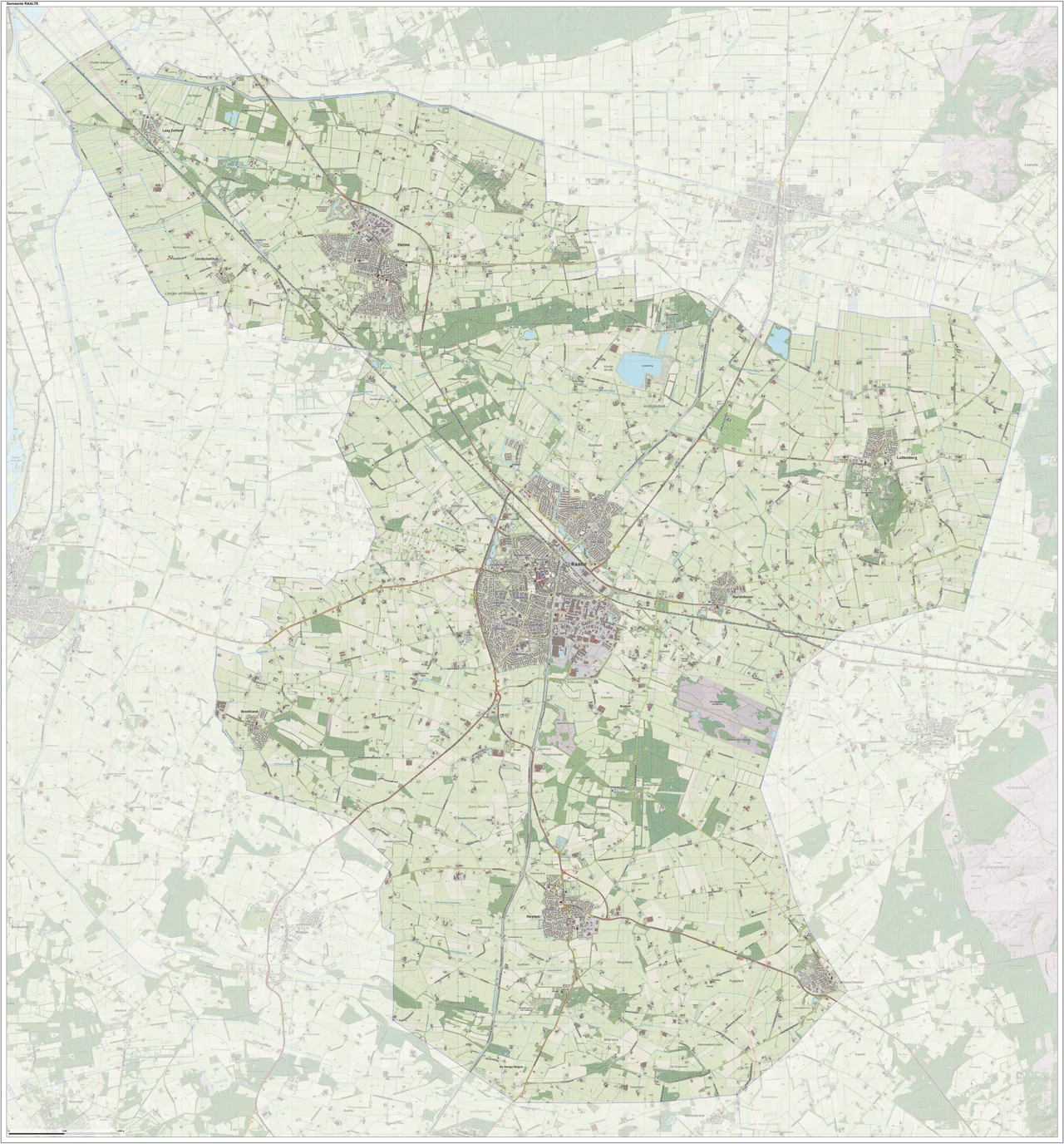

Raalte
On the last Thursday of August, the parade winds through the center of Raalte: floats banked with sheaves of grain, brass bands, costumes pulled from storage for one week a year. The festival is called Stoppelhaene, and the people of this small Overijssel town have been throwing it since 1951, when the harvest still defined the calendar and the church bells still set the rhythm. Inside the Neo-Gothic basilica, mosaics made entirely from seeds depict religious scenes for the duration of the celebration. The festival opens and closes with Mass. Then the floats are dismantled, the seeds are swept up, and Raalte gets back to the quieter business of being itself.
The Heart of Salland
Raalte sits at the geographic and emotional center of Salland, the agricultural belt that fills the western half of the Dutch province of Overijssel. Twenty thousand people live in the main town, most of them Roman Catholic in a country where Catholicism clusters in the south and east. The municipality functions as a regional market, a place where the smaller villages around it come for shopping and schools and the train. Trade and cattle breeding still matter to the local economy, alongside small industrial enterprises that mostly process what the surrounding farms produce. Tourism comes too, drawn by the festivals and the gentle Sallandse Heuvelrug ridge that rises a few kilometers east.
Stoppelhaene and the Harvest Calendar
The name Stoppelhaene refers to the stubble left in the fields after the grain is cut, and the festival has anchored Raalte's late summer for over seventy years. It runs Wednesday through Sunday in the final week of August, with the Harvest Parade as its centerpiece on Thursday. The seed mosaics in the Heilige Kruisverheffing basilica are the festival's quiet signature: instead of paint or stained glass, religious imagery rendered in lentils, wheat berries, and poppy seeds. The church itself, designed by the Neo-Gothic architect Alfred Tepe and finished in 1892, is the largest building in town. When the parade ends and the special Masses are sung, Raalte folds back into its weekday routines, but the calendar has been marked again.
Ribs, Blues, and Tolerance
Since 1997, Raalte has hosted a second annual festival that has nothing to do with grain. Ribs and Blues, held on the Whitsun weekend, has pulled in names that punch well above what a 20,000-person town might expect: the Beach Boys, Status Quo, the Dutch saxophonist Candy Dulfer. Outside the festivals, the town keeps a smaller and older landmark. The Plaskerk, a modest Protestant church and the oldest building in central Raalte, was restored in 2006. While the work was underway, the Protestant congregation held its Sunday services inside the much larger Catholic basilica across the way. In a country famous for confessional fences, the gesture is a small and very Dutch piece of practical ecumenism.
Around the Edges
The municipality stretches well beyond the town. Luttenberg, to the southeast, is known for its summer motorcycle races and for a Lourdes Cave, an artificial grotto with a statue of the Virgin opposite the village church. A small wooded hill of the same name offers heath walks. Just past the railway in nearby Heino, the Nijenhuis castle houses an important art museum with works by Constant Permeke and Van Gogh, ringed by a sculpture garden featuring Ossip Zadkine. The town has produced a few notable names of its own, including the speed skater Jan Smeekens, who took silver in the 500 meters at the 2014 Winter Olympics in Sochi. The painter Petronella van Woensel was born here in 1785.
From the Air
Raalte sits at 52.40N, 6.28E in the Salland farmland of Overijssel, eastern Netherlands. Best identified by the railway line running northwest to Zwolle and southeast toward Enschede, and by the patchwork of fields and small woodlots that surround it. The N35 trunk road cuts through town. Nearest major airport is Groningen Airport Eelde (EHGG) to the north, with Munster Osnabruck (EDDG) a short hop east across the German border. Schiphol (EHAM) lies about 130 km west. Best viewed from low cruising altitude in clear summer weather, when the harvest patchwork is most legible.
Nearby Stories
- Windpark Noordoostpolder 2.7 km away
- Giethoorn 5.1 km away
- Aviodrome 6.6 km away
- Hans Philipp 7 km away
- Haaksbergen 7.2 km away
- Siege of Zutphen (1591) 8 km away
- Sleen 9.3 km away
- Onze Lieve Vrouwetoren 17 km away