.jpg)
Windpark Noordoostpolder
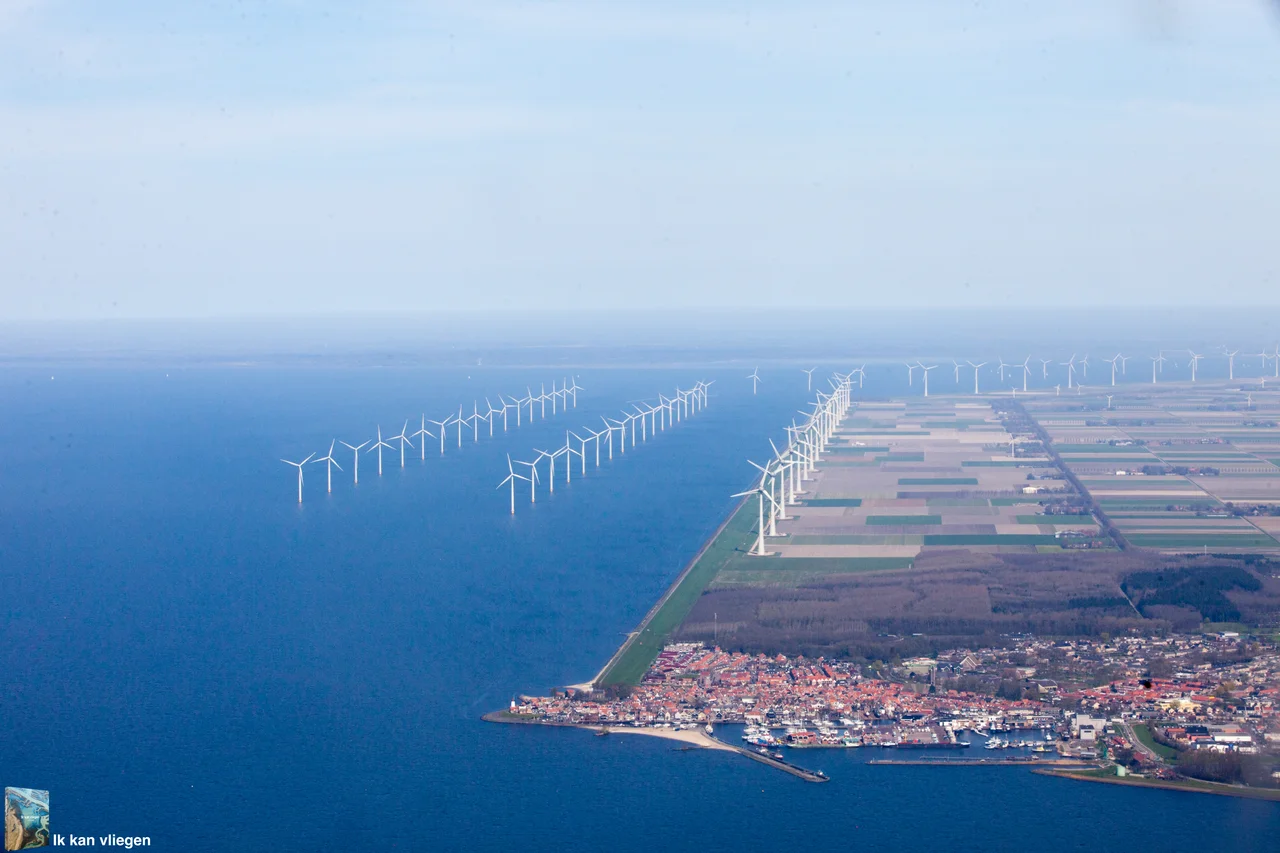
One new turbine, by itself, generates as much electricity as fifty old ones used to. That arithmetic is what built Windpark Noordoostpolder. The wind farm now standing along the western dykes of the Noordoostpolder - 86 turbines, 429 megawatts, enough power for 400,000 households - replaces an earlier generation of 55 smaller machines that lined the same coast through the 1990s and 2000s. The old turbines were dismantled the moment the new ones came online. What stands today is not just larger; it is a different idea of what "a windmill" can do. The towers rise nearly 200 metres from waterline to blade tip. Their blades sweep an area larger than a soccer pitch with every revolution. And they stand on land that did not exist before 1942.
Drained, Then Powered
The Noordoostpolder is one of the great geographic facts of modern Europe. Until the early 20th century, the area was the floor of the Zuiderzee - a shallow saltwater inlet patrolled by herring boats and prone to drowning villages. The Afsluitdijk closed off the Zuiderzee in 1932 and the Dutch immediately began draining sections of the new freshwater lake into polders. The Noordoostpolder emerged from the water between 1936 and 1942. It is, in the most literal sense, manufactured land: 480 square kilometres of farmland, towns and dykes pumped dry by Dutch engineers in the middle of the Second World War. Eight decades later, the polder grows more than wheat and sugar beet. Along its western edge, where the dykes meet the IJsselmeer, the country planted a forest of turbines.
A Decade of Permits
Big wind farms rarely arrive quickly. The Dutch government gave Windpark Noordoostpolder its final approval on 6 January 2011. The opponents - villagers worried about noise and sightlines, environmental groups concerned about birds and the IJsselmeer's freshwater ecology - took their case to the Council of State, the country's highest administrative court. The court ruled for the project on 8 February 2012. Construction of access roads began that May. By June, the national grid operator TenneT had started expanding its 110-kilovolt transport network to accept the new power. Engineers also built a curved stone guide-dam through the shallow water offshore - partly to create a sheltered flora-and-fauna area, partly to divert shipping safely around the future turbines. Onshore construction began in 2013. Near-shore construction began in 2014. The first turbine spun up in August 2014. The project was finished in 2017.
Two Kinds of Tower
The 86 turbines come in two flavours, divided by where they stand. The 48 near-shore machines are Siemens SWT-3.0-108 models, each rated at 3 megawatts, set into water 3 to 7 metres deep along the dykes of the IJsselmeer. Together they make up the Westermeerwind farm, commissioned in two phases in 2015 and 2016. The 38 onshore turbines are something larger - Enercon E-126 machines, each rated at 7.5 megawatts, planted along the Westermeerdijk and Noordermeerdijk in close formation with their offshore cousins. The E-126 is one of the largest onshore turbines ever built; its rotor diameter is 127 metres and its hub stands 135 metres above the ground. The total installed capacity of all 86 machines is 429 megawatts, and the farm produces about 1.4 terawatt-hours of electricity per year. The Dutch grid converts that into power for roughly 400,000 homes - approximately the number of households in the two surrounding provinces of Flevoland and Friesland combined.
The Farmers Who Own It
The story behind the project is unusual in European energy. The farm is owned by a partnership of more than a hundred agricultural entrepreneurs from the Noordoostpolder - the Koepel Windenergie Noordoostpolder - together with Innogy, a subsidiary of the German utility RWE. The local farmers were not just paid for the use of their land; they bought into the project as co-owners. The setup deflected some of the resentment that often follows industrial wind into rural communities. The dividends from the turbines now flow back into the same villages where the machines turn. It is a model the Netherlands has tried to replicate elsewhere, with varying success. The Noordoostpolder version works in part because the polder itself is a community used to large engineering decisions: the land they farm did not exist a century ago.
What You See From the Dyke
Drive the Westermeerdijk from Lemmer toward Urk on a clear day and the scale becomes physical rather than statistical. The towers stretch into the distance in two roughly parallel lines - one on land, one in the water - their blades turning at slightly different speeds, catching the sun in slow pulses. In the right wind you can hear them: a deep slow whump rather than a whine. Migratory geese still cross the IJsselmeer here, threading between the rotors with practised disinterest. The freshwater coast smells of mud and reed beds. Out beyond the offshore turbines, sailboats from Lemmer and Urk track south toward Flevoland. The wind farm, like the polder it stands on, is an act of national will rendered in concrete and steel - a Dutch insistence that geography can be edited, energy included.
From the Air
Windpark Noordoostpolder runs along the western dykes of the Noordoostpolder in Flevoland, centred near 52.75N, 5.60E. EHLE (Lelystad) lies 30km south; EHLW (Leeuwarden) 35km north across the IJsselmeer; EHAM (Schiphol) 60km southwest. Two parallel lines of turbines extend along the Westermeerdijk and Noordermeerdijk - the onshore Enercon E-126 machines (taller, dark-tipped) are closest to the dyke; the smaller offshore Siemens turbines stand in the shallow lake water. Best photographed late afternoon when the rotors throw long shadows across the polder.
Nearby Stories
- Exposure 4.4 km away
- Aylvapoldermolen 7.5 km away
- Action of 24 October 1798 7.7 km away
- Drachten 8.4 km away
- Vrouwenhuis 9.2 km away
- Zaanstreek-Waterland 9.5 km away
- Battle of Krabbendam 10 km away
- Giethoorn 11 km away