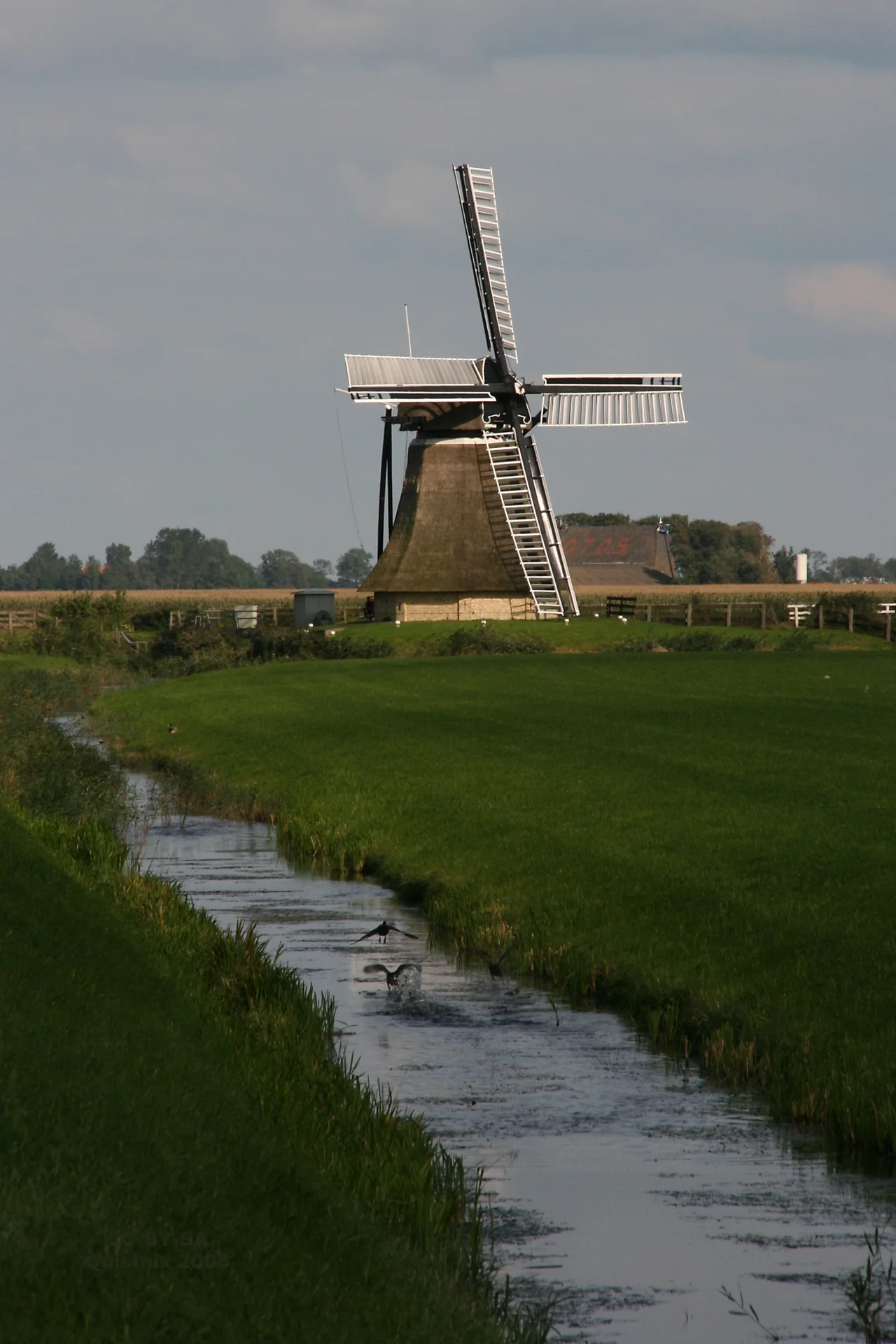

Aylvapoldermolen
On the night of 9 November 1959, the old Aylvapoldermolen burned to the ground. It had pumped water from the Aylvapolder - the first polder reclaimed in Friesland, drained in 1680 - since 1827. After the fire, the field where it had stood went quiet. A small Frisian village without its mill is a strange thing, like a clock face missing its minute hand. For thirty years the absence settled in. Then, in the 1990s, the people of Burgwerd decided they wanted their mill back. The mill they ended up with had never lived in Burgwerd at all.
A Polder Older Than the Mill
The Aylvapolder is older than almost anything else around it. Drained in 1680, it was the first true polder in Friesland - a stretch of low farmland ringed by dikes and kept dry only as long as the pumps kept running. For a century and a half it was drained by hand-cranked Archimedes' screws and animal power. Then, in 1827, a new smock mill arrived, and the wind began doing the work. The locals called it the Molen van de Tjaard, after the family that ran the farm beside it. The mill stood for 132 years before lightning, or wiring, or simple bad luck finally caught it during a November storm in 1959. The field went back to being just a field, with the polder still in working order but the mill that named it gone.
The Mill That Moved
Fifty kilometers north, in the village of Hallum, a different smock mill had been turning since 1846. Local people knew it as the Vijfhuistermolen or the Hoekstermolen. It had been carefully restored in 1964 and again in 1971, and in 1976 it passed to Stichting De Fryske Mole, the Frisian Mills Foundation - a stewardship organization that has saved scores of working windmills from demolition. In 1996, a local business wanted to expand onto the land the Vijfhuistermolen sat on. At the same time, the people of Burgwerd had a foundation, the Stichting Aylvapoldermolen, and a vacant site, and a polder still in need of pumping. Someone realized that one community's problem was another's solution. In 1999 the Hallum mill was disassembled - tower, sails, gearing, and all - and rebuilt on the Burgwerd plot where the Molen van de Tjaard had stood until the fire. The polder finally had a mill again. The mill, transplanted, finally had a job.
Achtkante Grondzeiler
What stands in Burgwerd today is what the Dutch call an achtkante grondzeiler - an eight-sided ground-sailer, a smock mill whose sails sweep close enough to the earth that a person standing nearby can almost touch them when they pass. The brick base is a single story; the thatched smock above rises three more stories to a thatched cap. The four Patent sails span 22 meters from tip to tip - wider than the road in front of the mill. Inside, a cast-iron windshaft drives a brake wheel with fifty-seven oak cogs. That wheel drives a smaller wallower, thirty-two cogs, which spins a vertical upright shaft running down through the heart of the mill. At the bottom, a crown wheel of fifty-three cogs hands the power off through a forty-eight-cog gear to an inclined Archimedes' screw - 1.7 meters wide, mounted at a 22-and-a-half-degree tilt. Each turn of the screw lifts 1,560 liters of polder water up and over the dike. When the wind blows, the screw turns. When the screw turns, Friesland stays dry.
Saved Twice
The Aylvapoldermolen has now been saved twice from fire - once by being absent, and once by sprinklers. After the 1959 burning of the original mill, the rebuilders fitted the relocated Vijfhuistermolen with an automatic sprinkler system, an unusual precaution for a Rijksmonument-listed thatched building. The decision was vindicated when fire did break out and the system held the flames in check long enough for the local brigade to arrive. The crews used 135,000 liters of water to fully douse the mill. About six square meters of thatch was destroyed - a patch the size of a kitchen table, on a roof that could have been lost entirely. The mill still turns. In the soft Frisian afternoon, it does what its predecessor did before it: catches the wind off the Wadden Sea, drops it through gears two hundred years old in spirit if not in metal, and pours water out the screw at a pace measured in liters per revolution. A polder reclaimed in 1680 still depends on the rhythm.
From the Air
The Aylvapoldermolen stands at 53.0978°N, 5.5594°E, in the village of Burgwerd in southwestern Friesland, in the broad polder country between the towns of Bolsward and Wommels. From cruising altitude the mill itself is a small white-and-thatched dot, but the polder grid around it - rectangular fields edged by drainage canals stretching to the horizon - is unmistakable. Recommended viewing altitude is 2,000 to 4,000 feet for the best view of the mill against its polder. Nearest airfields are Drachten (EHDR) to the northeast and Leeuwarden Air Base (EHLW) due north. Weather along this coast is dominated by maritime air from the Wadden Sea; expect frequent low cloud and brisk westerlies, both of which are part of why the mill is here.
Nearby Stories
- Stavoren 6.8 km away
- Protestant church of Jistrum 7.4 km away
- Duinen van Texel National Park 8.5 km away
- De Verwachting, Hollum 12 km away
- Battle of Krabbendam 15 km away
- Drenthse Veenkolonien 17 km away
- Schiermonnikoog 18 km away
- West Sole Gas Field 251 km away