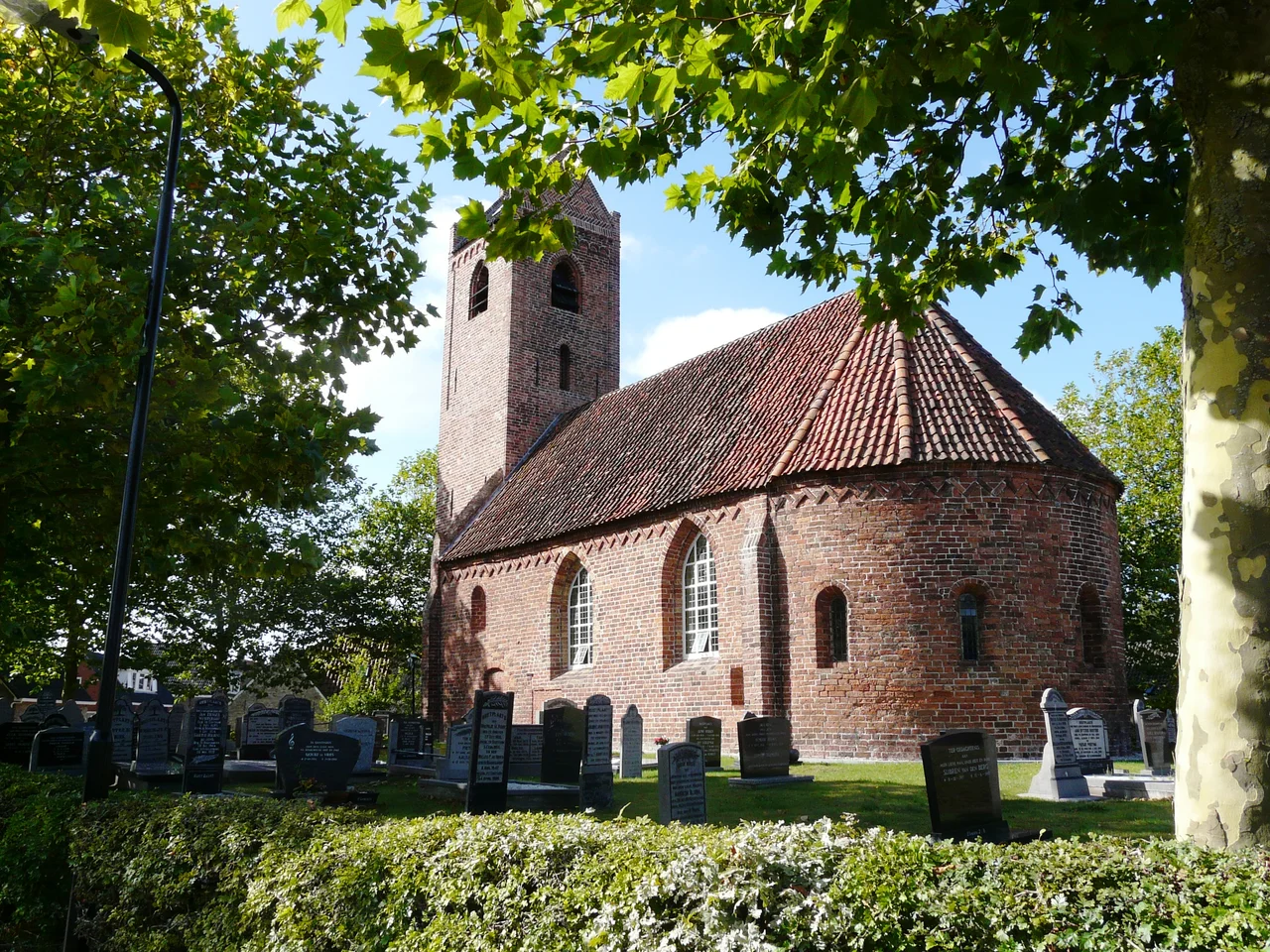

Protestant church of Jistrum
On top of the 20.5-meter brick tower in Jistrum, where almost every other Frisian village has a golden rooster turning in the wind, there is a horse. The rooster is the standard. It symbolizes Christ breaking the power of darkness, forgiving sins, calling the world to a new day, and it sits on church towers from Dokkum to Sneek doing exactly that work. Jistrum had one too, once, until a storm tore it down and the village had to decide whether to replace it. A new rooster cost money. A horse cost less. The horse won, and has been turning in the Frisian wind ever since, an admission written in metal that piety and practicality do not always agree.
Built in One Generation, Stripped in One Week
The tower went up around 1230, the nave and semicircular choir a few decades later in the 13th century. They built it in red brick, which is what Frisians built nearly everything in once they had the kilns going, because the clay was at hand and the trees were not. The church was Catholic then, dedicated to Saint Peter, with painted walls and statues of saints and the familiar interior of a working medieval parish. All of that came down in a single week in 1581 during the Protestant Reformation. The statues went, the painted plaster was whitewashed, the saints' niches stood empty, and the building became a Protestant church almost overnight. Stripped of its color and its company of saints, the brickwork itself became the architecture.
Windows for the Excluded
During a renovation, restorers found two hagioscopes in the walls, narrow openings that allowed someone outside to look in at the elevation of the host without entering the consecrated space. In Frisian these were called leprozenruitjes, leper windows, and that is who they were for: villagers with leprosy who could not be permitted into the body of the congregation but who still belonged to it, still wanted to see the moment of the Mass. The disease that gave the windows their name had largely vanished from northern Europe by the time the Reformation arrived, but the windows themselves stayed, plastered over and forgotten until modern hands found them. They are open again now, framing the same view they framed eight hundred years ago for people no one remembers.
Domevaults and Keper Friezen
Inside, the nave is covered by a Romanesque-Gothic domevault, a transitional ribbing where eight ribs converge into a ring at the apex of each bay. In the western bay the ribs are squared rather than rounded, a small variation that suggests the masons changed their minds halfway through. The outer walls along the upper edge are decorated with keper friezen, the chevron brick patterning that Frisian masons used like a signature on their plain Romanesque walls. The southern wall has two large lancet windows added later in the building's life; the northern wall holds two original high Romanesque windows above what were once doorways, now bricked closed. A wooden pulpit from the third quarter of the 17th century leans against the north wall where the choir meets the nave, dark and carved and Protestant in its modest dignity.
What the War Took
The bell in the tower was cast in 1759 and rang above Jistrum for almost two centuries before German occupiers cut it down during the Second World War, melted for the metal like thousands of other Dutch church bells. The current bell, dating from 1949, replaced it after the war when the village had to scrape together the money to be heard again. In 2007, a longer renovation began. As part of that work, the monumental pipe organ from another church in town was moved in and reinstalled here, so the same building that lost its statues in a week in 1581 and its bell in the war picked up an organ in the 21st century, accumulating across the centuries the things a working church needs to keep being one.
From the Air
Coordinates 53.212N, 6.067E. The church's brick tower with its distinctive horse weather vane is visible from 1,500-3,000 ft AGL on clear days, set in the small grid of Jistrum village among the wooded edges of the Friesland-Drenthe border country. Groningen Eelde (EHGG) lies 18 km east; Drachten airfield (EHDR) is 12 km south. Best lighting is afternoon when the sun catches the western face of the tower and the horse silhouettes against the sky.
Nearby Stories
- Foxhol 2.8 km away
- Ernst-Wilhelm Modrow 5.6 km away
- Drenthse Veenkolonien 7.1 km away
- Schiermonnikoog 7.6 km away
- Aylvapoldermolen 9.5 km away
- Eemshaven Railway Station 10 km away
- Low-Frequency Array 13 km away
- West Sole Gas Field 297 km away