_2.jpg)
Foxhol
Willem Albert Scholten went to Germany in the early 1840s to learn about paint. He came back fascinated by something else entirely: potato starch. The Germans were using it in their dyes, and Scholten could not stop thinking about everything else it might do - thickeners, adhesives, sizing for paper, food. The problem, he decided, was logistics. Potatoes are heavy, water-laden, and not worth shipping far. The factory needed to be where the potatoes already were. In 1842 he opened the Eureka factory in Foxhol, a small village between Groningen city and the peat colonies, on a lake near a canal. From that one decision came a Dutch industrial empire and, eventually, one of the great transatlantic shipping companies of the nineteenth century.
The Fox Hole
The name is older than the factory. Foxhol means 'fox hole' in Dutch, first recorded in 1460 as Vossehol. Local lore connects it to Nittert Fox, a Saxon knight said to have been killed here in 1499, but the village name predates the knight by forty years. The earliest inhabitants were fishermen and hunters working the edge of a large lake. In 1594 the city of Groningen started exploiting the peat in the surrounding area - peat was fuel, peat was money, and the city wanted it close. In 1612 a canal was dug to connect Foxhol to the wider trade network. It would eventually become the Winschoterdiep, one of the main industrial waterways of the Dutch north. Long before Scholten arrived, Foxhol had the three things he was about to need: cheap fuel, clean water, and a connection to the world.
Eureka and the Holland America Line
The Eureka factory took its name seriously. Scholten's instinct about potato starch turned out to be exactly right, and the operation expanded fast. By the end of his career he owned twenty-four factories across Europe, processing not just starch but the whole derivative chain that came out of it. He had become wealthy enough that he started looking for other industries to invest in. In 1873 he was among the founders of the Nederlandsch-Amerikaansche Stoomvaart-Maatschappij - the Netherlands-American Steamship Company. Within a few decades it was known by its English name: the Holland America Line. The same potato money that built a starch factory in a Groningen village helped launch ocean liners between Rotterdam and New York. The Foxhol plant is still in operation today, owned now by Royal Avebe, the Dutch farmers' cooperative that bought Scholten's old empire.
The Moluccan Neighborhood
In December 1961, Foxhol became the unwilling stage for a small, bitter chapter in postcolonial Dutch history. After Indonesian independence, thousands of soldiers from the South Moluccas - who had served in the Dutch colonial army and who supported an independent Moluccan republic - were brought to the Netherlands with their families and housed in camps. Many believed their stay was temporary, a way station before returning home. A camp at Coenraadpolder, not far from Foxhol, held 311 people who belonged to a resistance group called CRAMS, which still hoped to liberate South Maluku. By 14 December 1961, a new neighborhood had been built in Foxhol for these families. A group of 129 people refused to leave the barracks. Accepting the houses, they understood, meant accepting that they were never going back. On 21 December, Dutch police raided the barracks and forcibly moved them to the new neighborhood in Foxhol. In 1965 the Moluccan community built the Maranatha church there - a small, deliberate marker that they had not given up on who they were.
What Remains
The Maranatha church was replaced by the Petrus Church in 1995, and by 2009 only an estimated ten to fifteen Moluccan families still lived in Foxhol. Most had moved on, generation by generation, into the wider Netherlands. The village center was redeveloped in 2010 after the retail shops closed. Foxhol is now an extension of the neighboring town of Hoogezand, a single urban area on the Winschoterdiep, mostly given over to factories and shipyards. The starch plant still steams. The lake is still there. The fox-hole name on the road sign still points to the small Saxon village it once was. Empires are sometimes built from very small towns, and the people forcibly settled in them rarely get to choose.
Aerial View
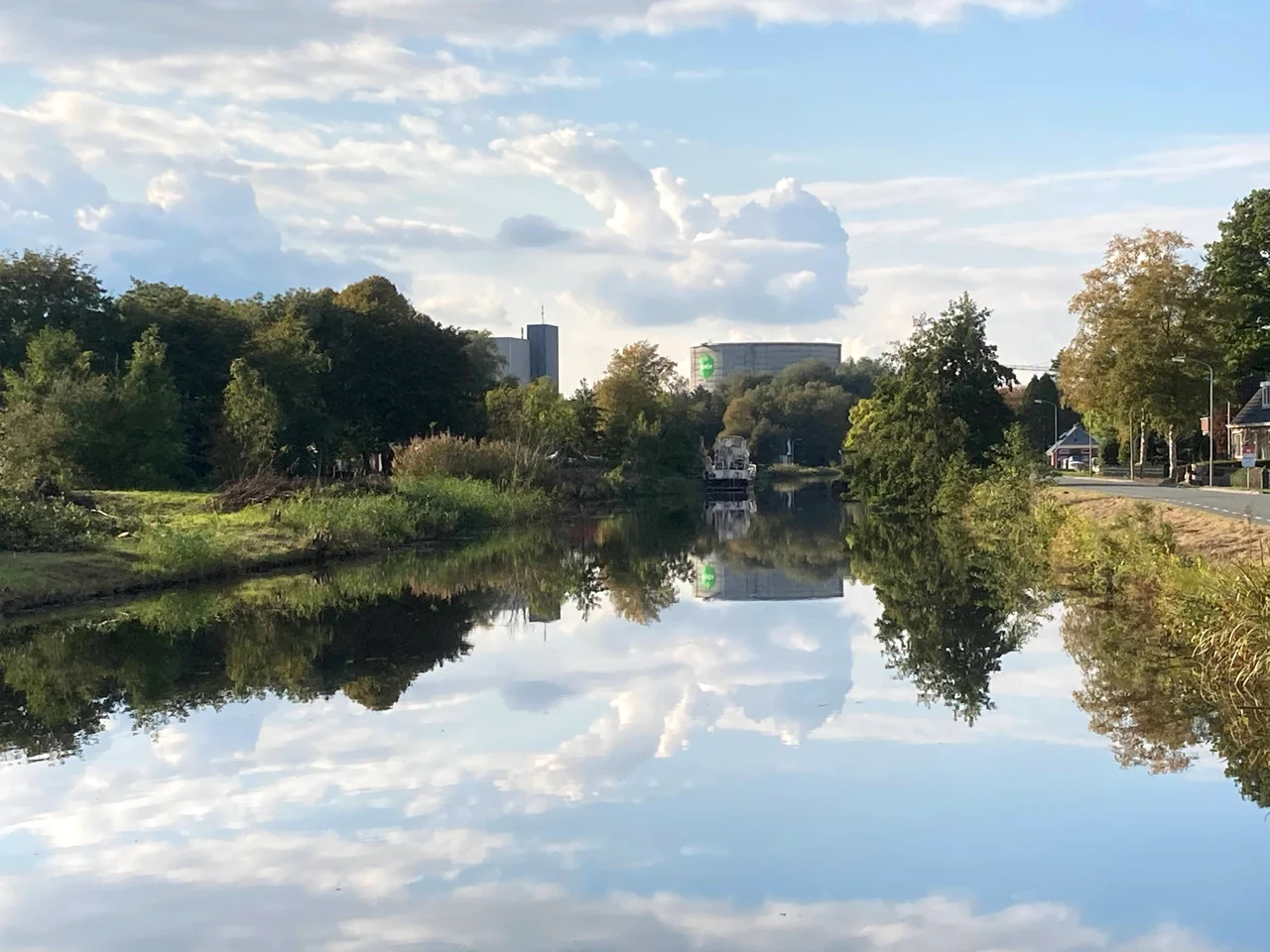
From above, Foxhol reads as a long industrial corridor along the Winschoterdiep, with the lake to one side and farmland stretching to the horizon. Tankers and barges still move starch product down the canal. The site of the original Eureka factory is still in operation, a continuous industrial footprint going back to 1842. To the east, the peat colonies fan out toward Veendam and Stadskanaal in their characteristic linear village pattern - long thin settlements stretched along their own canals, the geometry of an earlier industrial age still legible in the landscape.
From the Air
Foxhol sits at 53.17°N, 6.72°E along the Winschoterdiep canal, immediately southeast of Groningen city and Hoogezand. Industrial buildings and the wide canal corridor are visible from cruising altitude. The Zuidlaardermeer lake lies just south. Nearest airport is Groningen Airport Eelde (EHGG), about 15 km west.
Nearby Stories
- Low-Frequency Array 0.9 km away
- Eemshaven Railway Station 2.9 km away
- Nuis, Netherlands 3 km away
- Upstalsboom 3.4 km away
- Leer, Lower Saxony 7.9 km away
- Schiermonnikoog National Park 8.6 km away
- Börger 9 km away
- Drenthse Veenkolonien 9.9 km away