
Börger
Linguists believe the name Burgiri, recorded in 854, translates as high birch. The first 18 farms gathered around that tree, or that grove, and the village called Borger took shape on the sand of the Northern Hummling. For most of the next thousand years its residents would not have enough to eat. Each spring the men walked west across the border into the Netherlands to dig other people's peat for wages until the home crops were ready, and even that was not enough. Eventually many of them stopped coming back and crossed the Atlantic instead.
Four Tribes Before a Name
The archaeological record on the Northern Hummling reaches back about four thousand years. Stone tombs called Grosssteingraber and burial mound fields called Hugelgrabfelder still scatter the landscape, the work of people whose names no document preserved. Around the time of Christ, a tribe the Romans called the Amsivarier lived along the Ems river. Unlike many neighboring tribes, the Amsivarier refused to join Arminius at the Battle of the Teutoburg Forest in AD 9 and were considered allies of Rome. Around AD 58 the Chauci drove them from their Ems homeland; after Rome refused to grant them land, their fighters were killed in successive conflicts and the survivors distributed as slaves among neighboring tribes. Around AD 50 a Germanic group called the Chauken took over the region. By AD 400 the Saxons were pressing in from the east and the Frisians from the north. Both groups contested the area through the Middle Ages, with the Saxons generally holding the upper hand. Today's residents of Borger carry the inheritance of all four peoples, though most of that lineage was lost long before anyone wrote any of it down.
Founding in 854
The first written mention of Borger appeared in 854, in a document associated with the era of Charlemagne - Karl der Grosse to German speakers. The village name was spelled Burgiri then. By 879 the spelling had drifted to Burgium. By 1160 a document referred to it as Burgeren. In 2004, Borger celebrated 1,150 years of recorded existence. Eighteen farms in the village center - the area called the Dorfbusk - were the original nucleus. Over time the settlement grew into what geographers call a Haufendorf, a nucleated village rather than a planned street village. Two neighborhoods reportedly developed in this period, and according to local tradition the distinction between them survives in some form to the present day.
Subjects of Nobody, Then Subjects of Bishops
The medieval Hummling was scarcely populated, heavily forested, and effectively beyond the reach of any single ruler. The people who lived there never fully accepted the nobility's claim on them, partly because that nobility could not actually defend them. Pillaging from the Dutch, the Frisians, and the Stedinger swept through periodically. Local revolts erupted in 1340 and 1449, both following an earlier attempt in 1266 to gain protection by subordinating themselves to the Frisians - which failed. In 1394 the farmers of the North Hummling formally placed themselves under the protection of the bishop of Munster when he acquired authority over Cloppenburg. The deal was simple: in exchange for tax payments the bishop would defend them from raids. Whether he actually did is another question.
Thirty Years, Then the Plague
In 1647, during the Thirty Years' War, pillaging soldiers burned Wahn, Lorup, and six other villages along the Ems. The people of Borger hid in the swamps. Local tradition holds that one resident, Albert Dillen, was abducted by the soldiers and released only after he paid a ransom and promised the village would not be pillaged. After the war the Plague arrived. The 1666 outbreak was especially devastating to the Hummling population. The plague had been returning at intervals since the fourteenth century, each round cutting through a population that had no defense and little reserve. The church at Borger had been there since at least 1490, possibly earlier; its tower was first mentioned in 1523. The community shifted between Protestant and Catholic identity multiple times during the seventeenth century as different occupiers imposed different rules - Swedish soldiers persecuted Catholics in 1633; in 1659 it was declared that Borger would be Catholic again.
Hunger Sent Them West, Then West Again
Most of Borger's land was sand and swamp, useless for farming without fertilizer. The population survived on what little crop the suitable patches produced, supplemented by cattle and beekeeping. Between 1840 and 1880 came years of severe starvation. The poorest farmers and hired laborers suffered worst. Many men crossed each spring into the Netherlands to work as peat diggers and mowers, sending wages home or living on them until the home harvest was ready. Even that was not enough. Many decided that the only solution was to cross the Atlantic for the United States. The feudal system finally ended in 1887 and small farmers received clear ownership of their land, which began to improve the economy. In 1788 two daughter villages, Neuborger and Breddenberg, had been founded to absorb population pressure. In 1879 Borgerwald was settled in the forest. In the 1930s came Borgermoor. Those last two now form Surwold, with about 5,000 residents.
The Song From Borgermoor
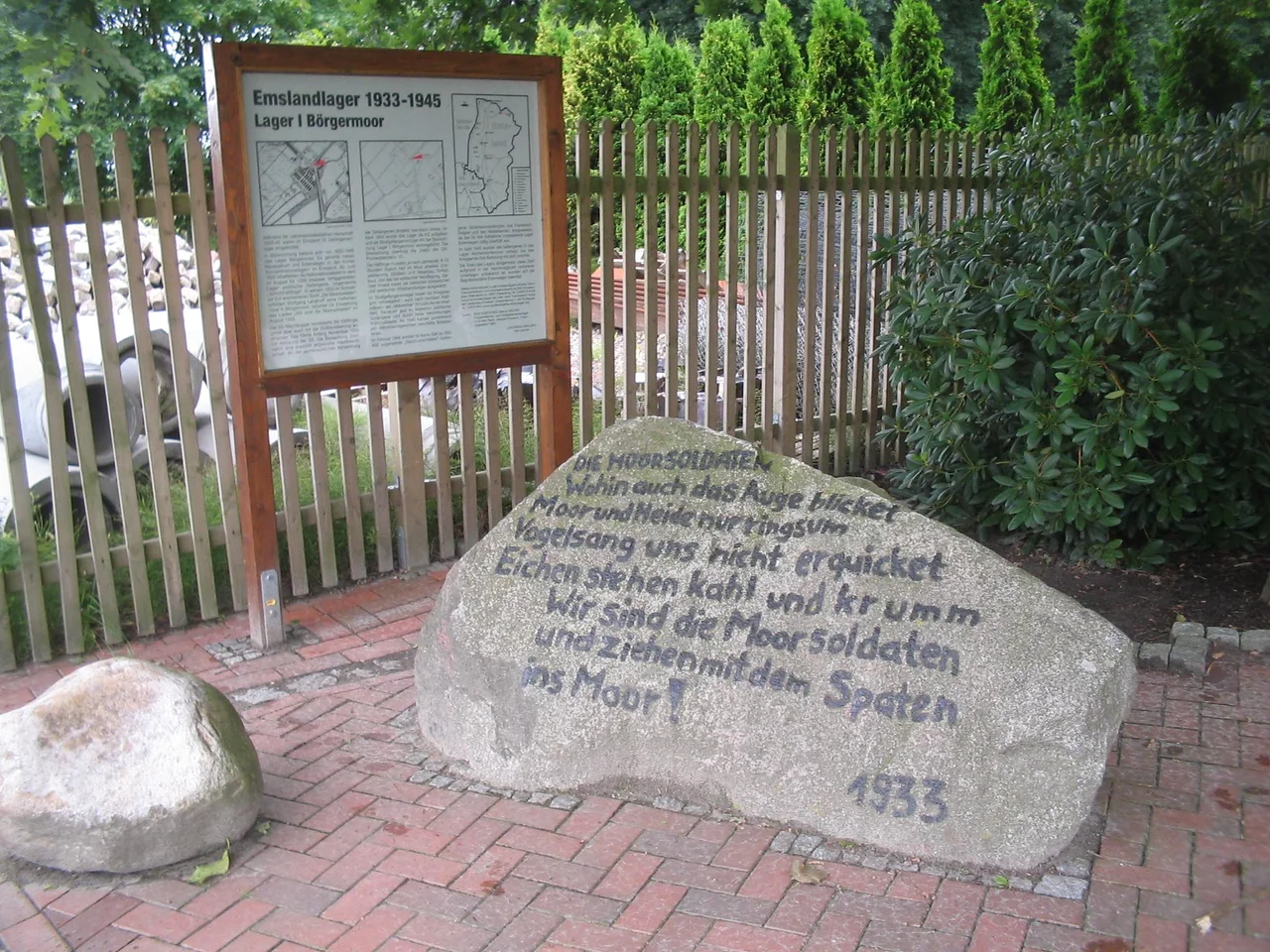
Borgermoor acquired a name far beyond its small size. It was the site of one of the first Nazi concentration camps, established for political prisoners in the early 1930s. Among the prisoners, the song known as Die Moorsoldaten - the Peat Bog Soldiers - was composed. The lyrics described the prisoners walking out each morning to dig peat with their spades on their shoulders, surrounded by guards. The melody is grim and slow. The song traveled out of the camp by way of released prisoners and spread across Europe, where it became one of the most widely sung resistance anthems of the twentieth century, translated into dozens of languages and recorded by Paul Robeson, Pete Seeger, and others. Its origin in this small corner of the Emsland is rarely acknowledged in those later versions, but the peat the song describes was dug from the same bogs that Borger's hungry sons had crossed the border for in the previous century.
From the Air
Located at 52.90 N, 7.52 E in the Emsland district of Lower Saxony, Germany, in the Northern Hummling region. The village is part of the Samtgemeinde of Sogel. Nearest commercial airport is Bremen Airport (EDDW), about 90 km east-northeast. Groningen Airport Eelde (EHGG) is about 95 km west across the Dutch border. The Dutch border lies about 30 km west, with Ter Apel and Westerwolde just beyond. The landscape is mostly flat polder and reclaimed bog with patches of forest; the village itself is small and sits in agricultural country. Visible at low to medium altitudes in clear weather.
Nearby Stories
- Oude Pekela 2.5 km away
- Broken Circle/Spiral Hill 7 km away
- Neuenhaus 7.8 km away
- 1st Panzer Division (Bundeswehr) 8.9 km away
- Damme Hills 9.1 km away
- Meyer Werft 13 km away
- Visbek 16 km away
- Siege of Lingen (1597) 17 km away