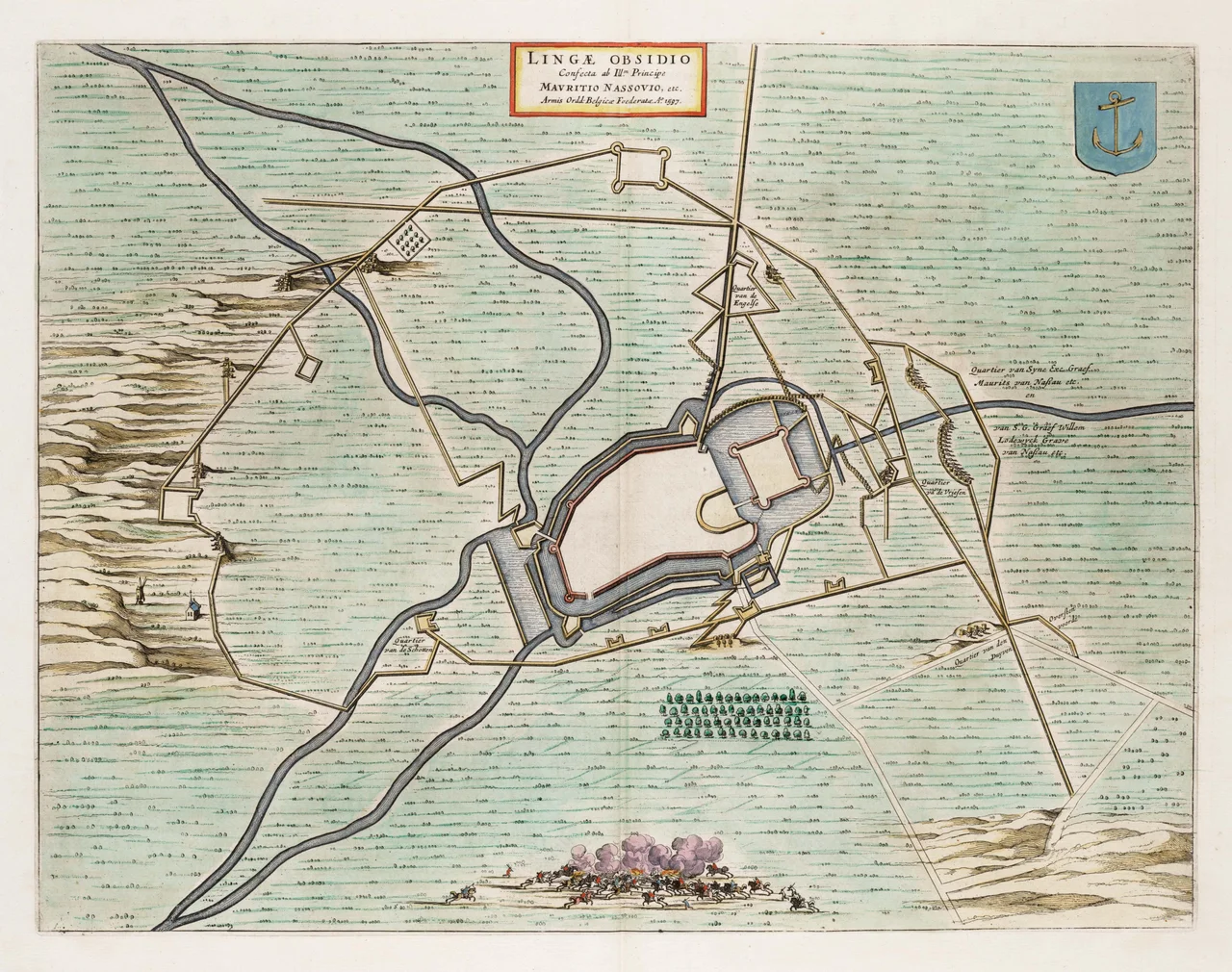

Siege of Lingen (1597)
Maurice of Orange did not arrive at Lingen with his artillery. That was the problem. His Dutch and English army marched in by land from recently captured Oldenzaal, crossing the Ems river without incident - but the big guns that would actually break the town's walls were still afloat, taking the long way around. They had to come by ship through the Wadden Sea, then upriver via the Ems. The detour cost several days. When the heavy artillery finally arrived and was dug in along the canal under defending fire, the siege of Lingen began in earnest. It was 25 October 1597, and the campaign that the Dutch would later call the Ten Glory Years was running toward its final chapter of the season.
Maurice's Method
By the autumn of 1597, the twenty-nine-year-old Maurice of Nassau had already established himself as the most methodical commander of his generation. The campaign that had begun that summer was, in the cold language of military results, one of the most successful of the Eighty Years' War: he had taken nine strongly fortified cities, five castles, opened the navigation of the Rhine, and rebuilt the eastern bulwarks of the Dutch Republic. Walking into Lingen was the closing move. His army included English and Scottish troops under Horace Vere - a name that would echo through English military memory for a generation. Horace's brother Francis Vere was already governor of Brielle and commander of Elizabeth I's forces in the Netherlands. Maurice's combined force fought, in effect, two wars in one place: the Dutch Eighty Years' War against Spain, and the Anglo-Spanish War of Elizabeth's England, fused on the same northern German border.
Cardinal's Letter
Inside Lingen, Frederik van den Bergh held the town for Philip II of Spain. As soon as Maurice's army arrived, the garrison made a brisk sortie out of the gates and burnt a mill standing within reach - a small disruption that achieved nothing strategic. The English and Scottish troops who formed the head of Maurice's attack drove them back. Then came the slow business of digging emplacements for the heavy guns by the canal, all of it conducted under steady fire from the walls. Once the guns spoke, they spoke with the brutal eloquence of late-sixteenth-century siege artillery: Lingen's fortified walls were pounded methodically. Van den Bergh waited for a relieving army. The Cardinal Archduke Albert, the Spanish commander in Brussels, sent only a letter, instructing him to save the city as best he could. With no rescue coming, Van den Bergh surrendered on 12 November 1597, after a siege of just over two and a half weeks.
The End of a Glorious Year
Lingen sealed the season. The Spanish abandoned Twente, as had been expected once Lingen fell, and military operations for the year ended. For the Dutch Republic, 1597 was simply the year the eastern border stopped bleeding. For Maurice, it confirmed a reputation that European captains would study for the next fifty years - the patient infantry, the disciplined siege engineering, the willingness to drag heavy guns through the North Sea rather than do without them. He did not need brilliant cavalry charges. He needed maps, gunpowder, supply lines, and time. The garrison that surrendered at Lingen was joining the long list of Spanish positions in the German borderlands that fell to a man who treated war as a problem of logistics rather than glory.
Eight Years Later
The victory was not permanent. In 1605, the great Genoese commander Ambrosio Spinola - then beginning his own campaign for Spain in the same theatre - retook Lingen for the Habsburgs. The town would change hands again in the long, exhausted decades of war that followed. But the siege of 1597 retained a particular significance in Dutch military memory. It was the closing punctuation on Maurice's most successful season, the moment when his method - cross the Ems, drag the guns, wait out the besieged - became indistinguishable from his identity. Walk along the Ems today, near Lingen, and the river looks too quiet to have ever carried siege artillery upstream. It did. And in October 1597, the guns it carried wrote the final lines of one of the most lopsided campaigns of the Eighty Years' War.
From the Air
The town of Lingen, where the 1597 siege took place, sits at approximately 52.52°N, 7.32°E in southwestern Lower Saxony, on the Ems river - the same river up which Maurice's heavy artillery was floated from the Wadden Sea. The terrain is gentle: river valley framed by low moor and farmland. Nearby airfields include Nordhorn-Lingen (EDWN) to the west and Münster Osnabrück (FMO/EDDG) about 55 km south. From cruising altitude, the Ems winding north toward Emden marks the same waterway that decided this siege.
Nearby Stories
- Haren, Germany 6.7 km away
- Vriezenveen 7.5 km away
- Ladbergen 7.8 km away
- Steinfurt 11 km away
- Westerbork 14 km away
- Berkelland 15 km away
- Alfsee 16 km away
- Cloppenburg (district) 21 km away