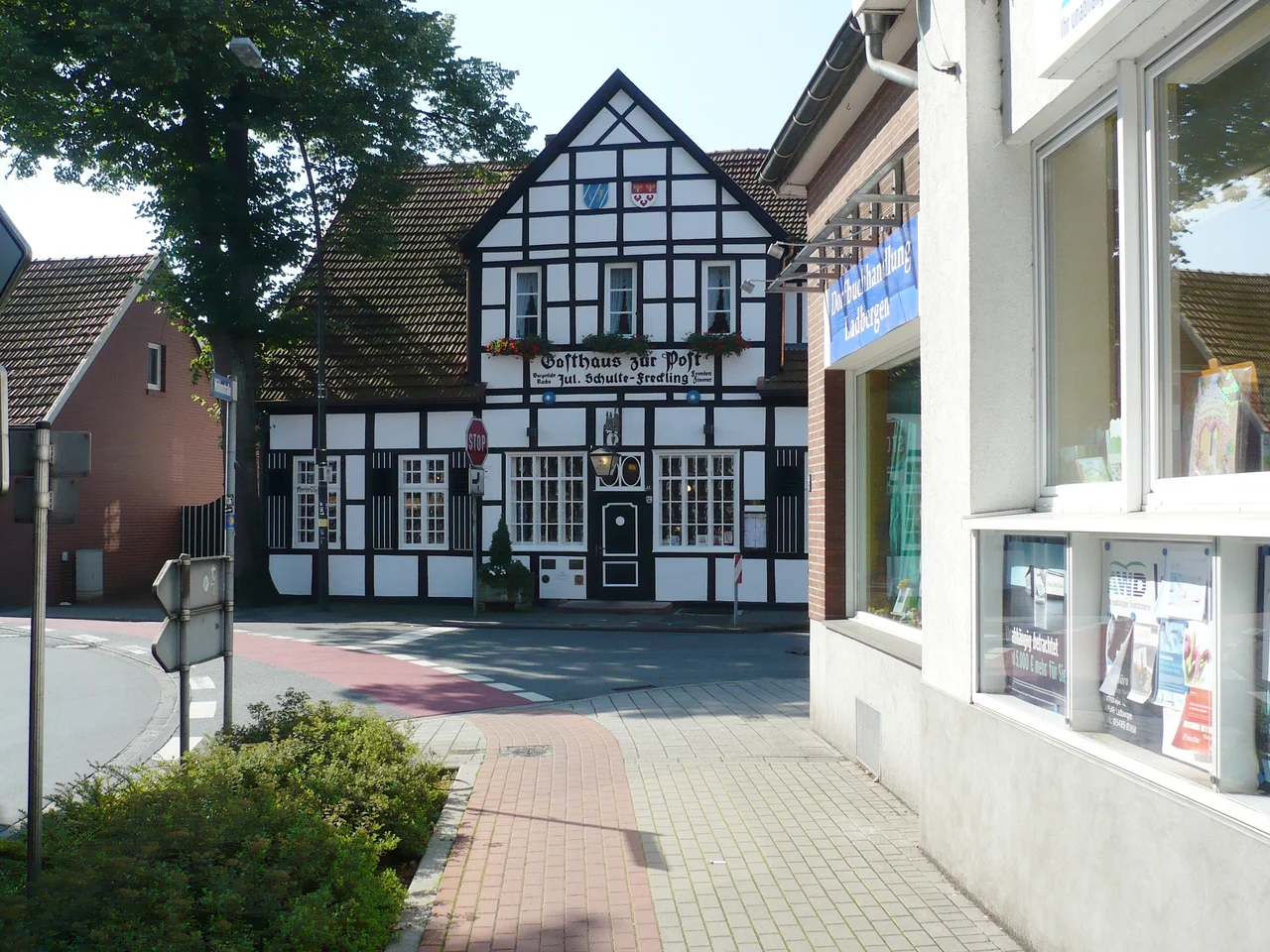

Ladbergen
Friedrich Wilhelm Kötter left Ladbergen for America in 1864. He was one of about 2,000 villagers - some 37 percent of the population - who emigrated during the nineteenth century, the highest emigration rate in any German community of the era. The sandy soil could not feed them, the bog drainage had not yet arrived, and Ohio looked better than another generation of hunger. Kötter settled with other Ladbergen emigrants in a village they called New Knoxville. A hundred and five years later, on 20 July 1969, his great-grandson Neil Armstrong stepped off a ladder onto the surface of the Moon. The line from a hungry Westphalian peasant to the Sea of Tranquility runs through three generations and 6,000 kilometers, and it is documented in the Ladbergen town hall.
Tallboys on the Aqueduct
The Dortmund-Ems Canal is one of Germany's strategic arteries, connecting the inland industry of the Ruhr to the North Sea ports. At Ladbergen the canal passes over the small Mühlenbach stream on a pair of aqueducts. During the Second World War those aqueducts became a target the Allies returned to obsessively, knowing that breaching them would drain the canal and stop barge traffic carrying coal, steel, U-boat components, and finished weapons. The Germans understood the threat. They installed two heavy 105mm flak batteries at Ladbergen - the kind of weapon usually reserved for defending major cities - and ringed the canal with lighter anti-aircraft guns. The defenses worked, for a while. Multiple raids failed. Then, on the night of 23-24 September 1944, Avro Lancaster bombers of No. 617 Squadron RAF - the famous Dambusters - returned with the new Tallboy bombs designed by Barnes Wallis. The Tallboys breached the canal banks. Traffic stopped for weeks. The shrapnel and the misses fell on the village.
The Glück of Cogeneration
For most of its history Ladbergen was a poor village on sandy soil with too many children. After the war it became something stranger: an energy producer disproportionate to its population. In 2005 a wind farm of three REpower MM82 turbines went up on the outskirts, each rotor sweeping more than five thousand square meters. The following year two anaerobic digestion plants joined them, fermenting agricultural waste into methane. Then in 2007 a wood-fired combined heat and power gasification plant opened at the canal harbor, producing 50 million kWh of electricity and another 60 million kWh of heat annually - enough power for 15,000 households, several times what Ladbergen itself consumes. The 6,400-person village now mathematically generates more energy than it uses. The excess feeds the nearby Airport Park at Münster Osnabrück.
The Names That Stayed
Of the families who did not emigrate, many carried surnames that appeared, recurred, and were eventually unique to Ladbergen itself: Gehde, Rahmeier, Schoppenhorst, Wibbeler, Wiethaupt, Wiethölter. These were not aristocratic lineages. They were the names of small farmers and millers and craftsmen who, generation after generation, married each other within the same handful of villages. The local dialect they spoke, called Ladbergen Platt, is a variant of Low German that until the 1930s was the dominant tongue in the village. A 2009 survey found just over 700 people - 11 percent of the population - still able to speak it, almost all over seventy years old. When that generation goes, Ladbergen Platt goes with them, but the names will probably linger in the phone book a while longer.
Markets and Sister Cities
In 1246, representatives of Münster, Osnabrück, Minden, and Herford met in Ladbergen and founded the Ladberger Marktbund - the Ladbergen Market Federation - one of the early precursors of the Hanseatic League and the broader patterns of Westphalian commercial cooperation that would shape northern German trade for centuries. The village was a meeting point: situated almost exactly halfway between Münster and Osnabrück, easily reached from Minden and Herford, central enough to host neutral negotiations. Eight centuries later Ladbergen's neighbors Lengerich and Lienen are twinned with Wapakoneta and Saint Marys, Ohio - Wapakoneta being, by another coincidence, Neil Armstrong's hometown. For New Knoxville's sesquicentennial in 1986, about a hundred Ladbergen residents made the trip across the Atlantic that their ancestors had made one-way in the previous century.
From the Air
Ladbergen sits at 52.14 N, 7.74 E in the Steinfurt district of North Rhine-Westphalia, almost exactly halfway between Münster and Osnabrück. The Dortmund-Ems Canal runs along the western edge of the municipality - look for the unnaturally straight east-west water cutting across otherwise irregular terrain. The canal aqueducts over the Mühlenbach, bombed by 617 Squadron in 1944, are still visible. Münster Osnabrück Airport (EDDG) is the nearest commercial field, just a few kilometers north. The three REpower wind turbines on the outskirts make distinctive moving landmarks. Terrain is flat (48-56 m elevation) across the entire municipality.
Nearby Stories
- Steinfurter Bagno 3 km away
- Osnabrück Canal 3.2 km away
- Bielefeld conspiracy 13 km away
- RAF Nordhorn 13 km away
- Hamm (Westfalen) Hauptbahnhof 21 km away
- Heinz Nixdorf MuseumsForum 25 km away
- Henrichenburg Boat Lift 27 km away
- Schnoor 81 km away