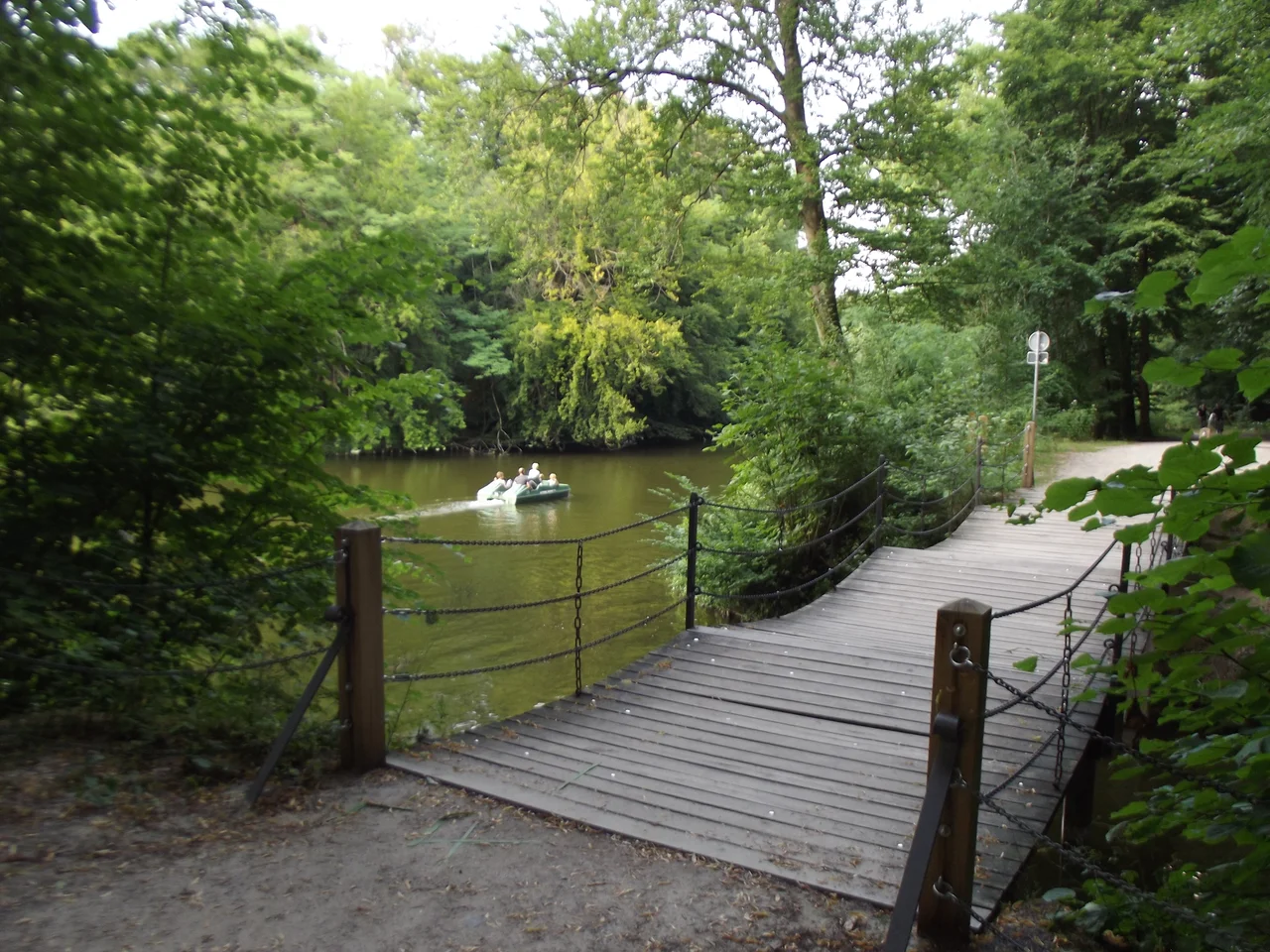

Steinfurter Bagno
Imagine standing on a 125-hectare lawn east of a moated castle in 1787 and counting one hundred and five separate buildings: a Greek temple, an Egyptian gateway, a Chinese palace, a Gothic chapel, an Arion ship moored on a lake, fountains in every direction, statues lining the avenues, an artificial castle ruin on its own island. Imagine that this was one Westphalian count's idea of a summer house. The Steinfurter Bagno - named, with cheerful directness, after the Italian word for bath - was for a few decades the most lavish landscape garden in northwestern Germany.
A Count Goes Shopping in Europe
Charles Paul Ernest of Bentheim-Steinfurt founded the park in 1765. He had traveled abroad, returned with French garden plans, and laid down something his neighbors had never seen: strict symmetry, geometric beds, water cascading on cue. When his heir Count Louis succeeded in 1780, fashion had changed. Louis began stuffing the place with what the period called the picturesque - the so-called Greece and Egypt, imitations of Oriental and Far Eastern styles, exotic trees planted to look as though they had grown there forever. The oldest surviving layout, dated 1787, records 105 buildings, fountains, bridges, statues, islands, gardens, and paths squeezed onto the grounds.
From French Order to English Wilderness
The Bagno did not stay frozen in its first design. Critics began grumbling that the park was too crowded, too gaudy, too theatrical - and the English landscape garden, with its meandering paths and apparently natural cascades, was sweeping across Europe. Straight avenues were rerouted into curves. Lawns were opened up. Pompous little ships sailed an enlarged lake. A widely known chapel held weddings and concerts. In an unusually modern gesture, the count opened the gates to the general public - this was a private pleasure ground, but the village could come walk in it.
Napoleon's Bill Comes Due
Then 1806 arrived, and with it the Confederation of the Rhine. Napoleon's vassals seized the county. Count Louis traveled to Paris to plead his case directly with the emperor and got nowhere. His son Alexius inherited a park he could no longer afford. By 1828, of the 39 buildings still standing in 1806, only sixteen remained - and of those sixteen, just three would survive to the present day: the concert hall, the New Guardhouse, and the artificial castle ruin on its island. The Arion ship, the Chinese palace, the Egyptian gateway - all of it became firewood or rubble.
What 4.1 Million Euros Restores
The park kept going as a public walking ground - quieter, plainer, but never abandoned. In 2004, state contributions of 4.1 million euros funded a serious restoration; the refurbished free-standing concert hall, one of the oldest in Europe, became popular all over again for chamber music and weddings. In 2006 the Bagno joined the European Garden Heritage Network. The fountains no longer leap a hundred feet, the Far Eastern follies are long gone, but the bones of the original landscape - the lake, the avenues lined with old beech and oak, the islands - still tell the story of a count who once tried to fit the world into 125 hectares.
From the Air
Coordinates 52.141 N, 7.357 E. The Bagno lies immediately east of Burgsteinfurt's moated castle complex; from above it reads as a wedge of mature woodland and lawn with a distinct lake at its center. Recommended viewing altitude 2,000-3,500 ft AGL. The dark green park stands out against surrounding agricultural fields. Nearest airports: Munster/Osnabruck International (FMO/EDDG) about 30 km southeast; Enschede Airport Twente (EHTW) across the Dutch border. Often paired visually with Steinfurt town in a single low pass.
Nearby Stories
- Ladbergen 2 km away
- Vriezenveen 4.9 km away
- RAF Nordhorn 5.9 km away
- Siege of Groenlo (1627) 8.8 km away
- Osnabrück Canal 15 km away
- Haldern Pop 16 km away
- Lembeck Castle 19 km away
- Hamm (Westfalen) Hauptbahnhof 20 km away