
Siege of Groenlo (1627)
Picture a small marshy town in the Achterhoek surrounded, in the span of ten days, by a continuous earthen wall ten feet tall and sixteen kilometers long. That is what greeted the Spanish garrison of Grol when they looked out over their ramparts in late July 1627. Frederick Henry, Prince of Orange, had arrived with more than 19,000 men, 1,000 supply carts, and a method that would change how the Dutch fought wars - encircle, isolate, dig, and wait.
A Town That Mattered More Than Its Size
Grol - the name Groenlo still carried in the seventeenth century - was barely a city. Yet anyone holding it controlled the Achterhoek and the Veluwe, because the surrounding marshland made every approach a slog. The Hanseatic trade route to Germany ran past its walls. Heavy taxes flowed through its tollhouses into the Spanish war treasury. Together with Oldenzaal, Bredevoort, and Lingen, Grol formed an eastern arc of Spanish strongholds aimed at the heart of the Dutch Republic. When Ernest Casimir took Oldenzaal in 1626, the States-General made a deliberate choice: instead of pouring more money into naval warfare, as Holland and Zeeland wanted, they would build an army big enough to peel away the rest of the arc. Grol was the obvious next target.
The Sixteen-Kilometer Ring
The technique was called circumvallation, and Frederick Henry had watched the Spanish commander Ambrosio Spinola use it to take Breda just three years earlier. Now he reversed the lesson. Thousands of soldiers and hired laborers - Scots, English, Frisians, French, Germans, Dutch - threw up a continuous earthen wall around Grol while Spanish cannon fired uselessly into the empty space between. Frederick Henry organized the work by nationality, giving each contingent its own fortified bastion: the Engelse Schans for the English, separate ramparts for the French, the Frisians, the Hollanders. Guns were placed so the line could be defended from any direction, sited just beyond the reach of the city's artillery. In ten days, the ring was closed. For the rest of the siege, it was constantly reinforced.
Inside the Walls
Matthijs Dulken commanded the Spanish garrison - 1,200 foot soldiers, about 100 cavalry under Lambert Verreyken, plenty of food, and orders to wound the enemy by musket or cannonball any way possible. The defenders worked tirelessly. They repaired the damage from Dutch bombardment, poured burning oil onto pioneers trying to dam the city canal, and counterattacked the trench-digging positions. Two hundred incendiary fireballs landed inside the town, burning buildings and killing inhabitants. Dulken took a musket ball in the shoulder and handed command to Verreyken. Then a careless soldier touched off two barrels of gunpowder by accident, killing forty bystanders in a single blast. The garrison fought on.
The Relief That Came Too Late
Frederick Henry's cousin, Hendrik van den Bergh, was marching north with a large Spanish army reinforced by 1,800 German mercenaries. By the time he reached the area, his force outnumbered the Dutch in the field - but he had arrived too late and too poor. His soldiers were short on supplies, his Spanish and Italian troops were quarreling, and the Dutch ring stood ready. Van den Bergh fired his guns so the garrison would hear that help had come. Then he tried to break the circumvallation at the Scottish rampart. The attack nearly succeeded before a counterattack led by Officer Morre threw the Spaniards back. On August 18, English sappers blew a mine under one of Grol's outer defenses, the faussebray, opening a great hole. Verreyken waited inside with hundreds of muskets and burning tar and repelled three assaults, killing many of the attackers. But Dulken knew the math. He called for an armistice.
What the Earth Remembers
The treaty borrowed its terms from Breda. The Spanish garrison marched out on August 19 with their arms, their loot, two cannon, and 200 borrowed Dutch carts to carry their gear. Frederick Henry then destroyed the entire circumvallation, filling the trenches so no future attacker could reuse them. Hugo de Groot wrote a detailed account, the Grollae Obsidio. Joost van den Vondel composed a 738-verse ode. A Dutch saying, Zo vaste as Grolle - as sturdy as Grolle - entered the language. Then the earth swallowed the story. Until the hot summer of 2003, when an ultralight pilot spotted a strange pattern in a barren cornfield: bright green plants tracing the outline of the French rampart. The old canal beds were still holding water just below the surface. The English rampart near Lievelde has since been excavated and restored, and every two years reenactors from across Europe converge on the town for the Slag om Grolle - the most recent gathering in October 2024.
From the Air
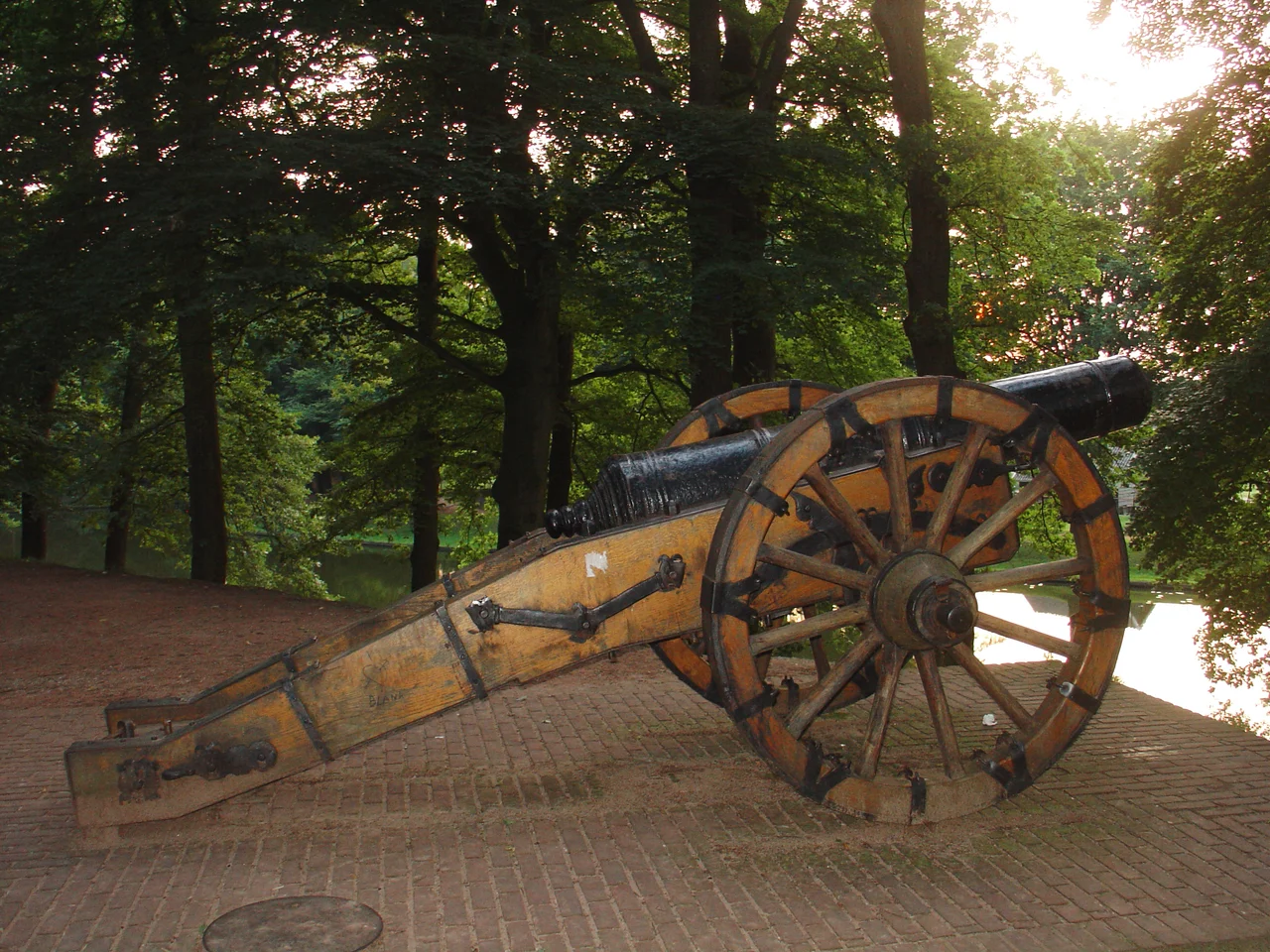
Groenlo sits at 52.05 degrees N, 6.62 degrees E in the Achterhoek of Gelderland, about 15 km west of the German border. Nearest airports: Twente Airport (EHTW) about 30 km north, Münster-Osnabrück (EDDG) about 60 km east, Niederrhein/Weeze (EDLV) further south. From altitude in clear conditions, look for the compact medieval street grid of Groenlo against the flat, hedge-divided fields of the Achterhoek; the restored bulwarks and the cannon on the Kanonswal are visible from low passes.
Nearby Stories
- Notre Dame des Anges 5.2 km away
- Anholt Castle 5.4 km away
- Nordhorn 6.1 km away
- Veluwe 7.4 km away
- Vriezenveen 8.9 km away
- Gronau, North Rhine-Westphalia 10 km away
- Lowlands Festival 15 km away
- Ewald Colliery 33 km away