.jpg)
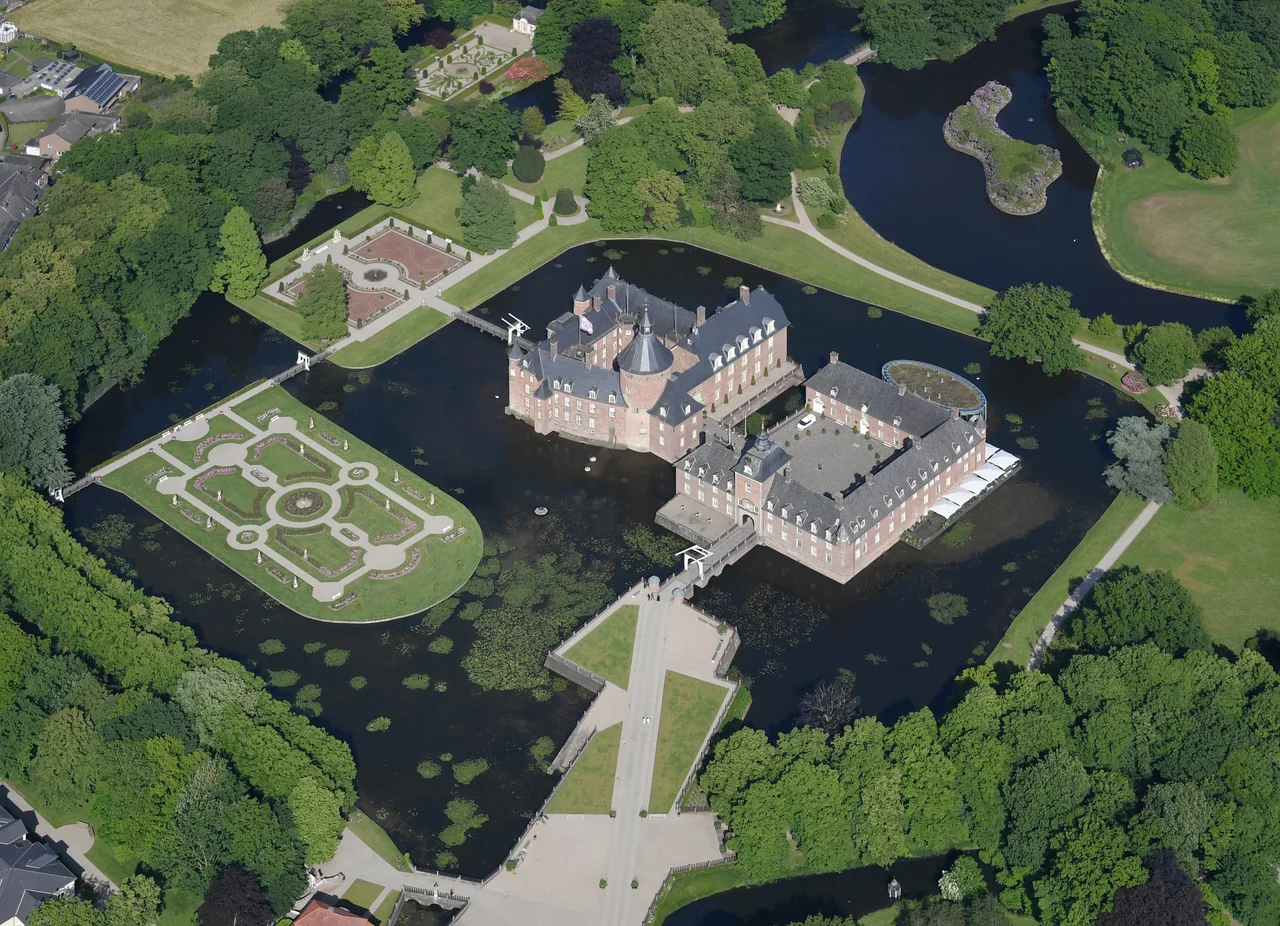
Anholt Castle
In a glass case inside the family archive sits a small lead bullet, deformed by impact. It is the slug that killed Emperor Maximilian I of Mexico on a hill outside Querétaro on 19 June 1867. His aide, Felix Salm-Salm, brought it home to the Lower Rhine. Home was Anholt Castle, the broad moated palace on the river Issel that the Salm-Salm princes still own today. That a bullet from a Mexican firing squad ended up on a German castle wall is the kind of fact Anholt collects without fuss. Eight hundred years of dynastic intrigue, marriage, plunder and restoration have left the place crowded with souvenirs.
Water and Stone
The castle stands on swampy ground, its tufa walls planted on timber piles that have held since before 1169. At the heart of the complex is the Dicke Turm, the Thick Tower, an eleven-meter round keep whose entrance once sat seven meters above the courtyard so that an attacker had to climb a removable stair. A dungeon waited below. Around 1700 Prince Charles Theodore of Salm crowned this medieval shaft with a soaring slate spire and rendered every facade smooth to imitate cut ashlar. The Milanese architect Tommaso Tommassini reshaped the outer bailey between 1697 and 1703. What had been a fortress became a stage set for baroque court life, framed by water on every side.
The Salm-Salm Inheritance
Anholt has passed through three great dynasties: the Lords of Zuylen, who freed its inhabitants from serfdom in 1347; the Bronkhorst-Batenburgs, raised to Imperial Counts in 1621; and from 1647 onward the House of Salm-Salm, who arrived through marriage and never left. They survived the Eighty Years' War, the Thirty Years' War, Napoleon's annexation in 1810 and the Congress of Vienna's reshuffling in 1815. Sovereignty came and went. The estate stayed. Today it remains one of the very few large estates in North Rhine-Westphalia still in private hands, and the family still lives in the house they have restored twice.
Rembrandt on the Wall
In spring 1945 seventy percent of the castle was destroyed. Prince Nikolaus Leopold zu Salm-Salm began rebuilding almost immediately, and to fund the work he opened parts of the house to the public. Today visitors walk through state rooms hung with the largest privately owned painting collection in the state. Rembrandt's Diana Bathing with Actaeon and Callisto hangs alongside works by Jan van Goyen, Gerard ter Borch and Lucas Cranach the Elder. Much of it survived the war because someone had the foresight to ship it into a mine tunnel before the bombs fell. An armoury, porcelain, period interiors and a 230-square-meter neoclassical library round out the inventory.
Anholter Schweiz
Between 1892 and 1900, Prince Leopold zu Salm-Salm built himself a private Switzerland. Inspired by Lake Lucerne, he laid out a miniature lake with artificial rocks and a wooden chalet on the estate grounds. The Anholter Schweiz became a game reserve in the early twentieth century, was rebuilt after the war, and opened to the public in 1966 as a wildlife park. Elsewhere on the grounds a court gardener named Maximilian Friedrich Weyhe and later the English landscape architect Edward Milner turned the eighteenth-century French parterres into something closer to an English park. The Baroque sections were rebuilt between 1962 and 1995, partly in their original geometry.
Castle, Hotel, Wildlife Park, Golf Course
Anholt does not pretend to live entirely in the past. The wildlife park draws families. The on-site hotel rents rooms with views over the moat. There is a restaurant with terraces, a water pavilion, and a golf course on the grounds. The castle has appeared on television, including the 2011 ARD fairy-tale Cinderella. A working noble estate in the twenty-first century has to earn its keep, and Anholt has chosen to do so by inviting people in rather than by selling parcels off. The result is a place where a Rembrandt, a chalet, a moat and a tee box all sit on the same map.
From the Air
Coordinates 51.84N, 6.43E. The castle sits on the Dutch border, between Isselburg and the Achterhoek, where the Münsterland meets the Lower Rhine. From altitude look for a near-square island of buildings inside a continuous rectangular moat, with the round Dicke Turm anchoring one corner and a long avenue of trees leading away to the west. Nearest airports are Niederrhein (EDLV, ~25 km southwest) and Düsseldorf (EDDL, ~80 km south). Schiphol (EHAM) lies about 140 km west.
Nearby Stories
- Zollverein Coal Mine Industrial Complex 2.1 km away
- Achilles '29 2.5 km away
- Ysselsteyn German War Cemetery 6.7 km away
- Siege of Groenlo (1627) 8 km away
- Hoge Veluwe National Park 13 km away
- Landschaftspark Duisburg-Nord 19 km away
- Gronau, North Rhine-Westphalia 20 km away
- Ewald Colliery 23 km away