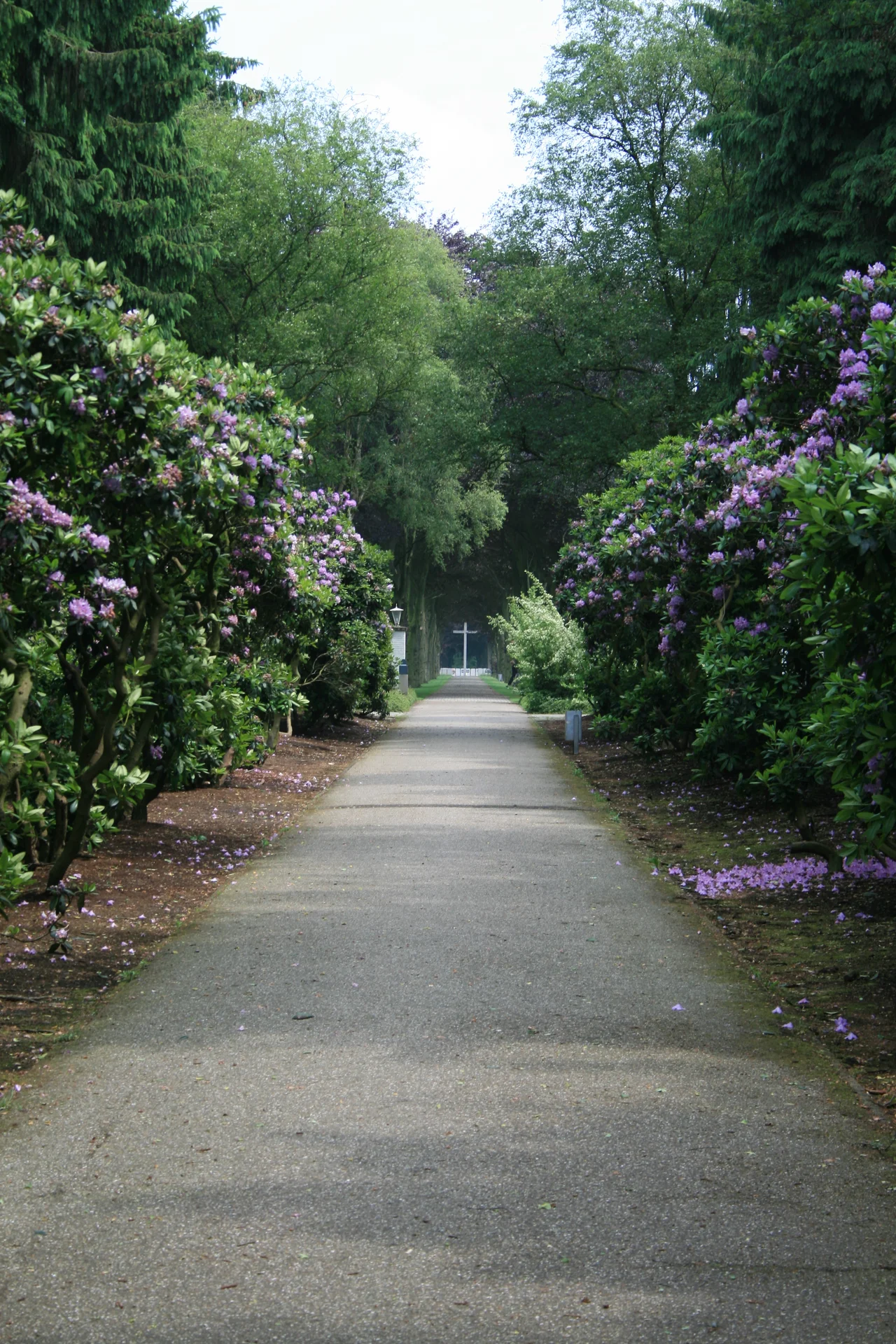

Ysselsteyn German War Cemetery
There are 31,598 of them. Concrete crosses in a quiet Dutch field, twenty-eight hectares of them, laid out in geometric rows beneath the trees of Limburg. Most are the dead of the German occupation of the Netherlands between 1940 and 1945 - young men in Wehrmacht uniforms, killed in skirmishes with the resistance, in air attacks, in the long retreat after Market Garden, on the Hürtgen and Ardennes fronts just over the border. Among them lie men who carried out atrocities. Among them lie boys of eighteen and nineteen who were given a rifle and an order and a uniform and never quite understood what the war was about. Among them lie 87 soldiers from the First World War whose bodies floated down the Meuse from the Western Front because the Netherlands was neutral and would not let their armies cross. Ysselsteyn is the largest German military cemetery outside Germany, and it is the only Nazi-German cemetery in the Netherlands.
Why Here
Limburg in 1944 and 1945 was the killing ground of the Allied advance through the southern Netherlands. The British Second Army pushed northeast through this exact landscape during Operation Market Garden; the American First Army fought eastward across the Meuse toward Aachen and into the Hürtgen Forest. Thousands of German soldiers died in fields and farmhouses and bombed-out villages within a day's drive of here. After the war ended, the dead had to be put somewhere. The Dutch government allocated a tract near the village of Ysselsteyn, in the municipality of Venray, about 32 kilometres east of Eindhoven, and the long process of exhumation and reburial began. Around 250 of the men interred here had died in the Battle of the Bulge in the Ardennes and the brutal fighting in the Hürtgenwald, and were initially buried beside their American adversaries at the Netherlands American Cemetery in Margraten before being moved here in keeping with post-war conventions about separating victors from vanquished.
Who Lies in the Ground
Calling it a German cemetery is a partial truth. The 25 nationalities buried here include Austrians, Dutchmen who fought for the Reich, Poles, Russians and Belarusians, Belgians, Czechs, Luxembourgers, Slovaks, men from the Danzig Free State, even men from Kazakhstan and Azerbaijan - the so-called Volksdeutsche, ethnic German communities scattered across central and eastern Europe, conscripted or coerced or volunteered into the Wehrmacht and the SS as the war ground east. Some were teenagers. Some were career officers. Roughly 3,000 had been assigned to occupation duties: the razzias, the round-ups, the deportation of Jewish families, the hunt for hidden people in the countryside and the cities. About 250 had been killed by the Dutch resistance. More than 5,000 graves are unknown burials, marked only Ein Deutscher Soldat - A German Soldier - which is itself often inaccurate given the mix of nationalities. The German War Graves Commission took over administration in 1976.
The Most Notorious Name on a Stone
Among the named dead is SS-Obersturmführer Julius Dettmann, born 1894, died 25 July 1945 in Allied custody. He was the officer who, on the morning of 4 August 1944, took the phone call at the SD office in Amsterdam from the informant who reported the hiding place of the Frank family in the Prinsengracht 263 annexe. Dettmann dispatched the arresting party that took Anne Frank, her family, and the others into custody and ultimately to the camps where most of them died. He killed himself in detention before he could be tried. His grave at Ysselsteyn is one of many here that complicate the simplest possible question a cemetery can ask: who is this person and how should I feel about them. The cemetery does not editorialize. The crosses are identical. The visitor has to do the moral work.
Architecture of Restraint
The grounds were designed for solemnity rather than monumentality. Most burials are individual graves marked by a grey concrete cross bearing, where the name was known, the man's name, his rank, and his dates of birth and death. A tall central cross stands in the memorial plaza. Roads extend left and right from the plaza past a carillon and a section of common graves. A memorial stone honours Captain Johan Lodewijk Timmermans, a Dutchman who served as manager of the cemetery from 1948 to 1976 on behalf of the Dutch government, and whose ashes were scattered here at his own request - a small, complicated grace note in a place that is otherwise about other people's dead. The cemetery hosts an International Youth Meeting Centre, where young people from Germany, the Netherlands, and elsewhere meet to study the war and its consequences.
Mourning and Protest
Since the 1960s, the cemetery has been the focus of repeated protests. Most have come from Dutch anti-fascist groups objecting to the presence of SS graves in their country, and to public commemorations there. In 2013 the Anti-Fascist League AFVN found that since 2000, the German ambassador had been laying wreaths annually at the cemetery. In 2020 the AFVN's petition against these visits gathered support from Dutch and German Jewish leaders, including the Dutch chief rabbi Binyomin Jacobs, the Nazi-hunter Beate Klarsfeld, and the board of the Dachau memorial. The ambassador stopped the practice. That same year, the U.S. ambassador to the Netherlands visited the cemetery and posted photographs of the graves, an act that drew its own controversy. Neo-Nazis occasionally appear here too, leaving flowers at particular graves; in November 2020 a Belgian woman placed flowers at the grave of Willem Heubel, the first Dutch SS-volunteer.
What a Field of Crosses Asks
Ysselsteyn is not a place that resolves easily. Some of the dead here were murderers in uniform. Some were Polish farm boys who happened to have a German grandfather and were never given a choice. Most lie in between. The crosses do not distinguish, because crosses cannot. The cemetery exists because, after a war that killed more than 60 million people, the survivors had to put the bodies somewhere, and Germany's enemies decided - in the Netherlands and elsewhere - that even soldiers who had served a monstrous regime would be given graves and dates. Mothers and widows came here for decades looking for the names. Most of them are gone now. The visitors are mostly their grandchildren, and the schoolchildren, and the historians, and people who simply want to see what 31,598 graves look like when they are laid out in rows under the Limburg sky. They look like a lot.
From the Air
The cemetery sits at 51.47°N, 5.90°E in the village of Ysselsteyn in the municipality of Venray, central Limburg, about 32 km east of Eindhoven and roughly 25 km west of the German border. From the air it is identifiable as a precisely rectangular wooded compound of about 28 hectares set among the open agricultural fields of the Peel region, the rows of grey crosses visible as fine geometric texture beneath the canopy. Nearest major airport: Eindhoven (EHEH), about 35 km west-southwest. Nearest smaller field: Niederrhein/Weeze (EDLV) across the border in Germany, about 35 km north-northeast.
Nearby Stories
- Aldendriel Castle 1.2 km away
- Rheindahlen 2.4 km away
- Ted Swales 4.5 km away
- Maaseik 5.7 km away
- Fort Crevecoeur 6.2 km away
- Haldern Pop 15 km away
- Bismarck Tower (Viersen) 17 km away
- City Hall of Tilburg 20 km away