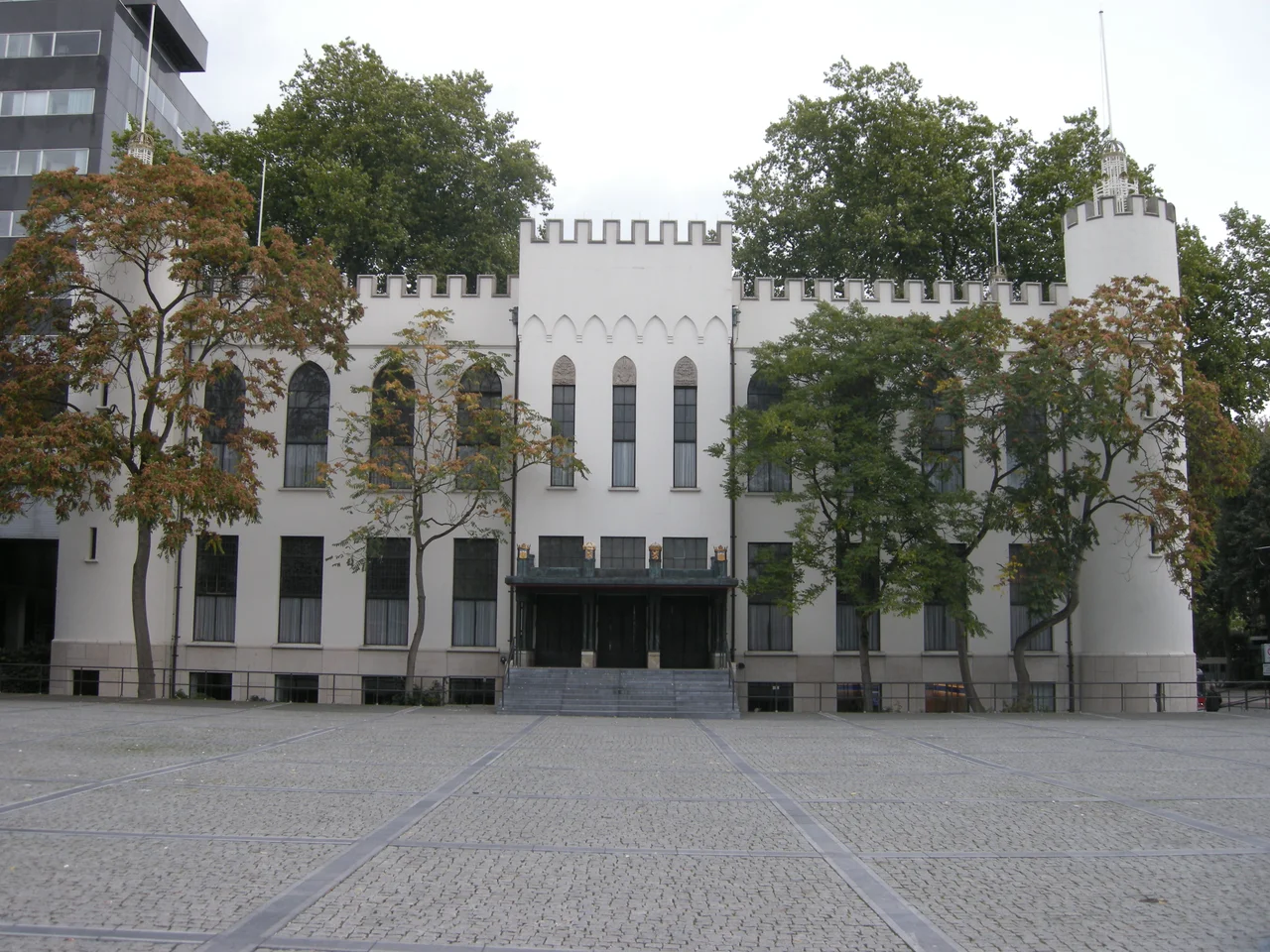

City Hall of Tilburg
William II of the Netherlands laid the cornerstone on 13 August 1847 and paid the carpenter ƒ57,000 to build him a country retreat in the textile town of Tilburg. By 7 April 1849 the building was complete: a neo-gothic palace with four corner towers and a piano nobile fit for receiving foreign guests. The king never set foot inside it. He had died on 17 March 1849, exactly twenty-two days before his palace was handed over. The building has spent every year since looking for a purpose to inherit from the monarch who never used it.
A King in Need of a Country House
Before the new palace, William used a row of houses bought in 1835 behind the Saint Denis church from a family called Frankenhoff, knocked together into what the records politely call a 'sober palace'. When he became king in 1840, that arrangement no longer matched his new station. The old residence was demolished in 1847 to make way for the new building, constructed in its own former back garden. Legend has it William drew the first sketches himself, returning to the neo-gothic style he had absorbed during his English childhood. The drawing teacher Frederik Lodewijk Huijgens of the royal military academy in Breda and royal master builder Jan C. Boon almost certainly fleshed out his ideas. The result was deeply traditional: a half-buried basement that was the norm for palaces of the era, a grand piano nobile above for entertaining, and four round towers at the corners enclosing four independent stone stairwells.
Van Gogh, Mediocre Student
The Dutch royal family kept ownership of the empty palace, but a building of that scale could not stay empty forever. In November 1863 Tilburg's city council wrote politely asking whether the king's house might serve as a new kind of secular high school - the Hogere Burgerschool, or HBS, aimed at middle-class boys destined for trade and industry rather than university. Permission came in 1864. Alterations began in 1865. On 9 April 1866 the building reopened as the Koning Willem II school. Among its first cohort was a thirteen-year-old boy named Vincent van Gogh, who attended classes from 1866 until he left, for reasons no one ever wrote down, in 1868. His average grade across his subjects was 7.36 on a Dutch ten-point scale - a respectable mark, but not a brilliant one. His art teacher was the painter Constant Cornelis Huijsmans, and the rooms where one of the most famous painters in Western history first learned to draw are still standing inside the building.
The First Girl Through the Door
The school's early decades were rocky. Staff turnover was constant and student numbers small. Catholic clergy attacked the secular curriculum from the pulpit. The school admitted only boys until 1894, when the mathematics teacher's daughter Maria Bes became the first girl to enrol. She passed her exams in 1899 and went to Delft to study engineering. She became one of the first female engineers in the Netherlands, and her name belongs to the palace as much as the king's does, even if no plaque mentions her. By the 1920s the building finally received electric light and central heating, and the original 50-year-old desks were replaced. In 1934 the school moved out for lack of space, leaving the palace empty again at 85 years old and structurally exhausted.
More Gothic Than It Ever Was
Tilburg's city council had been quietly considering turning the building into a new city hall since 1931. The conversion ran from 1934 to 1936 under an architect from Nijmegen, who tried to restore the building's original character but couldn't resist improving on it. He brought back the lost merlons. He replaced the square windows with pointed lancet windows. He swapped the slender pinnacled entrance towers for a single central projection - a risalit - with an art deco doorway tucked into the gothic stonework. The result, opened on 1 August 1936, was more gothic than the palace had ever actually been. Inside, the piano nobile was rearranged with wedding rooms in the northern wing and the mayor's office in the southern wing. A new half-circular stairwell carried a broad marble spiral staircase, lit through stained glass by Joep Nicolas depicting the virtues of administrators and figures from classical antiquity. On the lintel of the council chamber, the painter Henri Sicking added a fresco of a woman flanked by two others, writing the Latin words CVLTVRA and OECONOMIA - culture and economy - on a banner draped across a book.
The Palace Now
The palace lost its main administrative role in 1971 when a much larger modern city hall opened next door, connected by a sky bridge across the north side. The Paleis-Raadhuis still functions as a ceremonial space, the place where Tilburg holds weddings, oath-takings, lectures, and symposia in the half-circular stairwell beneath Joep Nicolas's stained glass. During the Second World War it had served a starker purpose: a German observation post for spotting Allied aircraft. It has been royal palace, secular school, wartime watchpost, and council chamber - four lives in 175 years for a building whose first occupant was supposed to be one king who never came.
From the Cockpit
Tilburg sits in central North Brabant province, roughly midway between Antwerp and Eindhoven. The Paleis-Raadhuis stands a short walk from the Saint Denis church in the older heart of the city. Coordinates 51.55°N, 5.09°E. Best viewed at 1,500-3,000 feet, looking for the four-towered footprint and the connecting sky bridge to the modern city hall to the north. Nearest airports: Eindhoven (EHEH) 30 km east; Rotterdam The Hague (EHRD) 70 km west. Tilburg railway station is roughly 800 m north.
From the Air
Located at 51.55471°N, 5.08686°E in central Tilburg, North Brabant. Look for the four-cornered neo-gothic palace with a connecting sky bridge to the modern city hall on its north side. Recommended viewing altitude 1,500-3,000 feet. Visual landmarks: the spire of the Saint Denis church immediately adjacent, Tilburg railway station 800 m north, and the green band of the city centre park. Nearest airports: Eindhoven (EHEH) 30 km E; Rotterdam The Hague (EHRD) 70 km W.
Nearby Stories
- Feyenoord 5.4 km away
- Heinz Struning 6.8 km away
- Moerdijk 7.5 km away
- Neder-Betuwe 8.7 km away
- Volkel Air Base 9.3 km away
- Kapellen 9.9 km away
- Campine 12 km away
- Limburg (Netherlands) 25 km away