
Heinz Struning
At six in the evening on 24 December 1944 - Christmas Eve - Heinz Struning climbed into his Messerschmitt Bf 110 over Cologne and went hunting Lancasters. Above him in the dark, in a fast wooden Mosquito, an RAF Flight Lieutenant named R.D. Doleman was hunting him. Doleman won. Struning bailed out of his burning aircraft and struck the tail on his way down. His body was found two months later. He was 33, and the war he had given his adult life to was four months from ending. The numbers in his file are 56 victories and 280 missions; the names beneath those numbers are the crews of British bombers - boys mostly, average age 22 - who never came home from the runs over the Reich.
The Path To That Aircraft
Struning was born in 1912 in Neviges, a town in the Rhine Province that is now part of Velbert. His father was an electrician, his early training pointed him toward the merchant trade, and in March 1935 - eighteen months into Hitler's chancellorship - he joined the Luftwaffe. The unit he was first posted to, Zerstorergeschwader 26, carried the honorific Horst Wessel, named for the young Nazi street-fighter the regime made a martyr. None of these were neutral choices. To become a Luftwaffe pilot in 1935 was to step into the machinery of a state already busy rebuilding itself for war. By August 1939 Struning was an Unteroffizier flying patrols on the western frontier. Within months he was escorting bombers to Narvik in Hitler's invasion of Norway. The pieces of his career were assembled, methodically, by a government that knew exactly what it intended to do with them.
Night Hunters
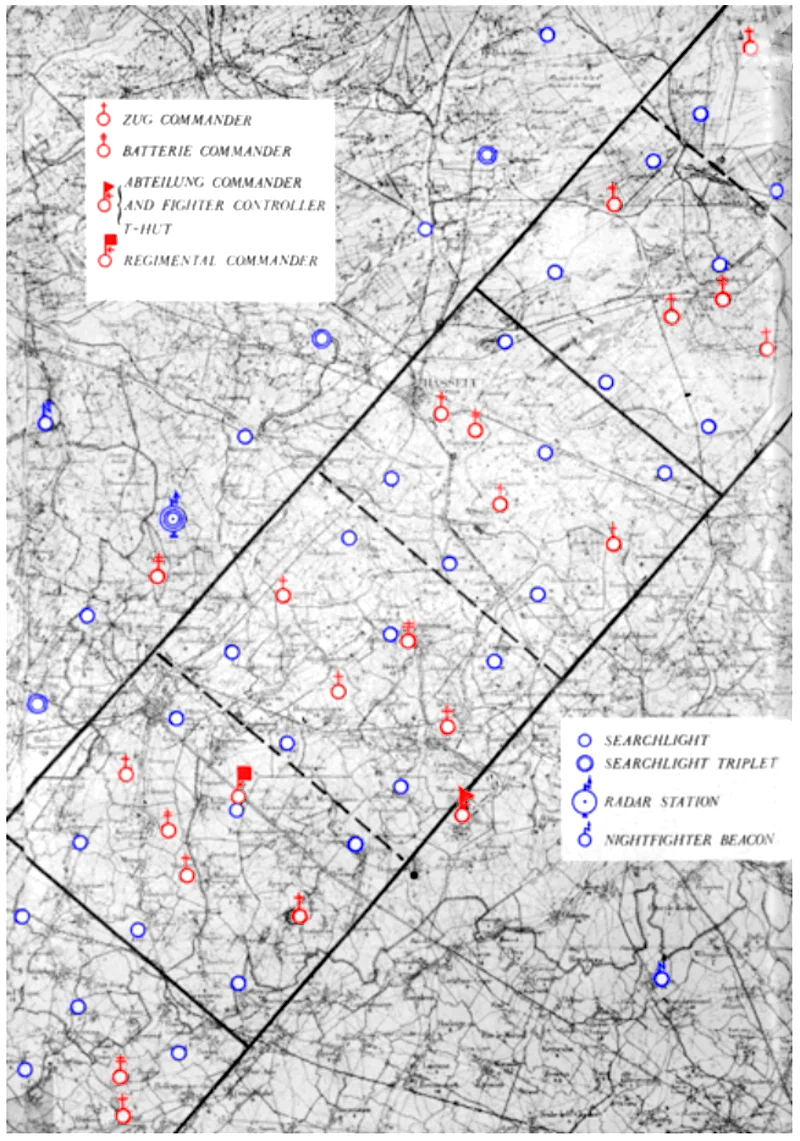
After the daylight Battle of the Heligoland Bight in 1939 chewed up RAF formations, Bomber Command shifted to operating in darkness. The Luftwaffe responded by building the Kammhuber Line: a chain of control sectors stretching from Denmark to France, each one a Himmelbett (canopy bed) of ground radar, searchlights, and a waiting night fighter. The job was clinical. Ground controllers vectored the fighter into visual range of a bomber - usually a Wellington, Halifax, Lancaster, or Stirling laboring at altitude with seven crew aboard - and the pilot closed in and fired. Struning was good at it. He claimed his first kill on the night of 23 November 1940, a Wellington 50 km west of Scheveningen. The crew of that Wellington - their names recorded in some RAF service file in Britain - went into the North Sea in the dark. The pattern repeated 55 more times over four years, each victory representing, on average, six or seven men who would not see morning.
Intruder Over England
For nearly a year Struning's unit, I./NJG 2 based at Gilze-Rijen in the southern Netherlands, did something different from defensive interception: long-range Fernnachtjagd missions, intruder raids deep into British airspace to catch RAF bombers as they returned to their own airfields. Struning flew 66 of those missions. He claimed nine bombers over England, the last a B-17 Flying Fortress near Upwood on 13 October 1941. Then Hitler, dissatisfied with what he could not see counted as wreckage on the ground, ordered the intruder operations stopped. The unit was sent to Sicily; Struning stayed in the Netherlands and was reassigned. From late 1942 the awards began to accumulate - the Knight's Cross in October, the Oak Leaves in July 1944 - and his name appeared in the guard of honor at the state funerals of other dead aces: Helmut Lent in October 1944, Walter Nowotny in November. The funerals were closer together now. The war was taking its own.
What He Carried, What He Cost
It is possible to write about a night-fighter ace without writing about who he served, but it would not be honest. Struning's victories were not abstractions. Each represented a Lancaster or Halifax or Wellington that fell out of the sky over occupied Europe with men trapped inside. Most never bailed out; those who did often came down in enemy country. The bomber crews were boys from Manchester and Toronto and Wellington and Brisbane who had volunteered, knowing the math - a Bomber Command tour was 30 operations, and the survival rate for completing one was sometimes under 50 percent. Their deaths kept Struning's tally rising and the medals coming. The system that pinned those medals on him was, in the same months, running the death camps. He flew for that government until a Mosquito found him on Christmas Eve. He is buried in the Ostfriedhof in Werl, field X, grave 14. The crews who did not make it home are buried, where their remains were ever recovered, in graveyards scattered across the Low Countries and the North Sea.
Gilze-Rijen Today
Gilze-Rijen Air Base, where Struning's unit flew from for the better part of two years, is still operational - now a Royal Netherlands Air Force station between Tilburg and Breda. Helicopters fly from it now, not Junkers Ju 88s and Heinkel He 219s. The runways and dispersal pans cross ground that was once a launching point for sorties that ended lives in distant English skies. Most people who pass it on the A58 motorway today have no reason to think about that. But the geography is the same, the prevailing winds are the same, and the angle at which a fighter would have lifted off into the night toward an incoming bomber stream is fixed by physics that has not changed. The men on both sides of those nights are gone. The places where they made their decisions remain.
From the Air
Heinz Struning's burial site at Werl lies near 51.55 N, 7.92 E in Germany. His former operational base, Gilze-Rijen (EHGR), is at 51.57 N, 4.93 E in the southern Netherlands - the coordinates supplied with this article are for that vicinity. Schiphol (EHAM) lies 50 nm north; Eindhoven (EHEH) 20 nm east. Fly the corridor between Gilze-Rijen and Cologne (EDDK) at 6,000 feet to trace the rough geography of a Luftwaffe night-fighter intercept track over what was once occupied Belgium and the Rhineland.
Nearby Stories
- Neder-Betuwe 1.3 km away
- Ommoord 2.5 km away
- Moerdijk 3.8 km away
- Teylingen Castle 4.4 km away
- Radio 538 4.6 km away
- Efteling 4.7 km away
- Volkel Air Base 6.2 km away
- Ermelo, Netherlands 10 km away