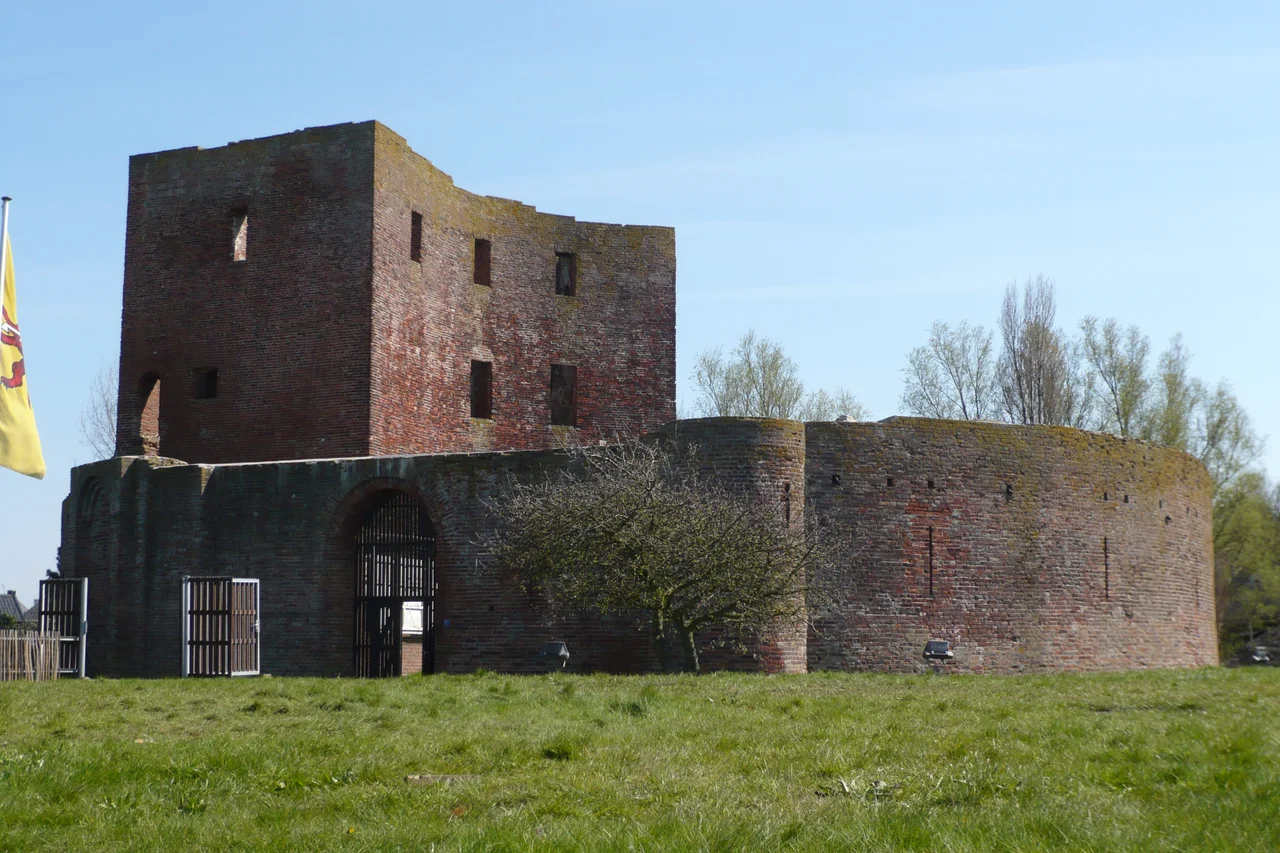

Teylingen Castle
Jacqueline of Bavaria had been Countess of Holland, Zeeland, and Hainaut by inheritance, and Dauphine of France by her first marriage. She had fought a war against her own uncle for her birthright. She had married four times, the last in secret because her cousin Philip the Good of Burgundy had explicitly forbidden it. By 1433 she had lost almost everything. Philip took the counties she had been born to rule and gave her, in exchange, a small allowance and permission to keep living. She moved to a round stone water castle near Sassenheim that had once been a forester's lodge for her ancestors. She lived there with her fourth husband, Frank van Borssele, for three years. She died at Teylingen in 1436. She was thirty-five.
The Stones That Made the Hold
Teylingen began in the early 1200s as something military and severe - a round water castle, 37 meters across, with a single massive ring wall and nothing inside. The wall, called an enceinte, was reinforced with buttresses on its inner face supporting arched arcades that carried a chemin de ronde, the elevated walkway from which defenders could rake the outer ground with arrows. The shape is unusual in the Netherlands. It belonged to a moment when castle-builders were experimenting with what worked against early siege engines, before the gunpowder revolution shifted the whole logic of fortification. Later in the same century, a donjon - the great central keep, the last refuge in a siege - was built into the ring wall itself, making it part of the perimeter rather than a separate tower inside the courtyard. The Van Brederode family, who descended from the original Van Teylingen lords, traced their blood back to this fortification.
The Forester's Castle
By the early 14th century, the counts of Holland had taken Teylingen as a forester's castle - a residence and administrative hub for the men who managed the count's hunting forests. William IV, count of Holland in the 1330s, is the earliest known holder. The political importance of a forester's job is easy to underestimate. Holland was thickly wooded then, and the count's right to hunt, to grant hunting privileges, to take timber and game, was one of the most valuable assets in his portfolio. The man at Teylingen ran that operation. An outer bailey grew up around the original round wall, with a comfortable house added in the 14th century - nothing remains of that house now, but it was where the working life of the castle moved as warfare ceased to be the building's primary purpose.
Jacqueline's Last House
When Jacqueline of Bavaria came to Teylingen in the 1430s, she came as the loser of a long civil war. She had been born to inherit, but the men of her family - her uncle John of Bavaria, her cousin Philip the Good - had taken the inheritance away through a combination of force, lawsuits, and arranged marriages she could not undo. Her fourth marriage, to Frank van Borssele, was clandestine; when Philip discovered it he forced her to abdicate formally and let her keep only her life and a small income. She and Frank lived together at Teylingen quietly. The drinking cups archaeologists later pulled out of the surrounding soil came to be called Jacobakannetjes - little Jacques pots - in her memory. She died here in 1436, probably of tuberculosis. The deposed countess outlived almost no one and outranked, on the day she died, almost everyone in the duchy that had taken her counties.
Fire, Decay, and Refusal
The castle was heavily damaged during the Eighty Years' War, particularly between 1572 and 1574, partly restored, then partially burned in 1675 when the donjon caught fire. After that the building entered a slow disintegration. Other sections were demolished piece by piece, their stone reused locally. By the time the lands and ruins became property of the Province of Holland and were nationalised in 1795, what remained was a ring of broken wall and a fragment of keep. Then something unusual happened: when the grounds were sold, the sale included a condition that the ruins could not be demolished. This obscure 18th-century clause turned Teylingen into one of the earliest cases of Dutch heritage protection - the idea that an old building, even in ruins, was worth keeping for its own sake.
Volunteers and a Shield
In 1889, Jhr. Mr. W. van Teylingen formally donated the ruins to the Dutch state, which still owns them. In the late 20th century, the Foundation Slot Teylingen bought back surrounding land - partly funded by the Prins Bernhard Cultuurfonds - and donated it back, allowing the moat to be re-excavated and the walls partially stabilised. Volunteers run guided tours. The Bassie and Adriaan television series, beloved in the Netherlands, used the castle extensively as a hideout for its clown villains, putting Teylingen into the imaginations of generations of Dutch children. On 24 June 2023, the Historical Circle of Voorhout presented the castle with a small shield - the HKV-schildje - thanking the volunteers and professionals who had kept the place standing. Six centuries after Jacqueline died inside its walls, the round keep still rises over the Sassenheim fields.
From the Air
52.2311 N, 4.5192 E near Sassenheim and Voorhout in the municipality of Teylingen, South Holland, in the bulb-growing region between Leiden and Haarlem. The ruined round keep and partial enceinte sit in restored moat-and-park surroundings; the circular ground plan is distinctive from the air. Best viewed at 1,500-3,000 feet. Nearest airports: Amsterdam Schiphol (EHAM) 19 km northeast, Rotterdam The Hague (EHRD) 35 km south. In spring the surrounding fields are a patchwork of tulips and hyacinths.
Nearby Stories
- Nexus Instituut 1.6 km away
- Delft 3.3 km away
- Egmond aan Zee Offshore Wind Farm 4.8 km away
- Dutch Language 6.4 km away
- Westfries Museum 13 km away
- HMS Cressy 14 km away
- Hollandse Kust West Offshore Wind Farm 15 km away
- Moermond Castle 34 km away