.jpg)
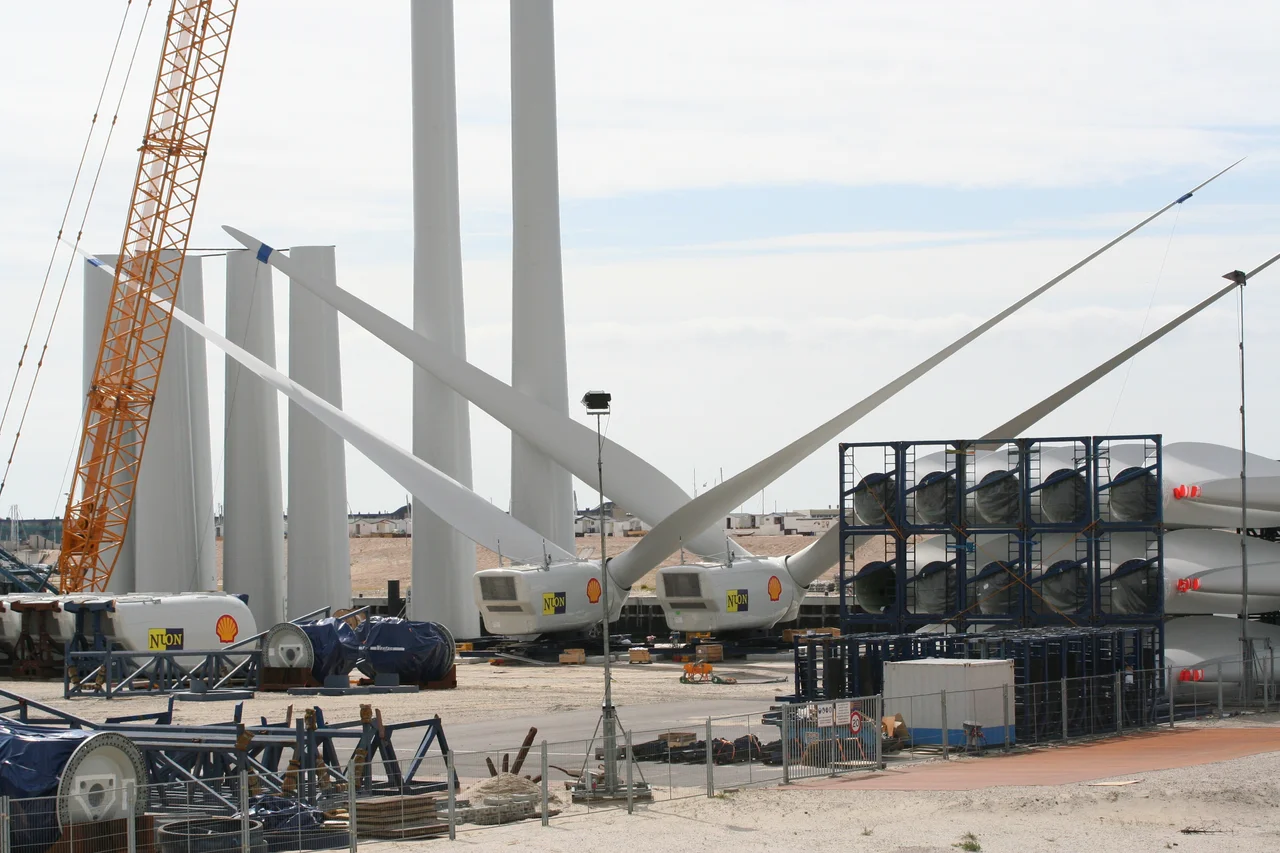
Egmond aan Zee Offshore Wind Farm
On a clear day, beachgoers in Egmond aan Zee can stand on the sand and count them: thirty-six white columns rising out of the North Sea, blades turning in a country that has been arguing with the wind for a thousand years. The Dutch built their first windmills to drain water. They built these to capture electricity. The principle is the same; the scale has changed. Offshore Windpark Egmond aan Zee was the country's first large-scale offshore wind farm, and when Prince Willem-Alexander cut the ribbon in April 2007, he was opening more than a power station. He was opening a national experiment.
Sea Trial
The tender went out in 2001. NoordzeeWind - a joint venture between Shell and the utility Nuon - won the concession that summer and signed with the Dutch government for the right to build something nobody in the Netherlands had built before. Construction did not begin until 2006. The delay was the point. Offshore wind was new, the seabed conditions off the Dutch coast were poorly understood, and the consortium chosen to do the work - Ballast Nedam paired with Danish turbine maker Vestas - had to figure out installation methods as they went. Heavy-lift vessels like the HLV Svanen drove monopile foundations into the seabed in water roughly 18 to 20 metres deep. Each foundation supported a Vestas V90-3MW turbine, three megawatts of capacity, blades sweeping a circle ninety metres across. The whole site spreads across about 27 square kilometres of open water.
Reading the Wind
OWEZ was conceived as much as a research project as a power plant. The Dutch government attached a five-year monitoring programme to the licence, with a clear question behind it: what does an offshore wind farm actually do to the sea around it? Researchers tracked harbour porpoises and seals. They counted seabirds passing through and below the rotors. They sampled the seabed inside the array, where commercial fishing was excluded, to see whether the structures functioned as artificial reefs. The findings were nuanced - some bird species avoided the area, others adapted, and benthic communities did indeed grow on the monopile foundations - but the cumulative dataset gave Europe its first long baseline for offshore wind impacts. Every project that came after built on the answers OWEZ generated.
Households on the Horizon
At full output the farm produces 108 megawatts, enough electricity for roughly 100,000 Dutch households. That number sounds modest now - newer North Sea projects measure their output in the gigawatts - but in 2007 it was a serious contribution to the Netherlands' renewable supply, and a deliberate signal. The Netherlands sits at sea level. It has more reason than almost any country to care about whether the world keeps warming. Putting 36 turbines just offshore from one of its most photographed beach towns was a way of making the energy transition visible. You cannot see a gas-fired power station from the dunes. You cannot miss OWEZ.
The Long Lease
The joint venture did not last. Vattenfall took Nuon's half in the late 2000s. Then in March 2021, Shell bought Vattenfall's stake too, taking full ownership of the farm it had once shared. That same year Vestas began a refurbishment programme to extend the turbines' working life past their original twenty-year design window. Wind turbines, like the ships and aircraft they sometimes resemble, are worth more than the steel they're made of. Gearboxes get replaced. Blades get inspected and recoated. The columns themselves, driven so deep into the North Sea floor that storms barely register, will likely outlast the people who installed them. The farm that taught the Netherlands how to do offshore wind is still teaching it how to keep one running.
From the Air
Located at 52.60°N, 4.42°E in the Dutch North Sea, 10 to 18 km offshore from Egmond aan Zee. The 36 turbines spread across roughly 27 square kilometres and are clearly visible from cruising altitude in good weather, with the Dutch coast and the inland city of Alkmaar as obvious landmarks to the east. Nearest airports: Amsterdam Schiphol (EHAM) approximately 50 km southeast, and Den Helder (EHKD) to the north. Coastal haze is common; the cleanest views come on cold, dry days with northerly winds.
Nearby Stories
- Centre for Research on Multinational Corporations 1.2 km away
- French submarine Amazone (Q161) 4.9 km away
- Hollandse Kust West Offshore Wind Farm 7.4 km away
- Westfries Museum 9.3 km away
- 1996 Texel Douglas DC-3 Crash 10 km away
- Action of 22 September 1914 13 km away
- Hofje Codde en Van Beresteijn 15 km away
- HMS Cressy 20 km away