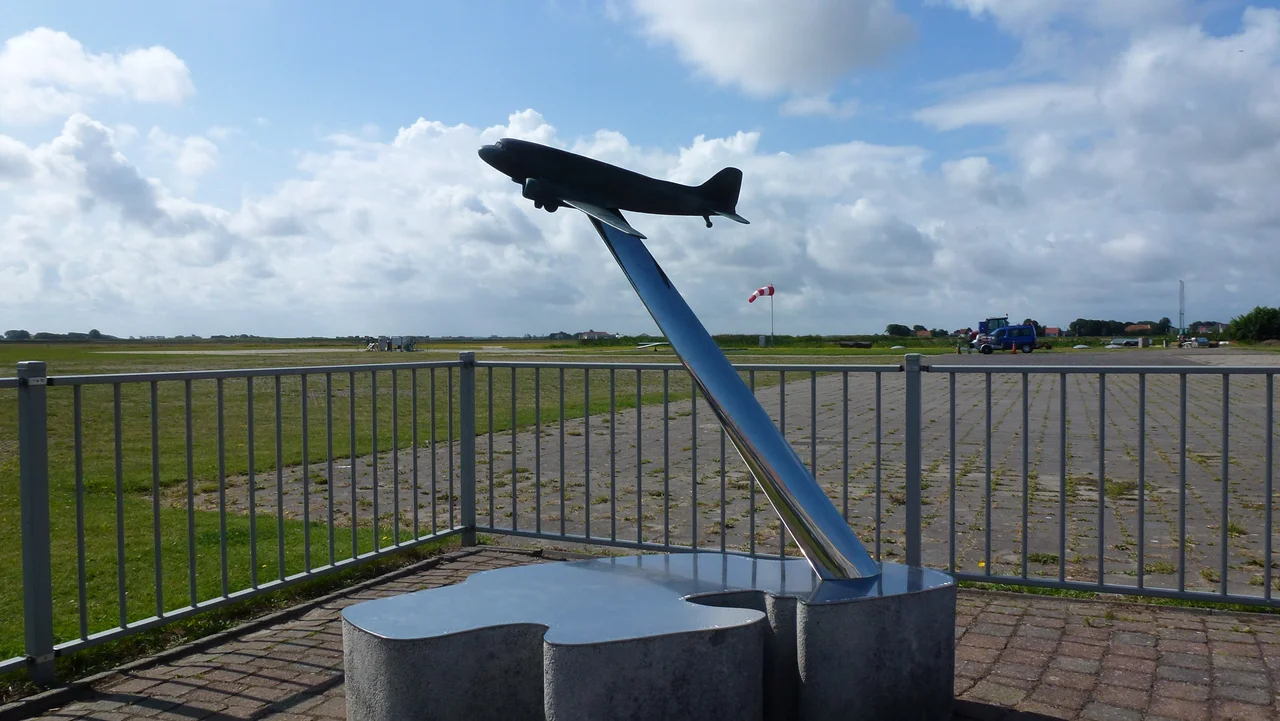

1996 Texel Douglas DC-3 Crash
It was meant to be the easy half of the day. The staff outing from the Roads, Traffic and Transport department of Noord-Holland had already enjoyed the special part - the vintage flight out to Texel that morning, the island in autumn light, the ride aboard a polished pre-war Dakota in cream and navy paint. The return leg, twenty minutes across the Wadden Sea to Schiphol, was the formality. Just before five o'clock on the afternoon of 25 September 1996, the DC-3 nicknamed Dakota - registration PH-DDA - climbed out from Texel International Airport with twenty-six passengers and six crew. Its left engine had perhaps four minutes left to live, and the people aboard had no way of knowing it.
A Dakota with a Long Memory
The aircraft itself was an heirloom. Built in 1943 as a C-47A military transport, delivered to the US Army Air Forces in the last full year of the war, it had crossed oceans, hauled freight, carried passengers and, in 1976, appeared on screen in Richard Attenborough's epic film about Operation Market Garden, A Bridge Too Far. By 1984 it had a Dutch registration and a new identity as the flagship of the Dutch Dakota Association, an enthusiast group dedicated to keeping the old workhorse flying. For Dutch aviation buffs, PH-DDA was something close to a national treasure - the Dakota you could actually board and ride, the same model that had dropped paratroopers over Arnhem and flown the Berlin Airlift. On staff outings it offered a kind of time travel: the smell of warm oil and old fabric, the rumble of twin Pratt & Whitney radials, the slow climb you no longer get from anything modern.
A Sticky Piston, a Lost Engine
Somewhere in the left engine's lubrication system, a piston in an oil-pressure switch had stuck. The crew did not yet know this. They knew only that, climbing out over the Wadden Sea, the left engine began to fail. A DC-3 can fly on one engine - reduced performance, but flyable - if the propeller of the dead engine can be feathered, its blades turned edge-first into the airflow to stop them windmilling and dragging the aircraft sideways. The Dakota's crew tried. The blades would not feather. Investigators later concluded the same stuck piston was almost certainly to blame. The DC-3 carried no warning system for oil-pump malfunctions, no cockpit voice recorder, no flight data recorder. The cockpit was a chaos of competing demands - a failing engine, a propeller refusing to feather, an awkward instrument panel - and only six people who ever knew exactly what was happening up front.
Lutjeswaard
At four minutes to five, the Dakota came down on a sandbank called Lutjeswaard, eighteen kilometres from Den Helder, just north of the village of Den Oever where the Afsluitdijk meets the North Holland coast. Thirty-one people were killed in the impact. One passenger died on the way to hospital. There were no survivors among the thirty-two on board. Most were colleagues from a single provincial department in Haarlem, people who had carpooled to work together and had now travelled together for the last time. Some were employees of Ballast Nedam, the construction company that sponsored the DDA. They had families waiting at home, dinners planned, weekend trips on calendars. In a country with a small aviation community, the loss rippled through every flying club, every airshow, every association. The Dutch word for the disaster - Dakotaramp, "Dakota tragedy" - entered the language that evening.
What Changed
The Netherlands Aviation Safety Board investigated for over a year. Its final report, published in December 1997, traced the chain: blocked oil pump, failed engine, stuck piston in the feathering switch, a cockpit workload that may have drawn the crew's attention away from the basic task of flying the aeroplane. The exact sequence inside the cockpit could not be reconstructed. After the crash, the rules for flying historic aircraft in the Netherlands tightened. The Dutch Dakota Association eventually shifted to operating under the same JAR-OPS regulations as commercial airlines and, in 2019, received a full Air Operator Certificate - the same kind of credential held by major carriers. The price of that progress had been paid on a tidal sandbank in the Wadden Sea.
Where Names Are Read
On 25 September 1997, exactly one year after the crash, two memorials were unveiled. In the garden of the Provincial House in Haarlem, the sculptor Theo Mulder set a glass plate, etched with the names of all thirty-two victims, between a pedestal of basalt and a pair of bronze wings. Two chaplains of the Royal Netherlands Navy, who had walked alongside the relatives through the worst year of their lives, performed the unveiling. The same day, at Texel International Airport - the place the flight had departed from - a second monument was raised: a bronze DC-3 in flight above a stainless-steel silhouette of the island. The Dakota disaster remains the deadliest aviation accident on Dutch soil. Every year on 25 September, families still gather at both monuments to read the names aloud.
From the Air
The Dakota came down on the Lutjeswaard sandbank in the Wadden Sea near 53.00N, 4.99E, roughly 18km from Den Helder and just north of Den Oever where the Afsluitdijk begins. EHTX (Texel International Airport, the departure point) lies ~12km north; EHKD (De Kooy / Den Helder) sits 18km southwest; EHAM (Schiphol, the intended destination) is 70km south. The Wadden Sea is a UNESCO World Heritage tidal flat - vast, shallow, and one of the world's largest sandbank systems. Fly slowly along the Afsluitdijk and look north for the open expanse where rescue boats searched that evening.
Nearby Stories
- Het Bildt 3.9 km away
- Frisian Lakes 4.4 km away
- Hoorn 9.2 km away
- French submarine Amazone (Q161) 11 km away
- Holmes's Bonfire 14 km away
- Wind Power in the Netherlands 18 km away
- IJssel 22 km away
- Antiope 57 km away