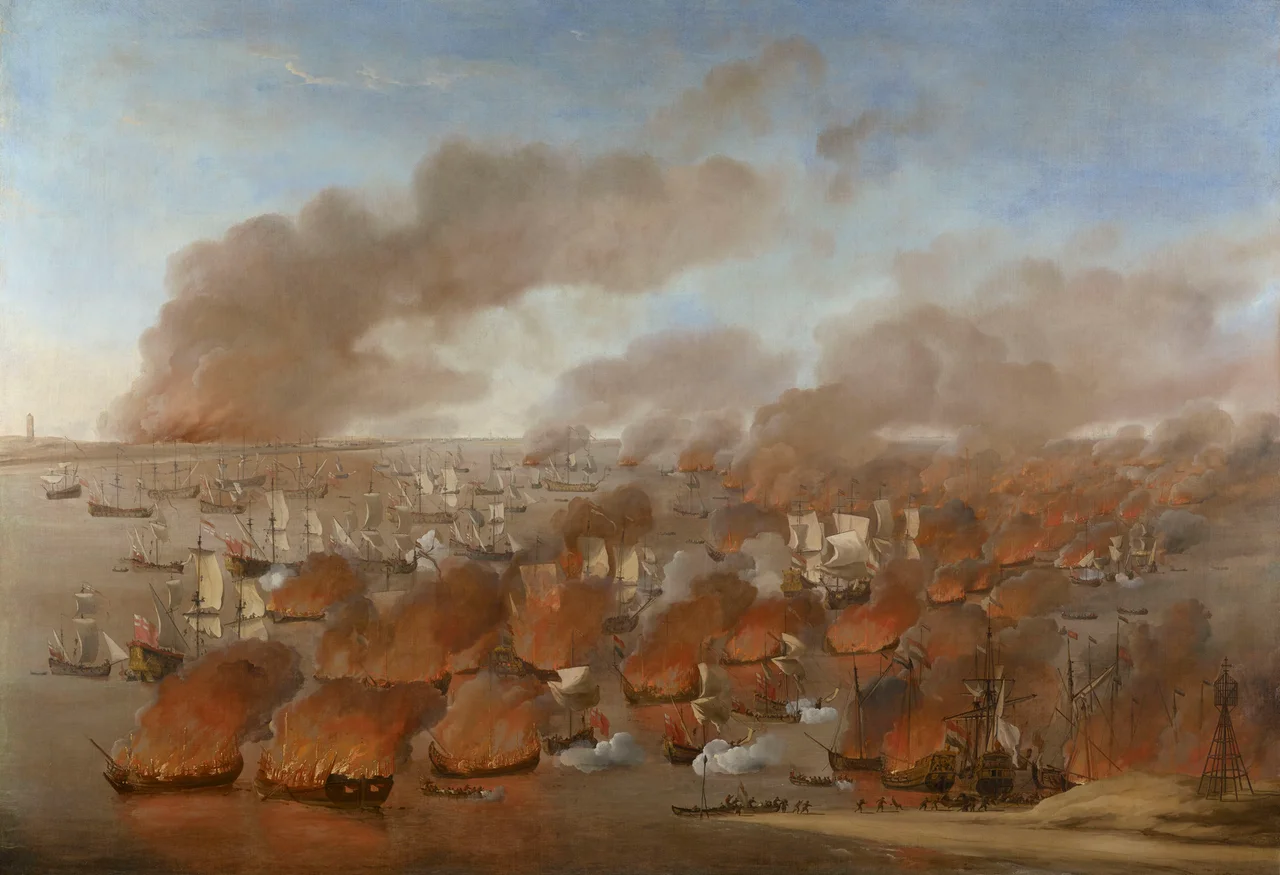
_-_%27Holmes%27s_Bonfire%27,_the_burning_of_Dutch_Merchant_Ships_between_Terschelling_and_Vlieland,_19th_August_1666_-_RCIN_406560_-_Royal_Collection.jpg)
Holmes's Bonfire
Before sunrise on 19 August 1666, English fireships drifted into the Vlie estuary on a southeasterly breeze. By the next evening the broad shallow channel between Vlieland and Terschelling was a forest of burning hulls — masts toppling, tar running molten down the planking, sailors leaping into water that was itself catching fire from the spilled oils. About 130 Dutch merchantmen burned that afternoon and through the night. Most sailors escaped by rowing to Harlingen or wading across shoals; Dutch records suggest far fewer perished than the two thousand deaths cited in a contemporary French ambassador's letter. The next morning the English came ashore on Terschelling and burned the town of West-Terschelling, a town of about four hundred stone houses inhabited largely by pacifist Mennonites and retired whalers, almost completely to the ground.
Why Here, Why Now
The Second Anglo-Dutch War had turned in England's favor at the St James's Day Fight two weeks earlier. With the Dutch fleet damaged and the English short of supplies, the joint commanders Prince Rupert and George Monck wanted one more blow before they had to return to port. The major Dutch harbors were too well defended. But a Dutch captain named Laurens Heemskerck — who had fled the Netherlands in 1665 after being condemned for cowardice at the Battle of Lowestoft — told them that the Vlie was open: about 140 merchant ships sheltered there, waiting out the blockade, guarded by only two light frigates. The Admiralty in Amsterdam had ordered the buoyage removed and the ships home, but the buoy-tender had not finished, and most owners had told their captains to stay. Rear-Admiral Robert Holmes was given the assignment.
Day One: The Fleet
Holmes entered the Vlie at eight in the morning with five fireships and a flotilla of sloops. By one in the afternoon the attack was underway in the Robbegat channel, where the merchant fleet stretched ten miles from north to south. The first fireship set the Dutch guard frigate Vollenhove ablaze; her commander Captain Adelaer drowned with most of his crew when their fleeing sloop capsized. After that the destruction was systematic and very fast. Twenty-two sloops carrying twelve men each moved between the anchored ships with pots of fire and tar, setting any vessel they could reach. The southeasterly wind drove the burning ships into the ones still trying to flee. By eight that evening it was over. Among the destroyed vessels were ships laden for Arkhangelsk or the ports of France and Spain, their crews rowing in sloops toward Harlingen or wading the Kracksant shoal to safety.
Day Two: The Town
On the evening of the first day Holmes learned that the main shore installations — the warehouses of the Dutch East India Company, the whaling stores — were not on Vlieland but on Terschelling. At five the next morning he landed six companies of soldiers on Terschelling's western tip and marched on the town the English called Brandaris, after its tall medieval lighthouse. The militia fired a few musket shots and scattered. The population had already fled east in the night, some on foot, some in any boat they could find. Most of the town was empty when the soldiers reached it. Three companies entered to plunder and burn. The summer had been dry; the stone houses had wooden interiors and thatched outbuildings. Within hours West-Terschelling was on fire. The English left before the tide turned. Only about thirty houses, the town hall, the Reformed church, and the Brandaris lighthouse survived.
Two Old Women, a Beacon-Keeper
The casualty count from the town itself was very low — most people had escaped. But not everyone could. When the people of Terschelling returned to the ruins, they found the operator of the northern fire beacon slain. They found, in the charred remains of two houses, the remains of two elderly invalid women who had been unable to walk. Dutch pamphlets soon described English soldiers burning grandmothers alive; in fact, the women seem to have died because they could not flee a fire that was meant for the warehouses next door. The distinction mattered less, to the families who buried them, than the simple fact of their dying. The Mennonite community of West-Terschelling, which had refused on principle to bear arms in the first place, had its town taken from it anyway.
Bonfires Here, Bonfires There
In London, King Charles II ordered the city's bonfires lit in celebration; an English poet wrote that Holmes's one bonfire across the sea was worth all of them. Three weeks later the Great Fire of London began on Pudding Lane and burned for four days. Dutch pamphleteers printed the two destructions side by side — Terschelling on the left, London on the right — and called it divine retribution. The connection was theological more than literal, but it set a mood. The Dutch population, which had been ready to riot against its own admirals after St James's Day, rallied to repair Terschelling instead. Churches across Holland competed in their collections for the town's poor. The following summer, when peace talks at Breda dragged on, the Dutch Grand Pensionary Johan de Witt cited the lingering anger of Holmes's Bonfire to win approval for a raid into the heart of England: Michiel de Ruyter sailed up the Medway in June 1667, burned three English warships, and towed the flagship Royal Charles home as a trophy. Dutch marines were under strict orders not to burn houses or harm civilians. Samuel Pepys, in his diary, noted the restraint and called it to England's eternal disgrace.
The Little Wife of Stryp
On Terschelling the memory of the raid stayed close to the ground. A legend grew up around an old woman near the hamlet of Stryp who was said to have saved the eastern villages by accident — peering through fog, English soldiers mistook a row of headstones in an abandoned graveyard for a line of Dutch troops and asked her how many there were. "Hundreds standing," she answered, "and thousands lying." She meant the dead beneath the dunes. The soldiers, the story goes, turned back. The tale is probably apocryphal; the bronze statue of the Stryper Wyfke that stands west of Midsland today is not. She faces east, into the wind, pointing toward the graveyard. The Brandaris lighthouse still stands at the western tip of the island, the same medieval tower that the English used as their landmark and somehow did not destroy. Around it, the rebuilt town of West-Terschelling has been quietly living for three hundred and sixty years.
From the Air
Coordinates 53.36°N, 5.22°E — the location is the Vlie estuary off West-Terschelling, between the islands of Vlieland and Terschelling. Recommended viewing altitude 3,000–6,000 ft AGL to see the historical setting: the long thin shape of Terschelling, the Brandaris lighthouse at its western tip, the broad Vlie channel curving south. Visual landmarks: West-Terschelling harbor and the Brandaris tower; Vlieland to the southwest across the Vlie; Harlingen on the Frisian mainland to the south. Note that the channel has shifted about four miles southwest since 1666, so the modern Vlie is not in the same place as the historical attack site. Nearest airports: Leeuwarden Air Base (EHLW) ~50 km southeast, Texel (EHTX) ~45 km southwest. Weather: best clarity on easterly winds; westerly weather often closes Terschelling under low cloud.
Nearby Stories
- Sneek 6.4 km away
- Het Bildt 6.5 km away
- Afsluitdijk 11 km away
- French submarine Amazone (Q161) 20 km away
- Gemini Wind Farm 52 km away
- Antiope 56 km away
- SMS Blucher 90 km away
- West Sole Gas Field 226 km away