
Action of 22 September 1914
Wenman Wykeham-Musgrave was 15 years old on the morning of 22 September 1914. He was a midshipman aboard HMS Aboukir when the first torpedo struck her at 06:20. He swam to HMS Hogue and was hauled aboard - then Hogue was hit twice at 06:55 and went over. He swam again to HMS Cressy, was pulled out of the water a second time, and was still on her deck when she took a torpedo at 07:25. By the time the third cruiser capsized at 07:55, the boy had survived three sinkings in 95 minutes. Around him, 1,459 other British sailors had not. They were the dead of the Live Bait Squadron, the men whose loss made the Royal Navy realise that a single submarine could end three armoured cruisers between breakfast and the morning watch.
The Squadron Nobody Wanted
The 7th Cruiser Squadron - Cruiser Force C - existed because the Royal Navy did not quite have ships to spare for the Broad Fourteens, the patch of southern North Sea that protected the eastern end of the English Channel. Its three ships - Aboukir, Hogue, Cressy - were Cressy-class armoured cruisers built around 1900. The Grand Fleet's officers called the squadron the Live Bait Squadron and meant it as both joke and warning. The cruisers were less than fifteen years old but everything had changed: warship design had moved on to oil fuel and turbines, and the standing patrol orders dated from 28 July 1914 - written days before the war began, by people who imagined the threat would come from destroyers, not from beneath the surface. Many of the men aboard were Royal Naval Reservists, part-timers - fishermen, dock clerks, merchant officers - called up because the regular fleet needed every regular it had. Some, in the gun-rooms and the engine rooms, were teenagers.
Weddigen Surfaces
U-9 had been ordered to attack British transports at Ostend, but the same storm that had driven the British destroyer escort to shelter had also forced Otto Weddigen to dive and ride it out. On the morning of the 22nd the wind moderated and Weddigen brought U-9 to the surface. Three large ships were patrolling in line abreast 2,000 yards apart, ten knots, no zigzag - a slow procession of dignified silhouettes. Weddigen took his time. At 06:20 he fired one torpedo from periscope depth at the middle ship. It struck Aboukir on the starboard side, flooded the engine room, and stopped her dead in the water. Captain John Drummond, the senior officer of the patrol, thought he had hit a mine. He ordered the other two ships to close in to take off his wounded. Aboukir was already listing badly. She capsized after twenty-five minutes and sank five minutes later. Only one of her boats could be launched; the rest were either smashed or could not be lowered because the steam winches had no steam. 527 men of Aboukir went into the water.
Hogue, Then Cressy
While Hogue closed on the survivors, Captain Wilmot Nicholson realised it had been a submarine attack and signalled Cressy to look for periscopes. He stopped his ship anyway. His crew lowered every boat, threw overboard anything that would float, and pulled stokers and reservists from the cold sea. At 06:55 U-9 surfaced briefly as her bow rose with the sudden loss of two torpedoes; Hogue's gunners had time to open fire but the boat dived before they could hit her. Both torpedoes struck. Hogue capsized in ten minutes and sank at 07:15. Cressy had seen the submarine and tried to ram her, failed, then resumed her own rescue work. At 07:20 Weddigen fired two stern torpedoes; one hit. He swung U-9 around to use his last bow torpedo and fired again at 07:30 from about 550 yards. It struck Cressy on the port side and ruptured boilers, scalding the engine-room watch in the same instant. Cressy capsized to starboard and floated upside down until 07:55, when she finally went under.
The Trawlers and the Reckoning
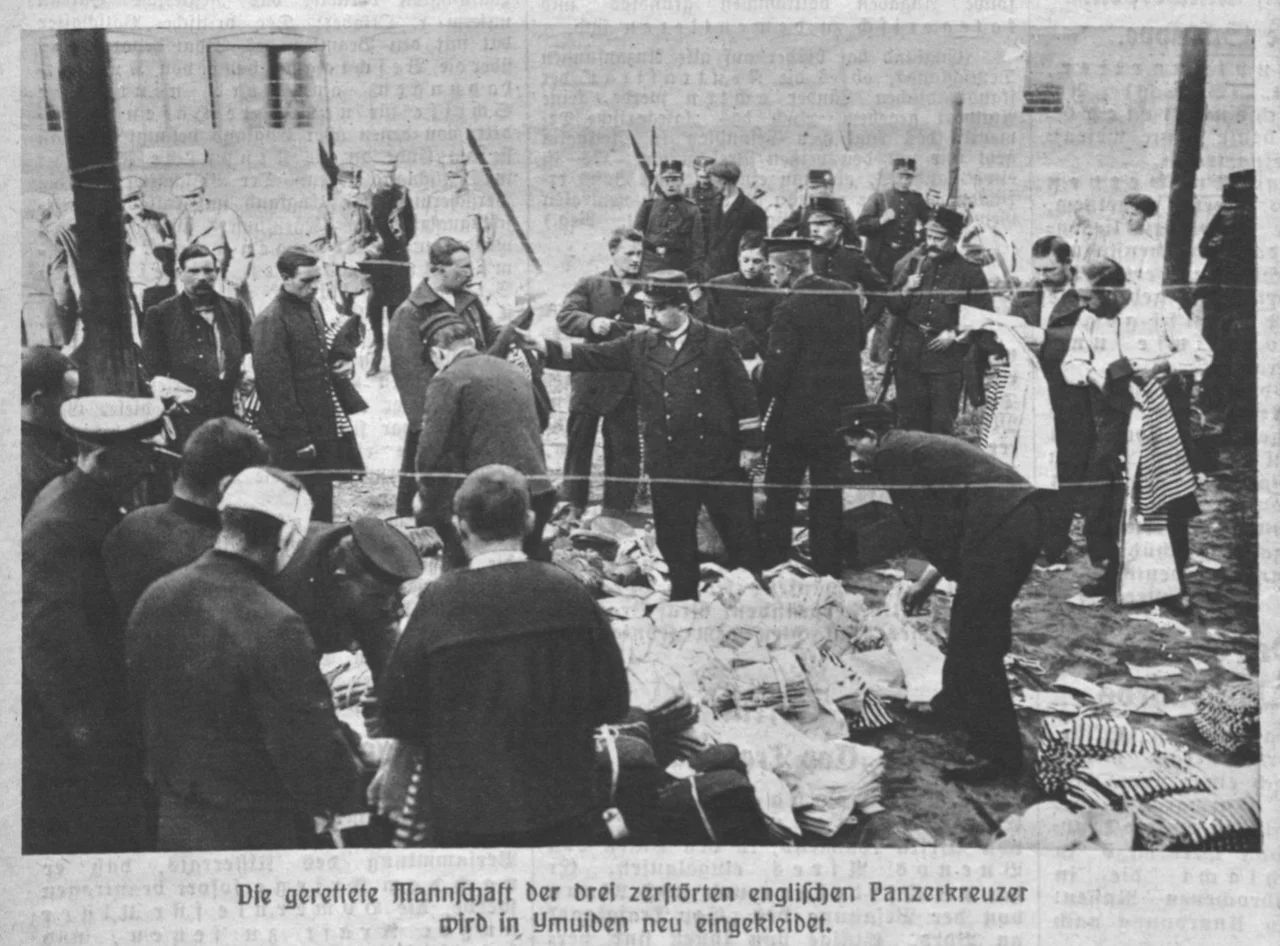
Two Dutch sailing trawlers were near enough to see the disaster and declined to close, fearing mines of their own. At 08:30 the Dutch steamer Flora pushed through and pulled 286 men out of the water. The Titan took 147 more. Lowestoft fishing smacks Coriander and J.G.C. worked through the slick of bunker oil and bodies. Reginald Tyrwhitt's destroyer squadron - hurrying south now that the weather had cleared - arrived at 10:45. By then 837 had been rescued; 62 officers and 1,397 men had been killed, among them Cressy's captain Robert Johnson and an unknowable number of teenage cadets and middle-aged reservists. Aboukir lost 527, Cressy 560, Hogue 377. The 28 officers and 258 men landed at IJmuiden by Flora's Dutch crew were repatriated on 26 September. Weddigen went home to a hero's welcome, an Iron Cross 1st Class, and a postcard print - 'Victories of U-9' - that hung in German shop windows.
What Britain Lost That Morning
These were not Jutland numbers, but the moral shock was the war's first great one. The British government had built its self-image around the dominance of the Royal Navy; in one quiet North Sea morning that image was shown to be older than its assumptions. Other cruisers were pulled off patrol; Rear-Admiral Christian was reprimanded; Drummond was both criticised for failing to take recommended anti-submarine precautions and praised for his personal conduct on the day. The Admiralty took the U-boat threat seriously from this morning forward - though the lesson was bought at very steep human price. Commander Dudley Pound, then aboard a battleship in the Grand Fleet and the future First Sea Lord, wrote in his diary on 24 September of the disaster. In 1954 the British government sold the salvage rights; commercial recovery has been working the wrecks since 2011. They are protected war graves now, and the families of the dead - including the descendants of the teenagers who never got out of the water - have asked, repeatedly, for the salvage to stop.
From the Air
The three cruisers lie in the Broad Fourteens of the southern North Sea near 53.00 N, 3.75 E, roughly 30 miles off the Dutch coast. Cruise at FL080-FL100 for the long sea horizons. Amsterdam Schiphol (EHAM) and Rotterdam (EHRD) lie east; Norwich (EGSH) and Lowestoft are due west. The wrecks are designated war graves; vessels working over them are visible from the air on calm days.
Nearby Stories
- Hollandse Kust West Offshore Wind Farm 8.1 km away
- KLM Flight 608 11 km away
- Antiope 14 km away
- French submarine Amazone (Q161) 19 km away
- Battle of Lowestoft 33 km away
- Holmes's Bonfire 67 km away
- Caister-on-Sea 104 km away
- HMS Cobra 138 km away