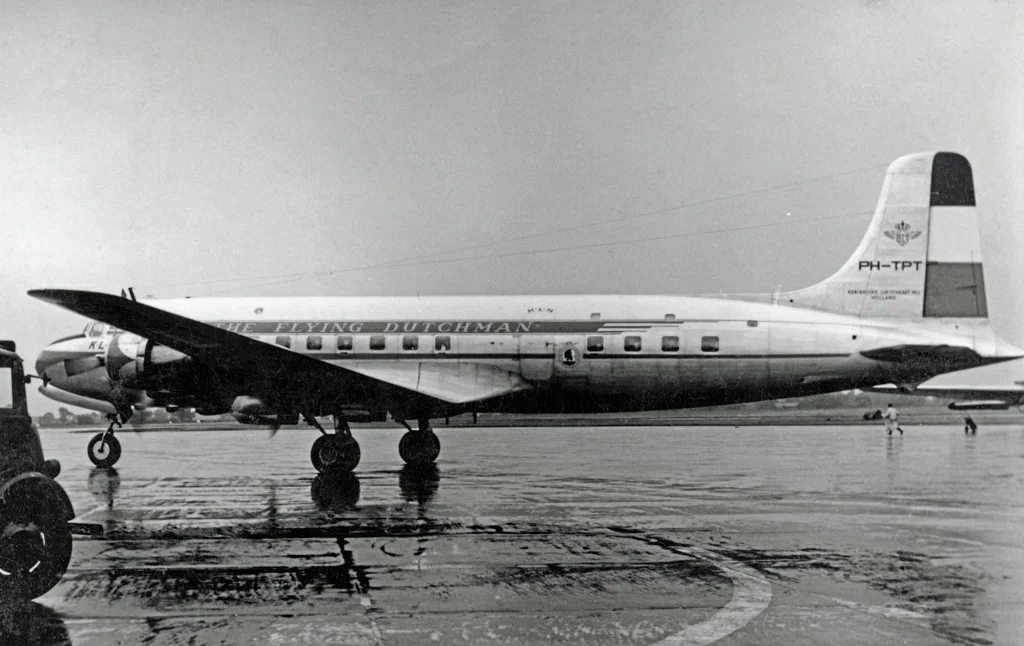

KLM Flight 608
At 11:35 on the morning of 23 August 1954, Amsterdam approach cleared KLM Flight 608 to descend from 3,500 to 2,500 feet. The DC-6B was over the North Sea, finishing the second leg of an Atlantic crossing that had begun in New York the previous evening. The crew did not acknowledge the clearance. They did not acknowledge anything after that. By mid-afternoon, search aircraft were spotting debris in the water off Bergen. All 21 people on board - passengers, captain, first officer, navigator, radio operator, cabin crew - were already gone.
Willem Bontekoe
The aircraft had a name. KLM christened most of its DC-6Bs after Dutch maritime figures, and this one - construction number 43556, line number 257, delivered in August 1952 - carried the name Willem Bontekoe, the seventeenth-century captain who survived the explosion and shipwreck of his East Indiaman and wrote a famous account of getting home. Reregistered as PH-DFO in March 1954, the aircraft had been flying KLM's transatlantic routes for two years. New York to Shannon to Amsterdam was a routine pattern. The Atlantic crossing had gone normally. Shannon to Amsterdam was supposed to be the easy part.
Bad Weather, Strange Witnesses
The weather over the Dutch coast that morning was poor: low cloud, heavy rain, the kind of conditions that make people on the ground squint upward when an aircraft passes overhead. Several of them did. Witnesses near Egmond reported hearing the DC-6B cross the coast on the Green 2 airway around the time of its descent clearance. Others reported seeing it pass over again at 12:01, low, heading back out to sea. A few said they heard a loud bang over the water - possibly an explosion. None of the accounts agree on more than the strangeness of what they saw. Whatever was happening in the cockpit of Flight 608 in those final minutes, it included at least one course reversal and an aircraft no longer following its clearance.
The Cabin Heater Theory
Salvage work began almost immediately, using an experimental sonar system developed at the Dutch Physics Laboratory - early postwar underwater acoustics being tested in earnest on a real wreck. By 25 November, crews had recovered roughly 45 to 50 percent of the aircraft. It was not enough. The cause of the crash was never determined. Investigators offered several possibilities: an electrical fire, a pressure-bottle explosion, a cockpit window failure, autopilot trouble. The most carefully argued theory came from a State Aviation Authority investigator who pointed at the cabin heater. Fumes from a malfunctioning heater, the theory went, would have driven the crew to open a cockpit window for fresh air. Fire risk would have demanded they cut the electrical system. That would explain the radio silence. It explains, too, why witnesses saw an aircraft that was still flying but no longer responding.
Twenty-One Names
The dead included a child. The passenger manifest carried Dutch, American and other names, businessmen and tourists and a family in transit, the routine summer cross-section of a transatlantic flight in the early jet age - except this was a piston airliner on the cusp of being replaced, a generation of aircraft and crew who learned to fly the Atlantic when the Atlantic was still long. Bodies came ashore on the Dutch coast in the weeks that followed. Some did not. The Willem Bontekoe, named for a captain who survived a shipwreck and made it home with stories, lies in pieces on the seabed somewhere off IJmuiden. The 21 people on board never finished their crossing.
From the Air
Crash site approximately 52.67°N, 4.33°E in the North Sea off IJmuiden and Bergen, Netherlands. Modern flight tracks into Amsterdam Schiphol (EHAM) from the west still cross this stretch of coast at the same altitudes Flight 608 was descending through; on clear days the IJmuiden harbour entrance, Egmond aan Zee, and the Egmond wind farm are obvious landmarks. Nearest diversion airports today: Schiphol (EHAM) and Rotterdam (EHRD); in 1954 the destination was Schiphol's earlier site. Coastal weather here is often what it was that morning - low cloud, rain showers, marginal visibility.
Nearby Stories
- Centre for Research on Multinational Corporations 1.2 km away
- French submarine Amazone (Q161) 4.9 km away
- Hollandse Kust West Offshore Wind Farm 7.4 km away
- Westfries Museum 9.3 km away
- 1996 Texel Douglas DC-3 Crash 10 km away
- Action of 22 September 1914 13 km away
- Hofje Codde en Van Beresteijn 15 km away
- HMS Cressy 20 km away